
Flame Retardants Market Size and Forecast 2026–2034
Fire Safety in Focus: How Regulations, Innovation, and Industrial Growth Are Shaping a US$ 18.87 Billion Market

Introduction
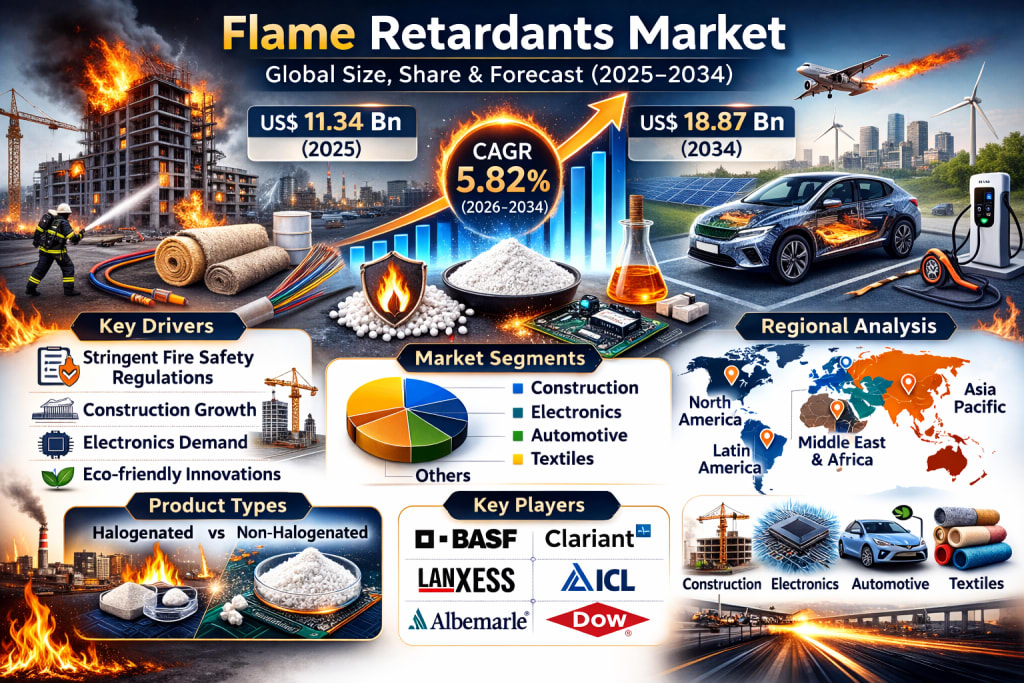
The global flame retardants market is entering a phase of steady and strategic expansion, driven by rising safety awareness, stricter regulations, and the growing use of advanced materials across multiple industries. According to Renub Research, the Flame Retardants Market is expected to grow from US$ 11.34 billion in 2025 to US$ 18.87 billion by 2034, registering a CAGR of 5.82% from 2026 to 2034. This growth reflects not only increasing industrial activity but also a deeper global commitment to fire safety in construction, electronics, automotive, textiles, and infrastructure development.
Flame retardants play a crucial role in modern material science. They are chemical compounds added to materials such as plastics, foams, textiles, coatings, and composites to slow down or prevent the spread of fire. By reducing flammability, limiting heat release, and suppressing smoke generation, these substances help protect human lives, critical infrastructure, and valuable assets. In an era marked by rapid urbanization, high-rise construction, electrification, and technological complexity, the importance of fire-resistant materials has never been greater.
As industries evolve and regulations tighten, the flame retardants market is also undergoing a transformation. Traditional halogenated flame retardants, long valued for their cost-effectiveness and performance, are increasingly being challenged by environmental and health concerns. This has accelerated the shift toward non-halogenated, more sustainable alternatives such as phosphorus-based, nitrogen-based, and mineral flame retardants. The result is a market that is not only growing in size but also changing in character, with innovation and sustainability becoming central themes.
Flame Retardants Industry Overview
The flame retardants industry serves as a backbone for fire safety across a wide range of end-use sectors, including construction, electronics, automotive, aerospace, textiles, and consumer goods. These chemicals are embedded into materials at the manufacturing stage, ensuring that everyday products—from insulation panels and electrical cables to vehicle interiors and electronic housings—meet required fire safety standards.
Broadly, the industry is categorized into halogenated and non-halogenated flame retardants. Halogenated variants, particularly brominated and chlorinated compounds, have historically dominated the market due to their high efficiency and relatively low cost. However, increasing concerns about toxicity, environmental persistence, and bioaccumulation have led to stricter regulations and, in some cases, outright bans in several regions.
In response, non-halogenated flame retardants are gaining momentum. Phosphorus-based compounds, nitrogen-based systems, aluminum trihydrate (ATH), and other mineral-based solutions are being adopted as safer and more environmentally responsible alternatives. While these options sometimes come with higher costs or performance trade-offs, continuous research and development are narrowing the gap and improving their commercial viability.
Construction remains one of the largest consumers of flame retardants. Insulation materials, cables, coatings, and structural components must comply with stringent fire resistance standards, especially in urban environments where high-rise buildings and dense infrastructure increase fire risk. The electronics and electrical industry is another major segment, as modern devices rely heavily on polymer-based components that require effective fire protection. Meanwhile, the automotive and transportation sectors are increasingly using advanced flame-retardant materials to enhance passenger safety and meet evolving regulatory requirements.
Growth Drivers for the Flame Retardants Market
Stringent Fire Safety Regulations Across Industries
One of the most powerful drivers of the flame retardants market is the tightening of fire safety regulations worldwide. Governments and regulatory bodies are continuously updating building codes, industrial standards, and product safety requirements to reduce fire-related accidents and losses. In construction, the use of flame-retardant materials in insulation, wiring, and structural components is no longer optional but mandatory in many regions.
Similarly, industries such as electronics and automotive must ensure that their products meet strict flammability and fire-resistance criteria. Electrical components, battery systems, and polymer housings are all subject to rigorous testing and certification processes. These regulatory pressures create a stable and long-term demand for flame retardants, as manufacturers must integrate compliant materials into their products to access global markets.
As urbanization and industrialization continue to expand, especially in emerging economies, regulatory enforcement is expected to become even more stringent. This will further reinforce the role of flame retardants as essential components of modern manufacturing and construction.
Growing Demand from Construction and Infrastructure Development
The global construction boom is another major growth engine for the flame retardants market. Rapid urbanization, population growth, and large-scale infrastructure investments are driving the demand for safer, more resilient buildings. Flame retardants are widely used in insulation foams, cables, coatings, and composite materials to enhance fire resistance in residential, commercial, and industrial structures.
The trend toward high-rise buildings, smart cities, and energy-efficient construction is further increasing the need for advanced fire-resistant materials. In addition, many countries are investing in the renovation and retrofitting of older buildings to bring them in line with modern fire safety standards. This creates an additional layer of demand, as existing structures require upgraded materials and systems.
With governments and private developers placing greater emphasis on safety, compliance, and sustainability, the adoption of flame-retardant materials in construction is expected to remain a key pillar of market growth.
Expansion of Electronics and Electrical Equipment Manufacturing
The rapid growth of the electronics and electrical equipment sector is significantly boosting demand for flame retardants. Modern devices are becoming more compact, powerful, and complex, often containing high-density circuitry and polymer-based components that can pose serious fire risks if not properly protected.
Flame retardants are essential in printed circuit boards, connectors, housings, and cables, where they help prevent ignition and slow the spread of flames in case of electrical faults. The increasing use of electronics in homes, industrial automation, data centers, renewable energy systems, and smart infrastructure is amplifying this demand.
Moreover, the rise of electric vehicles and the expansion of charging infrastructure are creating new opportunities for flame-retardant materials, particularly in battery systems and high-voltage components. As electrification and digitalization continue to reshape industries, the role of flame retardants in ensuring safety and reliability will only grow stronger.
Challenges in the Flame Retardants Market
Environmental and Health Concerns
Despite their importance, flame retardants face significant scrutiny due to environmental and health concerns, especially regarding certain halogenated compounds. These substances have been linked to toxicity, persistence in the environment, and potential long-term health risks. As a result, regulators in many regions have imposed strict restrictions or bans, forcing manufacturers to rethink their product portfolios.
This transition toward safer alternatives requires substantial investment in research and development. Companies must ensure that new formulations meet both performance and safety requirements while also remaining economically viable. Managing regulatory compliance across different regions adds another layer of complexity, making this one of the most pressing challenges for the industry.
Cost and Performance Trade-Offs of Eco-Friendly Alternatives
While non-halogenated and eco-friendly flame retardants are gaining popularity, they often come with higher costs and, in some cases, performance limitations. Some alternatives require higher loading levels to achieve the same level of fire resistance, which can affect material properties such as strength, flexibility, and durability.
These trade-offs can slow adoption, particularly in cost-sensitive markets and applications. Additionally, integrating new formulations into existing manufacturing processes may require technical adjustments, testing, and certification, increasing both time and cost. Balancing sustainability, performance, and affordability remains a critical challenge for market participants.
Regional Market Insights
United States Flame Retardants Market
The United States market is experiencing steady growth, driven by strict fire safety regulations and strong demand from construction, electronics, automotive, and industrial sectors. Flame retardants are widely used in insulation, cables, coatings, plastics, and composites to meet rigorous building codes and safety standards.
The construction sector remains a major contributor, supported by infrastructure development and the renovation of older buildings. At the same time, the growth of electronic devices and electric vehicles is boosting demand for flame-retardant polymers and components. Environmental concerns are encouraging a shift toward non-halogenated solutions, fostering innovation and product development. With strong regulatory enforcement and high safety awareness, the U.S. market is expected to maintain stable growth.
Germany Flame Retardants Market
Germany’s flame retardants market is supported by stringent national and EU-level regulations, as well as a strong focus on sustainability and energy efficiency. Flame retardants are widely used in construction materials, electronics, and automotive components to meet high safety standards.
The country’s leadership in automotive manufacturing and industrial technology makes it a key consumer of advanced flame-retardant materials, particularly in electric vehicles and electronic systems. Growing demand for eco-friendly, non-halogenated solutions is driving innovation and reshaping product portfolios. With robust industrial demand and a strong regulatory framework, Germany’s market outlook remains positive.
China Flame Retardants Market
China represents one of the fastest-growing markets for flame retardants, fueled by rapid industrialization, urbanization, and expanding manufacturing sectors. The construction industry is a major driver, as high-rise buildings and large infrastructure projects require advanced fire-resistant materials.
The electronics and automotive sectors are also significant contributors, especially with the rise of electric vehicles and consumer electronics production. Increasing regulatory enforcement and safety awareness are accelerating the adoption of flame-retardant materials, while environmental concerns are pushing the market toward non-halogenated alternatives. With continued economic growth and industrial expansion, China’s flame retardants market is poised for sustained development.
Saudi Arabia Flame Retardants Market
In Saudi Arabia, the flame retardants market is growing steadily, supported by large-scale infrastructure projects, urban development, and expanding industrial activities. The construction sector, in particular, is a major demand driver, as compliance with fire safety codes becomes increasingly important in residential, commercial, and industrial buildings.
The automotive and electrical sectors are also contributing to growth, with flame retardants used in wiring systems, electronic housings, and interior components. Rising awareness of environmental issues is encouraging a gradual shift toward halogen-free solutions. With ongoing development initiatives and a strong focus on safety, the Saudi market is expected to continue its upward trajectory.
Recent Developments in the Flame Retardants Market
The market has seen several notable innovations and product launches in recent years. In December 2024, ICL introduced VeriQuel R100, a reactive phosphorus-based flame retardant for rigid polyurethane insulation, designed to meet environmental standards and integrate smoothly into manufacturing processes.
In November 2024, Clariant launched Exolit AP 422 A, a melamine-free flame retardant offering strong fire resistance and regulatory compliance for firestop coatings and sealants.
In September 2024, Asahi Kasei unveiled LASTANTM, a flexible, flame-resistant nonwoven fabric aimed at improving electric vehicle battery safety.
Earlier, in April 2024, Finolex Cables introduced FinoGreen, an eco-friendly, halogen-free range of flame-retardant industrial cables designed to enhance safety while reducing smoke and toxic gas emissions.
Market Segmentation
By Product Type:
Halogenated Flame Retardants
Non-Halogenated Flame Retardants
By Application:
Polyolefins
Epoxy Resins
UPE (Unsaturated Polyester)
PVC (Polyvinyl Chloride)
ETP (Engineering Thermoplastics)
Others
By Chemistry:
ATH
Brominated
Antimony Oxides
Chlorinated
Phosphorus Compounds
Others
By End Use:
Electrical & Electronics
Construction
Transportation
Others
By Region:
North America, Europe, Asia Pacific, Latin America, Middle East & Africa
Key Players in the Market
Major companies shaping the global flame retardants market include Albemarle Corporation, BASF AG, Clariant AG, DIC Corporation, The Dow Chemical Company, ICL Group Ltd, Lanxess AG, and UFP Industries, Inc. These players compete on innovation, product performance, regulatory compliance, and sustainability initiatives.
Final Thoughts
The global flame retardants market is on a clear growth path, driven by rising safety standards, expanding construction and electronics industries, and continuous material innovation. With the market projected to reach US$ 18.87 billion by 2034, flame retardants will remain a critical component of modern industrial and consumer products.
While challenges related to environmental impact and cost remain, the ongoing shift toward safer, more sustainable solutions is reshaping the industry for the better. As regulations tighten and industries evolve, flame retardants will continue to play a vital role in protecting lives, infrastructure, and investments in an increasingly complex and electrified world.
About the Creator
Keep reading
More stories from shibansh kumar and writers in Trader and other communities.
Global Game-based Learning Market Size & Forecast 2026–2034
Global Game-based Learning Market: A New Era of Interactive Education The global game-based learning market is entering a powerful growth phase as education systems, enterprises, and individual learners increasingly turn toward interactive and technology-driven learning models. According to Renub Research, the market is expected to expand from US$ 27.54 billion in 2025 to US$ 138.62 billion by 2034, registering an impressive compound annual growth rate (CAGR) of 19.67% during 2026–2034.
By shibansh kumar3 days ago in Trader
Mexico EdTech Market Size, Share, Industry Trends, Growth and Forecast 2034
Market Overview The Mexico EdTech Market is witnessing rapid transformation as digital technologies increasingly reshape the country’s education ecosystem. From K–12 institutions to universities and corporate training programs, educational technology solutions are becoming central to learning delivery and performance tracking.
By Jackson Watson5 days ago in Trader




Comments
There are no comments for this story
Be the first to respond and start the conversation.