
Fire Sprinklers Market Size and Forecast 2025–2033
Global Fire Sprinklers Industry Set to Reach US$ 21.05 Billion by 2033 Amid Stricter Safety Regulations and Smart Building Boom

Introduction: A Market Built on Safety, Regulation, and Urban Growth
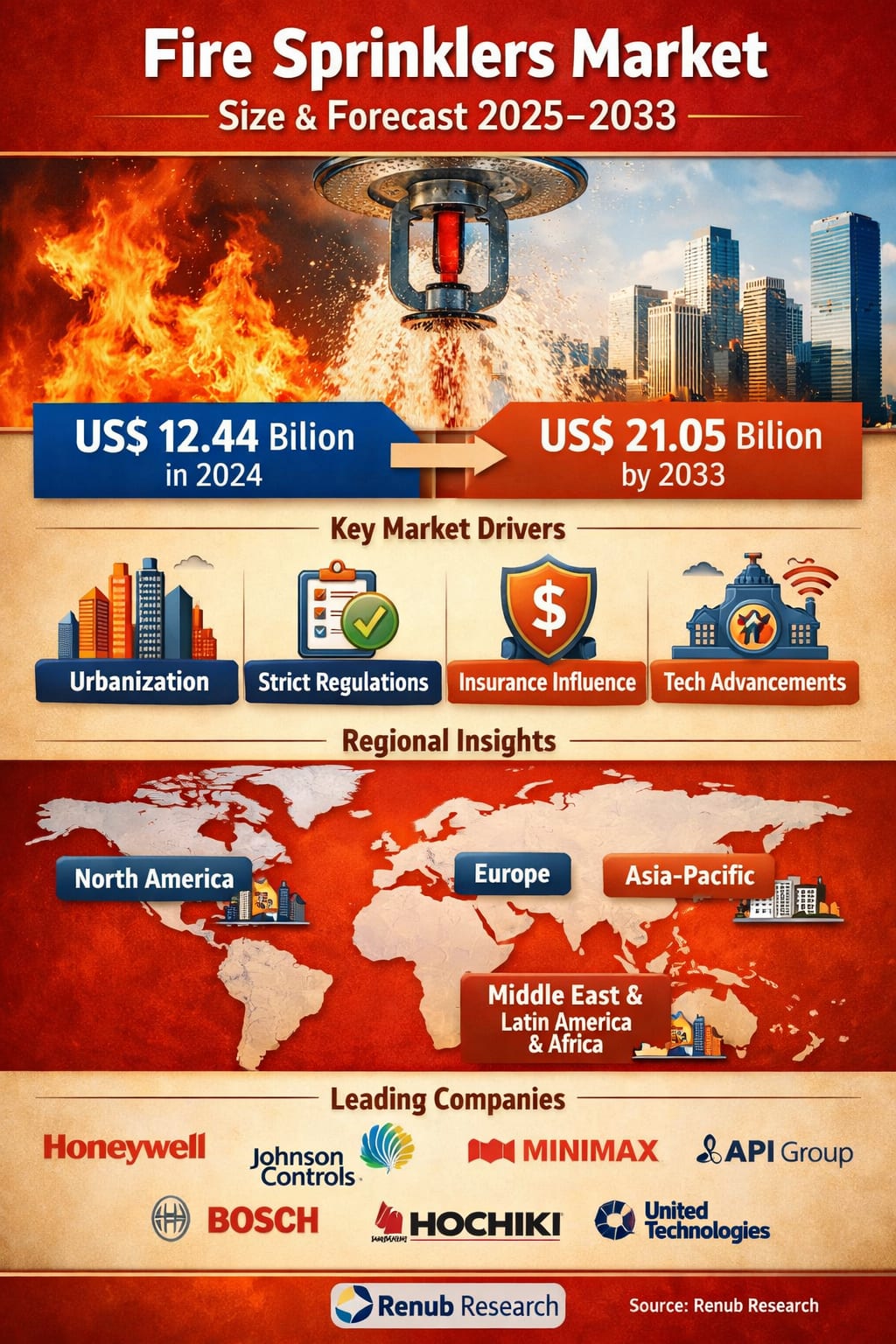
The global fire sprinklers market is entering a decisive growth phase, driven by a combination of stricter safety regulations, rapid urbanization, and rising awareness of fire-related risks across residential, commercial, and industrial environments. According to Renub Research, the fire sprinklers market is expected to reach US$ 21.05 billion by 2033, up from US$ 12.44 billion in 2024, growing at a CAGR of 6.02% from 2025 to 2033.
This steady expansion reflects more than just construction activity. It highlights a global shift toward proactive fire protection, risk mitigation, and compliance-driven safety investments. Governments, insurers, and building owners are increasingly aligned in recognizing fire sprinkler systems not as optional add-ons, but as essential components of modern infrastructure.
From high-rise residential towers and shopping malls to factories, warehouses, and data centers, the demand for reliable, automated fire suppression systems continues to grow. At the same time, technological innovations—such as smart, sensor-enabled sprinklers and integrated building management systems—are reshaping how fire protection is designed, monitored, and maintained.
Global Fire Sprinklers Industry Overview
The fire sprinklers market is expanding rapidly due to the surge in construction activity across both developed and emerging economies. Urbanization is accelerating, infrastructure investments are rising, and cities are becoming denser. These trends significantly increase the potential impact of fire incidents, making prevention and early suppression more critical than ever.
Modern building codes and government regulations now mandate fire sprinkler installations in a wide range of structures, particularly in commercial complexes, high-rise residential buildings, hospitals, hotels, and industrial facilities. This regulatory push is reinforcing demand, while also standardizing safety expectations across markets.
At the same time, property owners and businesses are becoming more conscious of the financial and human costs of fire-related disasters. Beyond compliance, fire sprinkler systems are increasingly viewed as strategic investments that protect assets, reduce downtime, and enhance occupant safety.
Technological progress is also playing a key role. Smart and automated sprinkler systems, capable of integrating with building management platforms, offer faster response times, better monitoring, and improved system reliability. These features are especially attractive in large commercial and industrial facilities where early detection and rapid suppression can prevent catastrophic losses.
United States: A Mature but Innovation-Driven Market
In the United States, the fire sprinklers market is well-established, supported by strict building codes, strong enforcement, and a deeply rooted culture of safety compliance. Rising construction activity, particularly in commercial real estate and multi-family housing, continues to support steady demand.
Fire safety standards such as those issued by the National Fire Protection Association (NFPA), including NFPA 13, have set clear benchmarks for system design, installation, and maintenance. Compliance is not optional—non-adherence can result in heavy fines, legal consequences, and increased insurance costs.
Technological innovation is shaping the next phase of growth. Smart sprinkler systems with automated controls, sensors, and real-time monitoring are increasingly being adopted, especially in critical infrastructure, healthcare facilities, and large commercial buildings. These systems improve response accuracy and reduce the risk of system failures.
The U.S. market also benefits from a strong ecosystem of contractors and service providers. As of 2025, there are 19,845 companies in the U.S. specializing in security and fire protection system installation, reflecting both the scale and maturity of the industry.
A notable development in September 2024 was the partnership between Plumis and Ferguson, aimed at introducing Plumis’ Automist fire suppression systems to the U.S. market. The product was formally showcased at the 43rd Annual American Fire Sprinkler Association (AFSA) Convention, signaling growing interest in advanced and alternative suppression technologies.
Key Factors Driving the Fire Sprinklers Market
1. Growing Infrastructure Development and Urbanization
Rapid urbanization remains one of the strongest drivers of the fire sprinklers market. According to United Nations estimates, nearly 68% of the world’s population is expected to live in urban areas by 2050. This demographic shift is fueling massive investments in residential complexes, commercial buildings, transportation hubs, and industrial zones.
As cities grow denser, the risks associated with fire incidents increase significantly. High population concentration means that even a single fire can result in severe human and economic losses. Governments and urban planners are therefore placing greater emphasis on preventive safety measures, including mandatory fire sprinkler installations in new constructions and, in some cases, retrofitting older buildings.
This trend is particularly strong in emerging economies, where large-scale infrastructure projects are reshaping urban landscapes and creating sustained demand for fire protection systems.
2. Expanding Impact of the Insurance Sector
The insurance industry plays a crucial role in accelerating the adoption of fire sprinkler systems. Insurers widely recognize sprinklers as one of the most effective tools for reducing fire-related losses. As a result, properties equipped with certified fire sprinkler systems often benefit from lower insurance premiums.
In many high-risk sectors—such as manufacturing, warehousing, hospitality, and healthcare—insurance providers may even require sprinkler installations as a condition for coverage. This creates a powerful financial incentive for property owners to invest in compliant fire protection systems.
Moreover, insurers frequently collaborate with regulators and standards bodies to shape fire safety codes. Their expertise in risk assessment and loss prevention helps reinforce the central role of sprinkler systems in modern building safety strategies.
3. Strict Fire Safety Regulations
Government regulations remain a cornerstone of market growth. Across North America, Europe, and parts of Asia-Pacific and the Middle East, fire safety laws increasingly mandate sprinkler installations in residential, commercial, and industrial buildings.
In the United States, NFPA standards have become global reference points for system design and performance. Similar regulatory frameworks exist in Europe and other regions, often adapted to local building codes and risk profiles.
Non-compliance can result in legal penalties, project delays, higher insurance costs, and reputational damage. As enforcement becomes stricter, demand for certified, high-quality fire sprinkler systems continues to rise.
Challenges in the Fire Sprinklers Market
High Installation and Maintenance Costs
Despite their proven effectiveness, fire sprinkler systems involve significant upfront and ongoing costs. Installation expenses include system design, materials, labor, and integration with existing building infrastructure—particularly challenging in older structures not originally designed for such systems.
Beyond installation, regular inspections, testing, and maintenance are required to ensure reliability and regulatory compliance. For small businesses and residential property owners with limited budgets, these costs can act as a deterrent, slowing adoption in certain segments and regions.
Regulatory Compliance Variability
Another major challenge is the lack of uniform global standards. Fire safety regulations vary widely across countries and even between regions within the same country. Manufacturers and service providers must adapt their products and practices to meet diverse local requirements.
This complexity increases costs, extends project timelines, and complicates international expansion strategies. Frequent updates to building codes and standards also require continuous training for installers and ongoing adjustments to product designs and documentation.
Regional Outlook: A Market Shaped by Regulation and Development
North America and Europe
These regions represent mature markets characterized by strict safety standards, high awareness, and strong enforcement. Demand is driven by both new construction and the retrofitting of older buildings to meet modern codes. Technological upgrades, particularly smart and automated systems, are gaining traction.
Asia-Pacific
Asia-Pacific is the fastest-growing regional market, fueled by rapid urbanization, large-scale infrastructure projects, and expanding industrial activity. Countries such as China, India, and Southeast Asian nations are investing heavily in commercial and residential construction, creating strong long-term demand for fire sprinkler systems.
Latin America and Middle East & Africa
These regions are experiencing moderate but steady growth, supported by increasing awareness of fire safety, regulatory improvements, and rising investments in commercial and industrial infrastructure.
Country Spotlight: Key Markets
United Kingdom
The UK fire sprinklers market is growing steadily due to strict fire safety regulations and heightened public awareness following high-profile fire incidents. Government mandates for automated fire suppression systems in high-rise buildings have significantly influenced market dynamics.
There is also growing interest in environmentally friendly and smart sprinkler systems, particularly in commercial and residential projects. Retrofitting older buildings to comply with modern safety standards is another important growth driver, despite challenges related to cost and skilled labor shortages.
India
India’s fire sprinkler market is expanding rapidly, supported by urbanization, stricter building regulations, and increasing awareness of fire risks. High-rise residential buildings, shopping malls, IT parks, and industrial facilities are key demand centers.
The urgency is underscored by alarming fire statistics. By 2022, 21% of fire accidents in India were attributed to electrical issues and short circuits, up from just 3% in 1996. This sharp rise has prompted authorities to tighten safety regulations and enforce fire compliance more strictly.
Smart, IoT-enabled sprinkler systems are gradually gaining attention, offering real-time monitoring and improved safety performance. While high costs and skill shortages remain challenges, rising investments in safety infrastructure and retrofitting projects are expected to sustain growth.
United Arab Emirates
The UAE fire sprinklers market is benefiting from rapid urban development, iconic high-rise projects, and strict fire safety regulations. Commercial complexes, luxury residential towers, hotels, and industrial facilities are all major adopters of advanced fire protection systems.
Government enforcement, combined with insurance requirements, is driving widespread installation in both new and existing buildings. The adoption of smart and integrated fire protection solutions is also increasing, particularly in large-scale and high-value projects.
Recent Developments in the Fire Sprinklers Industry
April 2025: The British Automatic Fire Sprinkler Association (BAFSA) launched a new online continuing education program titled Principles & Practices of Automatic Fire Sprinkler Systems. The course provides comprehensive training on system design, components, and certification, and offers a CPD-recognized certificate upon completion.
April 2025: AGF Manufacturing introduced the PURGENVENT™ Model 7940 BLE, an automated air vent assembly compliant with BABAA requirements for wet fire sprinkler systems. The redesigned model meets NFPA 13 standards and enhances air management and overall system reliability.
Market Segmentation Overview
By Component:
Product
Service
By Product Type:
Wet Pipe
Dry Pipe
Deluge Systems
Pre-Action Systems
Others
By Technology:
Active Fire Protection
Passive Fire Protection
By Application:
Commercial
Residential
Industrial
By Region:
North America (United States, Canada)
Europe (France, Germany, Italy, Spain, United Kingdom, Belgium, Netherlands, Turkey)
Asia Pacific (China, Japan, India, Australia, South Korea, Thailand, Malaysia, Indonesia, New Zealand)
Latin America (Brazil, Mexico, Argentina)
Middle East & Africa (South Africa, Saudi Arabia, United Arab Emirates)
Competitive Landscape: Key Players
The global fire sprinklers market is highly competitive, with leading players focusing on innovation, strategic partnerships, and geographic expansion. Major companies covered include:
Honeywell International
Johnson Controls
Minimax GmbH & Co. KG
API Group Inc.
United Technologies Corporation
Robert Bosch GmbH
Hochiki Corporation
VT MAK
These companies compete on product reliability, technological innovation, service networks, and compliance with international safety standards.
Final Thoughts: A Market Where Safety Meets Strategy
The global fire sprinklers market is no longer driven by regulation alone. It is increasingly shaped by a broader understanding of risk management, asset protection, and long-term sustainability in building design. With the market projected to grow from US$ 12.44 billion in 2024 to US$ 21.05 billion by 2033, the industry’s future looks both resilient and opportunity-rich.
Urbanization, infrastructure expansion, insurance incentives, and technological innovation will continue to reinforce demand. While challenges such as high costs and regulatory complexity remain, the long-term trajectory is clear: fire sprinkler systems are becoming a standard, non-negotiable component of modern, responsible construction worldwide.
About the Creator
Global Logistics Market Size and Forecast 2025–2033: The Backbone of Modern Global Trade
Global Logistics Market Overview In 2024, the Global Logistics Market was valued at US$ 6.68 trillion and is projected to expand to US$ 11.27 trillion by 2033, growing at a CAGR of 5.98% during 2025–2033, according to Renub Research. This impressive growth trajectory highlights how logistics has become one of the most critical pillars of the modern global economy.
By Sakshi Sharmaa day ago in Trader
Polygon (MATIC) Layer-2 Scaling, Price Trends, and Investment Analysis
Introduction Polygon, formerly known as Matic Network, has become one of the most prominent Layer-2 solutions for Ethereum. As Ethereum’s popularity grew, high gas fees and network congestion limited scalability for decentralized applications. Polygon solves these challenges by providing faster and cheaper transactions while maintaining Ethereum’s security. From an investment perspective, MATIC represents exposure to a blockchain solution that is increasingly critical for the Ethereum ecosystem and DeFi adoption. Understanding Polygon’s price trends, ecosystem growth, and risks is essential before investing.
By Hammad Nawazabout 3 hours ago in Trader



Comments
There are no comments for this story
Be the first to respond and start the conversation.