
Europe Diesel Gensets Market Size and Forecast 2025–2033
Backup Power in a Time of Transition: Why Diesel Gensets Still Matter in Europe

Introduction
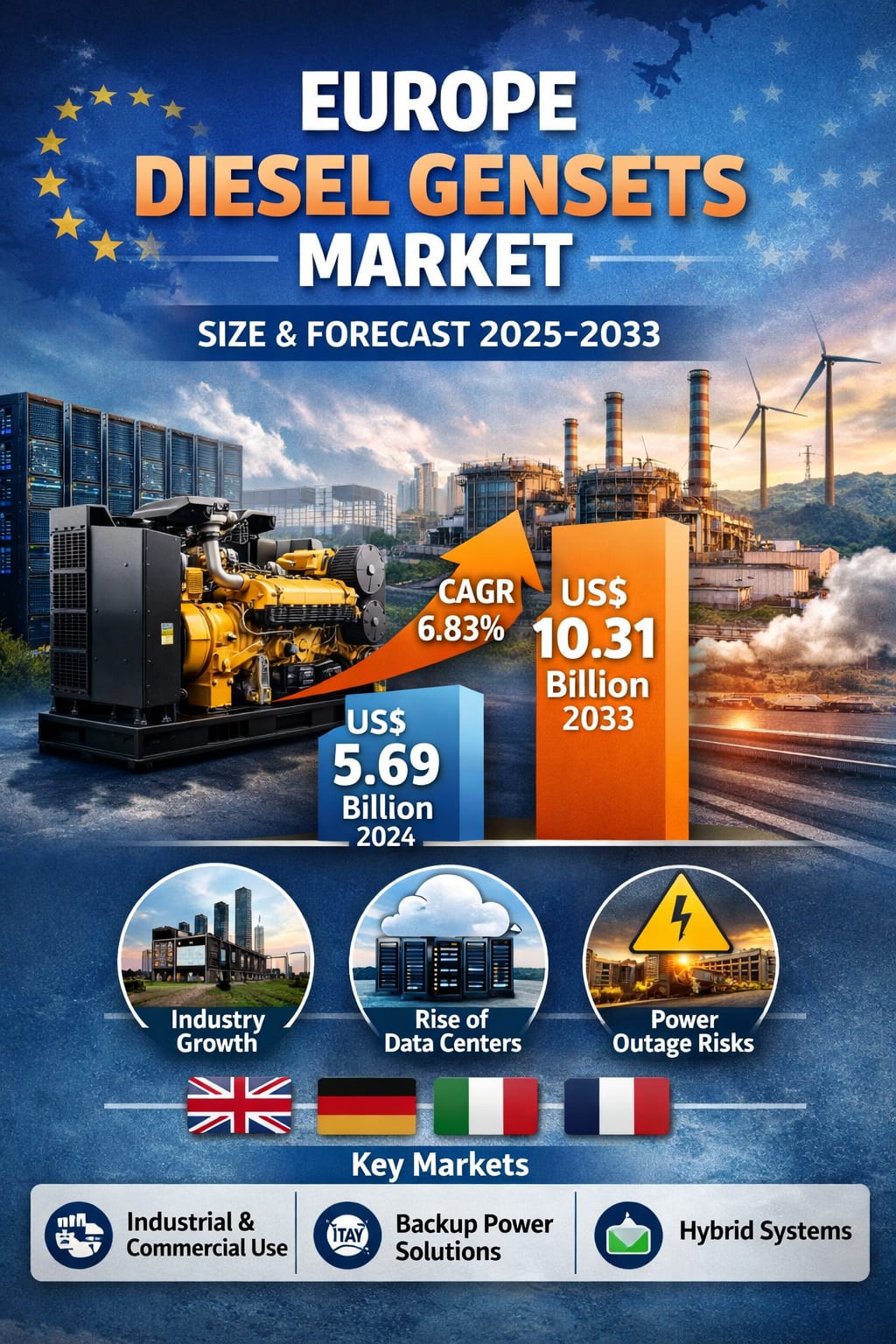
The Europe Diesel Gensets Market is entering a decisive decade shaped by two powerful and sometimes conflicting forces: the urgent push toward decarbonization and the equally urgent need for reliable, uninterrupted power. According to Renub Research, the Europe Diesel Gensets Market is expected to reach US$ 10.31 billion by 2033, up from US$ 5.69 billion in 2024, growing at a CAGR of 6.83% from 2025 to 2033.
This growth reflects a reality that many policymakers and businesses quietly acknowledge: despite rapid investments in renewable energy, diesel generator sets remain a critical pillar of Europe’s energy security. From data centers and hospitals to manufacturing plants and construction sites, diesel gensets continue to provide dependable backup and standby power where grid reliability, weather volatility, or operational risk make interruptions unacceptable.
Europe’s power landscape is changing fast. Renewable energy integration is accelerating, digital infrastructure is expanding, and extreme weather events are becoming more frequent. In this environment, the role of diesel gensets is also evolving—from primary power sources in some applications to increasingly sophisticated, cleaner, and more efficient backup systems designed to support resilience and business continuity.
Europe Diesel Gensets Market Overview
The Europe diesel gensets market plays a crucial role in ensuring power continuity across multiple sectors, including data centers, commercial buildings, healthcare facilities, manufacturing plants, and critical public infrastructure. Aging grid infrastructure in some regions, combined with the variability of renewable energy sources such as wind and solar, has increased the risk of power disruptions. As a result, reliable backup power systems are no longer optional—they are strategic necessities.
One of the strongest demand drivers is the rapid growth of data centers, fueled by cloud computing, artificial intelligence, digital services, and expanding online ecosystems. These facilities require uninterrupted power, even for milliseconds, making diesel gensets a core part of their energy resilience strategies. Similarly, hospitals, emergency services, and telecom networks depend heavily on diesel generators to ensure continuous operation during outages.
Despite the strong policy push toward cleaner energy, diesel gensets remain competitive because of their reliability, rapid response time, fuel availability, and proven performance in mission-critical applications. At the same time, manufacturers are investing heavily in innovation to comply with Europe’s strict emission norms, leading to cleaner, quieter, and more fuel-efficient models. Hybrid systems that combine diesel generators with batteries or renewable sources are also gaining traction, helping reduce fuel consumption and emissions while preserving reliability.
Key Factors Driving the Europe Diesel Gensets Market Growth
1. Growth in Industrial and Commercial Infrastructure
One of the most important growth drivers is the continued expansion of industrial and commercial infrastructure across Europe, particularly in Eastern and Southern regions. Manufacturing plants, logistics hubs, warehouses, and large commercial complexes all require stable and reliable power to operate efficiently.
Diesel gensets are widely used both as standby power solutions and, in some cases, as prime power sources in areas with unstable grid access. Construction sites, in particular, depend heavily on diesel generators due to their portability and ability to operate in remote or underdeveloped locations. As Europe continues to invest in infrastructure modernization, transportation networks, and industrial capacity, the demand for dependable power solutions is expected to remain strong.
2. Emergency Preparedness and Disaster Resilience
Climate change is reshaping Europe’s risk landscape. Heatwaves, storms, floods, and other extreme weather events are becoming more frequent and severe, increasing the likelihood of grid disruptions. This has pushed emergency preparedness and disaster resilience higher up the priority list for governments, businesses, and institutions.
Hospitals, government buildings, emergency services, and critical infrastructure operators rely on diesel gensets because they can start quickly, run for long durations, and operate independently of the grid. Their proven reliability in crisis situations makes them indispensable for continuity planning. As awareness of operational risk grows, investments in backup power systems are rising across sectors, reinforcing the market’s long-term growth outlook.
3. Technological Advancements and Hybrid Systems
Modern diesel gensets are very different from their older counterparts. Today’s systems feature improved fuel efficiency, lower noise levels, and advanced emission control technologies that help them comply with strict European regulations. Digital monitoring, predictive maintenance, and smart control systems have further improved reliability and reduced downtime.
One of the most important trends is the rise of hybrid power systems, which integrate diesel generators with battery storage and renewable energy sources such as solar. These systems reduce fuel consumption, lower emissions, and optimize operating costs while maintaining high reliability. Hybrid solutions are especially attractive in remote, off-grid, or semi-urban locations where grid access is inconsistent. This technological evolution is helping diesel gensets remain relevant in an increasingly sustainability-focused energy market.
Challenges in the Europe Diesel Gensets Market
1. High Operating and Maintenance Costs
Despite their reliability, diesel gensets come with significant operating and maintenance expenses. Fuel price volatility can increase running costs, while regular maintenance—such as oil changes, filter replacements, and mechanical inspections—is necessary to ensure dependable performance.
When compared with alternatives like solar power or battery storage, which often have lower long-term operating costs, diesel gensets can appear less attractive, particularly for non-industrial users. This cost factor is encouraging some businesses and institutions to explore cleaner and more economical energy solutions, especially for applications where continuous diesel usage is not essential.
2. Limited Adoption in the Residential Sector
The residential segment remains a relatively small part of the European diesel gensets market. Diesel generators are typically large, noisy, and produce exhaust emissions, making them less suitable for dense urban environments. Strict noise and pollution regulations in many European cities further limit their appeal for household use.
At the same time, the growing availability of quieter, cleaner alternatives—such as home battery storage systems and small-scale renewable solutions—has reduced the need for diesel gensets in residential settings. While the commercial and industrial sectors continue to drive demand, limited residential adoption constrains the market’s broader expansion potential.
Europe Diesel Gensets Market Overview by Regions
Demand patterns vary across Europe, shaped by differences in industrial activity, infrastructure development, and energy policies.
United Kingdom
The UK diesel gensets market plays a vital role in supporting data centers, healthcare facilities, manufacturing, and construction projects. The country’s strong focus on business continuity and operational resilience keeps demand steady, especially for mission-critical applications. While there is increasing pressure to shift toward greener energy sources, diesel gensets remain a preferred backup option due to their fast response time and proven reliability. Technological improvements and cleaner models are helping the market adapt to evolving regulatory requirements.
Germany
Germany’s strong industrial base drives significant demand for diesel generator sets, particularly in manufacturing, logistics, healthcare, and public infrastructure. Even as the country leads Europe’s energy transition toward renewables, the need for reliable backup power remains critical. Diesel gensets are widely used to protect operations from grid instability and outages. Stricter environmental regulations are pushing manufacturers toward cleaner and more efficient technologies, but the fundamental role of diesel gensets in emergency and temporary power applications remains intact.
Italy
Italy’s diesel gensets market is growing steadily, supported by rising demand from telecommunications, data centers, healthcare, and industrial facilities. Infrastructure development and concerns about grid reliability are encouraging businesses to invest in dependable backup power solutions. Technological advancements have made modern gensets more fuel-efficient and environmentally friendly, aligning better with sustainability goals. Despite the growing use of renewables, diesel gensets continue to play a key role, especially in regions with inconsistent grid access.
France
France is witnessing steady growth in diesel genset demand across the commercial, industrial, and healthcare sectors. Data centers and hospitals, in particular, rely heavily on diesel generators to ensure uninterrupted operations. Infrastructure development and industrial activity are further supporting market expansion. While environmental regulations are becoming stricter, diesel gensets remain popular due to their reliability, ease of deployment, and fuel availability. Manufacturers are responding by introducing cleaner and more efficient models to meet regulatory standards.
Market Segmentations
By KVA Rating
5–75 KVA
75.1–375 KVA
375.1–750 KVA
750.1–1,000 KVA
1,000.1–2,000 KVA
Above 2,000 KVA
Smaller KVA segments are commonly used in commercial buildings, small industries, and backup applications, while higher-capacity gensets are critical for large industrial facilities, data centers, and infrastructure projects.
By End User
Residential
Commercial
Industrial
The commercial and industrial segments dominate the market, driven by data centers, manufacturing plants, healthcare facilities, and infrastructure projects. The residential segment remains limited due to regulatory, environmental, and practical constraints.
By Region
France
Germany
Italy
Spain
United Kingdom
Belgium
Netherlands
Russia
Poland
Greece
Norway
Romania
Portugal
Rest of Europe
Competitive Landscape and Company Analysis
The Europe diesel gensets market is characterized by the presence of well-established global and regional players focusing on product innovation, efficiency improvements, and regulatory compliance. Companies are investing in cleaner technologies, hybrid solutions, and digital monitoring systems to strengthen their competitive positions.
Key Players Covered:
Aggreko
Atlas Copco AB
Ashok Leyland
Caterpillar
Cummins, Inc.
Cooper Corp.
Greaves Cotton Limited
Deere & Company
Kirloskar
Company Analysis Includes:
Overview
Key Persons
Recent Developments
Revenue Analysis
These players compete on factors such as reliability, fuel efficiency, after-sales service, technological innovation, and compliance with emission standards. Strategic partnerships, new product launches, and expansion into hybrid and low-emission solutions are shaping the competitive dynamics of the market.
Future Outlook
Looking ahead, the Europe diesel gensets market will continue to evolve alongside the continent’s broader energy transition. While the long-term direction clearly points toward cleaner and more sustainable energy systems, the need for reliable, fast-response backup power is unlikely to disappear anytime soon.
Growth in data centers, digital infrastructure, healthcare, and industrial automation will keep demand strong, while technological advancements will make diesel gensets cleaner, quieter, and more efficient. Hybrid systems will play an increasingly important role, helping bridge the gap between reliability and sustainability.
At the same time, regulatory pressure and environmental concerns will continue to challenge manufacturers and users to reduce emissions and operating costs. The companies that succeed will be those that can combine performance, compliance, and innovation into integrated, future-ready power solutions.
Final Thoughts
The Europe Diesel Gensets Market stands at a fascinating crossroads. On one side is the unstoppable momentum toward decarbonization and renewable energy. On the other is the practical, real-world need for energy security, resilience, and uninterrupted power. The projected rise from US$ 5.69 billion in 2024 to US$ 10.31 billion by 2033, at a CAGR of 6.83%, shows that diesel gensets are far from being phased out.
Instead, they are being redefined—cleaner, smarter, and increasingly integrated into hybrid energy systems. For Europe’s industries, institutions, and infrastructure operators, diesel gensets remain a critical insurance policy against uncertainty in an increasingly complex energy landscape. The market’s future will not be about choosing between reliability and sustainability, but about finding smarter ways to deliver both.
About the Creator
Keep reading
More stories from shibansh kumar and writers in Trader and other communities.
Saudi Arabia Data Center Market Size and Forecast 2025–2033
Saudi Arabia Data Center Market: A Digital Infrastructure Boom in Motion Saudi Arabia’s data center market is entering a decisive decade. According to Renub Research, the Saudi Arabia Data Center Market is expected to reach US$ 6.5 Billion by 2033, growing from US$ 2.75 Billion in 2024, at a CAGR of 10.02% from 2025 to 2033. This rapid expansion is being fueled by the explosive growth of digital data, rising demand for cloud computing services, and the Kingdom’s ambitious Vision 2030 agenda to diversify its economy and build a knowledge-driven society.
By shibansh kumarabout 12 hours ago in Trader
Silver Price Outlook: XAG/USD Approaches $78 Amid Safe-Haven Demand
Introduction Silver, often called the “poor man’s gold,” is a key safe-haven asset and industrial metal. Recently, XAG/USD has risen to near $78, driven by global economic uncertainty and increased demand for hedging against inflation and market volatility. Investors closely track silver alongside gold to diversify portfolios, manage risk, and capitalize on price movements.
By Hammad Nawaza day ago in Trader
Pasta Market Set to Soar to USD 26.2 Billion by 2033 | At CAGR 1.3%
The pasta market is experiencing steady and consistent growth worldwide. One of the biggest drivers behind this expansion is the increasing demand for convenient food products. In a fast-paced world where consumers juggle work, family, and social commitments, quick meal solutions are more valuable than ever. Pasta offers an affordable, easy-to-cook, and versatile meal base that fits perfectly into modern lifestyles.
By James Smitha day ago in Trader



Comments (1)
😊😊😊👍👍