
Digital Signage for Pharmacy: How Screens Improve Accuracy, Flow, and Patient Experience
Digital Signage for Pharmacy

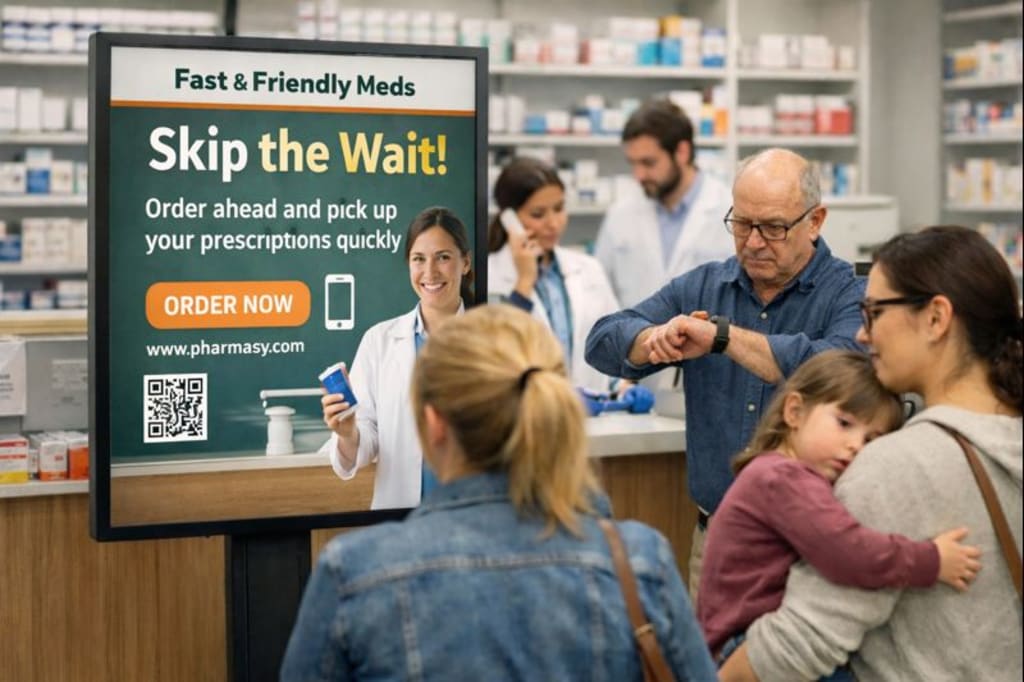
Pharmacies operate in high-responsibility environments. Every interaction involves time sensitivity, accuracy, and trust. Customers arrive with prescriptions, questions, and expectations of clarity. At the same time, pharmacists and staff manage inventory, regulations, insurance workflows, and long queues.
In this setting, communication gaps are costly. Printed notices, posters, and countertop signs often become outdated quickly or go unnoticed altogether. Digital signage for pharmacy environments is increasingly used to solve this challenge by keeping information visible, current, and easy to manage.
Rather than acting as advertising displays, pharmacy digital signage systems function as operational tools that support both patients and staff throughout the day.
The Communication Challenge Inside Pharmacies
Pharmacies handle constant information changes. Prescription wait times fluctuate, services vary by hour, and health advisories update regularly. Relying on static signage makes it difficult to keep messaging accurate.
Digital signage in a pharmacy allows information to be updated instantly. Whether it’s service availability, wait-time guidance, or health reminders, screens ensure customers see the most current information without requiring staff to repeat it verbally.
This reduces misunderstandings and helps pharmacies operate more smoothly during busy periods.
Supporting Queue Management and Patient Flow
One of the most stressful parts of a pharmacy visit is waiting without clarity. Customers want to know where to stand, when they’ll be served, and what to expect next.
Pharmacy digital signage is often used to:
- Display queue instructions
- Share estimated wait times
- Direct customers to pickup, consultation, or payment areas
- Clear visual guidance helps keep lines organized and reduces frustration, especially during peak hours.
Improving Visibility of Services and Information
Many pharmacies offer services beyond prescription fulfillment, such as vaccinations, consultations, and health screenings. These services are often underutilized simply because customers are unaware of them.
Digital signage for pharmacy environments allows these services to be highlighted clearly without cluttering the space. Screens can rotate service information throughout the day, keeping messaging visible without overwhelming customers.
This creates awareness while maintaining a calm, professional environment.
Reducing Repetition for Pharmacy Staff
Pharmacists and staff frequently answer the same questions throughout the day. Digital signage in a pharmacy helps address common inquiries before they are asked.
When customers can see:
- Service hours
- Pickup instructions
- Policy notices
Staff can focus on patient care rather than repeating logistical information. This improves efficiency and reduces burnout in high-pressure environments.
Keeping Health Messaging Current and Clear
Health information changes quickly. Seasonal advisories, public health updates, and safety notices need to be communicated clearly and responsibly.
Pharmacy digital signage allows updates to be deployed centrally and instantly. This ensures that messaging remains accurate and compliant without relying on printed materials that may become outdated.
Screens can also be scheduled to display different content at different times, helping pharmacies manage seasonal or time-sensitive messaging more effectively.
Maintaining a Clean and Professional Environment
Printed posters and flyers can accumulate quickly, creating visual clutter. Digital signage for pharmacy settings consolidates information into organized displays, helping stores maintain a clean and professional appearance.
Clear layouts and minimal motion ensure screens support the environment rather than distract from it. In healthcare-adjacent spaces, restraint and clarity are especially important.
Extending Digital Signage Beyond Customer Areas
Digital signage in a pharmacy isn’t limited to customer-facing spaces. Many pharmacies use screens in staff-only areas to display internal updates, shift reminders, and operational notices.
This improves internal communication and reduces reliance on emails or paper notices, helping teams stay aligned throughout the day.
Adapting Content Throughout the Day
Pharmacy activity varies by time of day. Mornings may focus on prescription pickups, while afternoons see increased consultations and vaccinations.
Digital signage for pharmacy environments allows content to adapt automatically based on time, helping ensure relevance without manual updates. This flexibility is especially useful in high-volume locations.
Industry Context
Healthcare and pharmacy environments continue to adopt digital displays to support communication and patient experience.
This overview from Digital Signage Today explores how pharmacies and healthcare settings use digital signage to manage information and flow:
Digital Signage Platforms Used in Pharmacies
Pharmacies typically rely on digital signage platforms that support centralized updates, scheduling, and remote screen management. Platforms such as AIScreen are used in pharmacy environments to manage digital signage across customer areas and staff spaces while maintaining reliability and control.
These platforms are generally selected for ease of use, stability, and compliance-friendly operation rather than marketing features.
Key Takeaways
Digital signage for pharmacy environments supports clearer communication, smoother queues, and better use of staff time. It helps keep information accurate, visible, and easy to update throughout the day.
When implemented thoughtfully, pharmacy digital signage becomes a practical support system that improves patient experience while helping pharmacies operate with greater efficiency and clarity.
About the Creator
AIScreen
AIScreen is a reliable, easy-to-use cloud-based digital signage software for managing content across industries affordable, scalable, and trusted worldwide.
Australia Wellness Tourism Market Set for Explosive Growth Fueled by Holistic Experiences
The Australia wellness tourism market reached USD 18.1 billion in 2024 and is forecast to expand to USD 67.6 billion by 2033, exhibiting a robust compound annual growth rate (CAGR) of 14.6% between 2025 and 2033. This rapid growth reflects strong consumer interest in wellness oriented travel that blends physical, mental and cultural well being with leisure and outdoor experiences. Eco conscious retreats, premium spa services, nature immersion activities and wellness focused itineraries are reshaping Australia’s travel landscape, attracting both domestic and international visitors.
By Rashi Sharma6 days ago in Trader
Philippines AI in Fintech Market: Intelligent Finance, Digital Growth & Risk Innovation
Philippines AI in Fintech Market Overview The Philippines AI in fintech market is rapidly gaining momentum as financial institutions, digital payment platforms and emerging fintech startups adopt artificial intelligence (AI) technologies to enhance service delivery, operational efficiency and customer experience. AI in fintech covers a range of intelligent systems including machine learning models, virtual assistants, fraud detection tools, behavioural analytics and credit scoring systems that optimise decision-making and reduce risks. The Philippines AI in fintech market size reached USD 79.38 Million in 2024. The market is projected to reach USD 419.35 Million by 2033, exhibiting a growth rate (CAGR) of 18.11% during 2025-2033 as AI becomes integral to financial innovation and digital transformation across banking, payments and financial services.
By Manisha Dixit5 days ago in Trader




Comments
There are no comments for this story
Be the first to respond and start the conversation.