
Dhando Investor (Mohnish Pabrai): 12 Reasons Running a Lemonade Stand as a Kid Predicts Financial Success
It's not about lemonade - it's about incentives, margin, and low-risk bets.

The Dhando Investor Core Idea: Heads I win a lot. Tails I lose little.
Pabrai often points to lemonade stands as a microcosm of business - a simple system where incentives, pricing, margins, and demand become immediately visible.
1. Early Understanding of Incentives
A lemonade stand forces one core question: why should someone stop and buy this?
Kids who grasp incentives early tend to understand markets later.
That's Dhando thinking at its root.
2. Natural Sense of Margin
The best lemonade stand operators instinctively minimize costs.
Cheap inputs, simple setup, high markup.
That's margin consciousness before the word "margin" is ever understood.
My dad made bomb dot com lemonade.
My siblings and I used his recipe, which only required lemons, sugar, and water.
That's a cheap ass recipe.
Production costs were nil.
3. Location Arbitrage
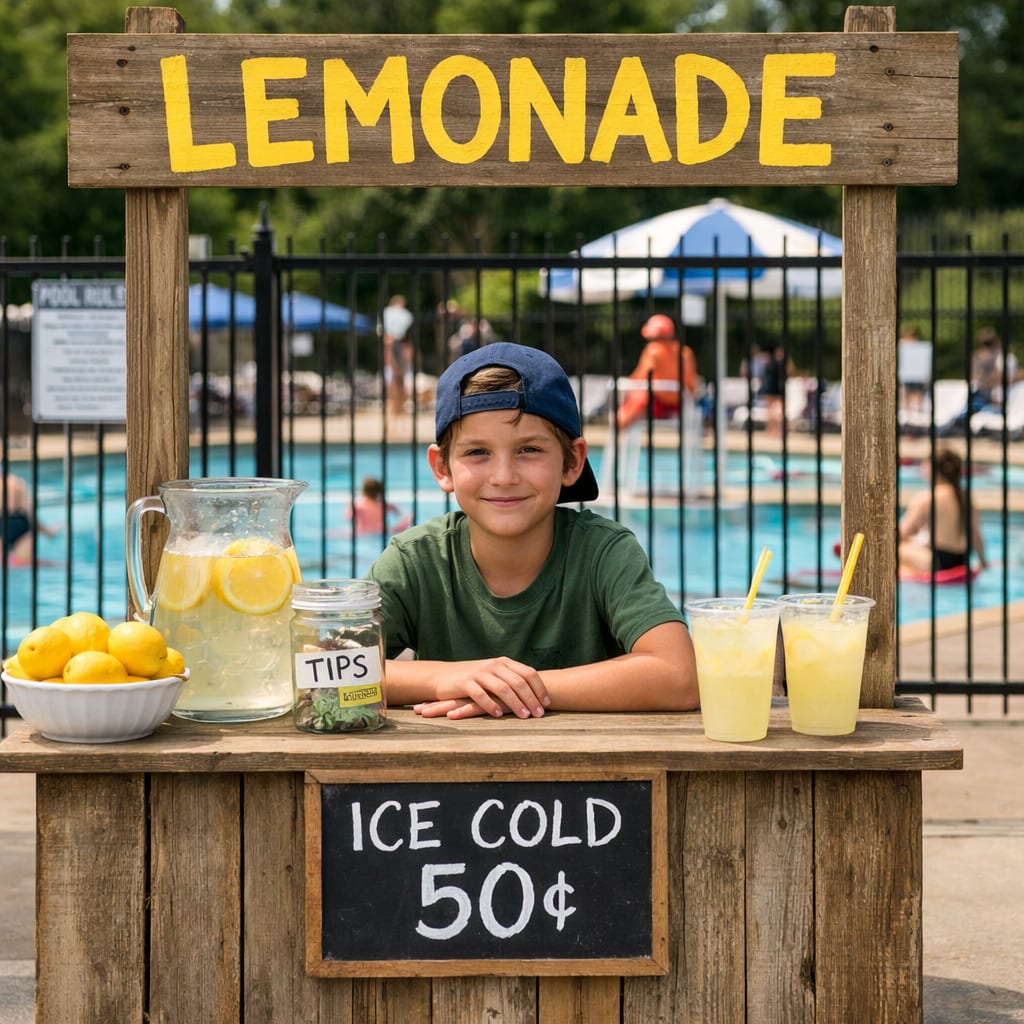
Location 1: Neighborhood Pool
Where did I choose to run the lemonade stand?
At the top of the neighborhood right in front of the pool during the middle of summer.
Talk about prime real estate.
The sales were easy, natural, and flowing.
Which is why location arbitrage is so key.
What are the best times to sell drinks?
When people are hot
When people are very active (e.g., raves, races, etc.)
When people are walking for long periods (e.g., sporting events or concerts)
When people are relaxing at beaches and pools
Wherever people could use a drink
Location 2: Gas Station
My friend and I were on our way to an event and he ended up stopping at a gas station. A kid was selling lemonade there. It was prime real estate because the lemonade stand was positioned at an extremely busy stop light.
You might question, why sell lemonade where drinks are already being sold. But another thing to consider is to go where the business already exists or go where the sharks are already eating, so you don't have to find new customers.
Location 3: Rome Italy
My family and I were waiting to get into the famous Colosseum during a hot summer day and guess what, adults were selling bottles of ice cold water. We see this at many sporting events and concerts as well
Smart.
4. Comfort with Pricing Decisions
Most people are afraid to price.
A kid who experiments with $0.50 vs $1.00 and watches demand respond is learning price elasticity in real time.
That's rare and transferable.
5. Willingness to Iterate Fast
Change the sign.
Change the pitch.
Move locations.
Try again tomorrow.
This feedback loop mentality matters far more than the stand itself.
When I was running my music business, I only used signs to advertise.
Volume was my best friend here. The more signs I put out, the more customers I received, but certain signs were hot spots.
How did I know? Ask the customer where they saw the sign.
Seek feedback loops continuously to elevate your sales.
6. Low Emotional Attachment to Failure
Some kids quit after one bad day.
Others shrug and adjust.
That emotional neutrality toward failure is one of the strongest predictors of long-term financial success.
7. Ownership Mindset
A lemonade stand is ownership, not chores.
Kids who enjoy owning the outcome rather than just "doing work" often gravitate naturally toward investing, entrepreneurship, or leverage-based careers.
8. Intuitive Dhando Logic: Low Risk, Asymmetric Upside
The downside of a lemonade stand is tiny.
The upside is experience, confidence, and profit.
Kids who lean toward low-risk, high-upside bets early mirror the exact logic Pabrai uses in investing.
9. Distribution Beats Product (Even for Lemonade)
Most people obsess over the recipe.
The kids who "win" obsess over distribution: foot traffic, visibility, timing, and convenience.
Same lemonade, different corner = different results.
The best product in the world loses if nobody sees it. Wealth follows distribution - audience, traffic, networks, deal flow.
10. Presentation and Messaging Convert Strangers
A handwritten sign that's bold, simple, and readable from a car or down the street will outperform a "better" stand with weak messaging.
The offer matters too: "ICE COLD" and "$1" beats a paragraph explaining organic lemons.
Clarity sells. Marketing isn't manipulation - it's translating value fast.
11. Reinvesting Thinking Is The Earliest Form of Compounding
Some kids spend the profit immediately. Others buy more cups, better signage, a cooler, or upgrade the location.
That tiny choice - consume vs reinvest - creates two completely different trajectories.
Compounding starts as a mindset before it becomes a math equation.
People who reinvest early often build assets faster later.
12. Social Skill Is A Financial Asset
A lemonade stand is a "micro sales call." Kids learn how to greet people, read energy, handle "no," and keep going without taking it personally.
The ability to ask for money confidently is rare - and it pays forever.
In business, investing, salary negotiations, partnerships - your comfort with conversation is a multiplier.
The Lemonade Stand Is A Signal, Not the Source
A lemonade stand doesn't cause financial success.
It reveals tendencies:
Incentive awareness
Margin thinking
Iteration
Risk asymmetry
These tendencies - when reinforced later - are what compound.
That's the real lesson.
Why This Matters more Than Ever (Especially Now)
The reason the lemonade stand still matters isn't nostalgia.
It's contrast.
We now live in a world where most people don't interact with money.
Paychecks are automated.
Purchases are frictionless.
Debt is abstract.
Risk is hidden behind apps, subscriptions, and monthly minimums.
A lemonade stand collapses all of that abstraction.
You see:
effort → outcome
pricing → behavior
visibility → demand
decisions → consequences
Immediately.
That feedback loop is rare and incredibly valuable.
Many adults have never experienced a clean, honest money loop where their choices alone determined results.
Instead, they inherit systems, salaries, and narratives.
That's why so many people feel confused, entitled, or resentful around money.
They were never taught to observe it.
The lemonade stand is powerful not because it makes money, but because it removes excuses.
There's no boss.
No algorithm to blame.
No degree required.
No complex theory.
Just: Did this work? If not, why?
People who learn early to ask that question without ego tend to do better financially over time - whether they become investors, founders, or quiet asset builders.
That's also why Dhando thinking scales so well. It rewards observation, humility, patience, and asymmetry - not force.
The stand is small.
The lesson is not.
And once someone internalizes that money responds to incentives, not intentions, they rarely unlearn it.
-
This article is for informational purposes only. It should not be considered Financial or Legal Advice. Not all information will be accurate. Consult a financial professional before making any significant financial decisions.
About the Creator
Destiny S. Harris
Writing since 11. Investing and Lifting since 14.
destinyh.com
Keep reading
More stories from Destiny S. Harris and writers in Trader and other communities.
Rachel Reviews: The Spiral Archive by Pieter Hendrik
It's difficult for me to know where to start with a review of this book as it was, for me, an entirely unique experience and one that I'll probably never have again. I don't want that to be interpreted as unenjoyable but it has left me scratching my head a little and ruminating on its content, its themes and its characters.
By Rachel Deeming3 days ago in BookClub


Comments
There are no comments for this story
Be the first to respond and start the conversation.