
Crypto Stablecoin USDC USDT Eure on LUNA 2.0 Erisprotocol
Crypto Defi LUNA 2.0 Stablecoins Yield

The Terra Phoenix Strategy: How to Build Real Yield with Creda & ErisProtocol
Let’s talk about building real, sustainable yield in DeFi. Not the pump-and-dump hype, but a strategic approach where you can put your stablecoins and LUNA 2.0 to work in a cohesive system. If you're holding USDC, USDT, or EURe and watching the Terra ecosystem rebuild, you're sitting on an opportunity most are overlooking.
The game has changed with two powerful new pillars: Creda Finance, Terra's next-gen money market, and the Eris Protocol with its Terra Liquidity Alliance. Used separately, they're strong tools. Used together? They form a compounding engine that can seriously boost your returns. I’ve been mapping this out, and the synergy is too good to ignore.
Here’s your strategic playbook.
Part 1: Understanding the Tools in Your Arsenal
First, you need to know what you're working with.
Creda Finance is Terra's new decentralized lending hub. Think of it as the central bank for the ecosystem. You can deposit your stablecoins (USDC, USDT, EURe) to earn interest, or use them as collateral to borrow other assets. Its launch marks a crucial step in Terra's recovery—bringing deep, reliable liquidity back to the chain. A healthy money market is the bedrock of any flourishing DeFi landscape.
Eris Protocol and the Terra Liquidity Alliance (TLA) are about amplification. Eris lets you stake your LUNA 2.0 and other assets to mint amplified LUNA (ampLUNA), a liquid staking derivative. This is your key. Instead of locking LUNA and watching it sit idle, ampLUNA remains liquid and tradeable. The TLA then directs this liquidity into the ecosystem's most critical pools, often offering those eye-popping APRs (sometimes 200%+) to incentivize and secure the network.
The magic happens in the connection. Creda provides the stable, yield-bearing base layer. Eris Protocol provides the leveraged, high-octane growth layer. Your job is to move assets between them intelligently.
Part 2: The Core Strategy – A Compound Yield Flywheel
This isn't about picking one. It's about creating a loop where the yield from one platform fuels your position in the other. Let's break down a powerful, yet manageable, strategy.
Step 1: Establish Your Base at Creda.
Start with your stablecoins. Deposit your USDC or USDT into Creda to earn a base yield. This is your safety pool—low-risk, generating steady interest. But don't stop there. Use those deposited stables as collateral to borrow a volatile asset like LUNA 2.0. Why? Because you're not borrowing to sell; you're borrowing to invest within the same ecosystem. This is a strategic leverage move, putting Creda's liquidity to work for you.
Step 2: Amplify Your Position with Eris.
Take the LUNA you just borrowed from Creda and head to Eris Protocol. Here, you stake that LUNA to mint ampLUNA. Instantly, you've unlocked liquidity from a staked asset. Now, you take that ampLUNA and provide it to a high-yield liquidity pool in the Terra Liquidity Alliance. This is where you capture those premium APRs, which are often paid out in additional project tokens or trading fees.
Step 3: Close the Loop and Compound.
This is the flywheel effect. The high yields you earn from your Eris/TLA participation—whether in more LUNA, ampLUNA, or other tokens—are your profit. Now, take a portion of those earnings, convert them back to stablecoins, and funnel them back into your Creda deposit.
This does two brilliant things:
It increases your collateral base at Creda, allowing you to safely borrow more if you choose.
It earns you more of that steady interest on a now-larger stablecoin pile.
Rinse and repeat. You're using borrowed capital to farm high yields, then recycling profits back into a low-risk vault to compound and de-risk your overall position. It's a disciplined, capital-efficient cycle.
Part 3: Risk-Aware Conviction – Why This Makes Sense
Of course, no strategy is without risk. If you borrow LUNA from Creda and its price drops sharply, you face a liquidation risk on your loan. The high-APR pools on Eris may involve impermanent loss, especially for volatile pairs.
But here’s the convincing argument for this approach: You are directly contributing to Terra's most critical recovery metrics. You're not just speculating; you're providing essential liquidity where the ecosystem needs it most.
By depositing stables in Creda, you're building the lending depth that all other DeFi apps need to function.
By staking and providing ampLUNA via Eris, you're securing the chain and deepening its liquidity pools.
The ecosystem rewards this behavior with high yields because your capital is useful. You're getting paid a premium for being a foundational supporter. That’s a fundamentally different proposition than chasing the next meme coin.
Final Thought: Be the Architect of Your Yield
The old way was chasing farms. The new way is architecting systems. With Creda as your foundational vault and Eris Protocol as your growth amplifier, you’re not just a passive holder. You become an active participant in Terra's rebuild while constructing a sophisticated yield strategy for yourself.
Start small. Understand the interfaces. Maybe just deposit stables on Creda first. Then, take a small portion to try the borrow->stake->provide loop. Get comfortable with the flow.
The tools are here, and the community is building. It's time to put your capital to strategic work.
About the Creator
Keep reading
More stories from Paul Haner and writers in Trader and other communities.
Astroport Dex And Liquidity Alliance Erisprotocol Defi Strategy
Terra's Phoenix Playbook: Uniting Astroport, Eris, and Creda for a Community Renaissance Look, if you’re in the Terra ecosystem, you don’t need me to tell you it’s been a ride. A brutal, heart-stopping, rebuild-from-the-ashes kind of ride. But here’s the thing about ashes—they’re fertile ground. What’s growing now in Terra 2.0 isn't just a repeat of the past; it's a smarter, more interconnected, and fiercely community-driven landscape. And for the Astroport DEX community, three powerful forces are aligning to create something special: the foundational liquidity from the Terra Liquidity Alliance, the innovative yield mechanics of Eris Protocol, and now, the new credit engine of Creda Finance.
By Paul Haner2 months ago in Trader
Global Transdermal Skin Patches Market Size and Forecast 2026–2034
The Global Transdermal Skin Patches Market is entering a dynamic growth phase as healthcare systems worldwide increasingly prioritize patient-friendly drug delivery solutions. According to Renub Research, the market is projected to expand from US$ 8.75 billion in 2025 to US$ 13.64 billion in 2034, growing at a compound annual growth rate (CAGR) of 5.06% between 2026 and 2034.
By Sakshi Sharma6 days ago in Trader
Mexico Software as a Service (SaaS) Market Size, Share, Demand, Trends and Forecast 2026-2034
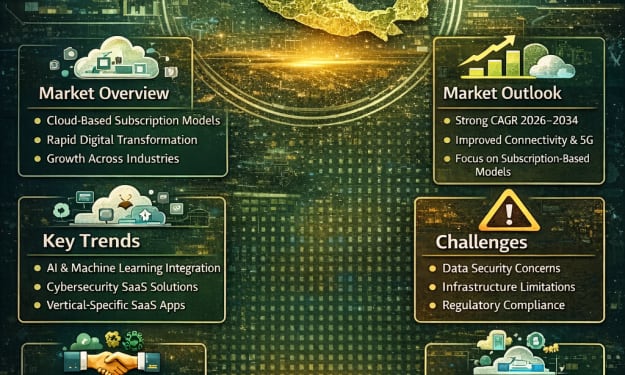
Mexico Software as a Service (SaaS) Market Overview The Mexico Software as a Service (SaaS) Market is experiencing significant expansion as businesses increasingly shift from traditional on-premises software to cloud-based subscription models. SaaS solutions provide organizations with scalable, flexible, and cost-effective software access without the need for heavy infrastructure investments.
By Jackson Watson5 days ago in Trader



Comments
There are no comments for this story
Be the first to respond and start the conversation.