
Creating Your Own Mutual Fund
Lesson Three: Investments by Devlin Bronte Rachele


Okay, so far we have learn that panic kills in the market and the key to not panicking is to invest responsibly. A major portion of investing responsibly is creating and developing a budget to help you manage and gain confidence in your finances. Another major part of not panicking, clouding your judgment, and making costly mistakes while investing is learning all you can about the various investments and markets. Let’s take a look at Bonds, Stocks, Commodities, and Mutual Funds. I will warn that this is not meant to be an exhausted comprehensive look at these investments. To do that you would require a small library to learn everything there is about each. There are various types of Bonds, Stocks, and Mutual Funds, as well as what is considered a Commodity. Instead this is to give you a basic understanding and general familiarization.
Before we get started I should explain if you are still of unsure of investing think about this. Everything you do is an investment. When you eat right and get enough exercise you are investing in a healthier you in future years. Just as when you don’t you could be investing in problems in the future. Everything you do from the job you chose to your associations, all your experiences or lack of are investments for the future you.
After gaining years of experience and saving up we make the decision to leave the job market and create our own business. Unlike many we do our homework. We go to small business workshops and seminars at local schools. We find out all we can about marketing and develop various viable strategies to identify, reach, and inform potential customers. We have identified excellent locations and potential suppliers. We have sat down and hammered out a very thorough business plan for our new enterprise. We have all of our bases covered except for start up capital. We do have $300,000 of the $500,000 we need to get things up and running smoothly on opening day. Armed with a copy of our business plan which includes well prepared financial projections or Pro Forma Budget, Cash Flow, and Income Statement we head with a well rehearsed presentation to our local bank.
When I was in business school we were taught that 1 out of 5 new businesses will survive the first year of operation. That is a success rate of only 20%. Worse yet is of the businesses which survive the first year only 1 out of 5 will make it through the first five years. Reasons for these failures are many including poor understanding of the market, ineffective advertising, poor supply, bad pricing, poor accounting and other financial controls, poor location, mistakes with and poor inventory control, and not understanding or underestimating the competition but one of the single biggest reason for a business failure is financial problems. Without enough financial resources to start and operate your business you may not have the cash for advertising or to make payroll. You may have to make costly sacrifices such as settle for a less than ideal location to set up shop or have to use lower standards of production and service. However, for the truly able and willing it is an opportunity to push yourself and learn much in the process.
Nothing is more skittish than a bank loan officer with the exception of speculators (in fact, loan officers are speculators) and this is even when you are armed with a wonderfully well thought out business plan where all of the corners are covered. As I had mentioned before the easiest way to obtain a loan from the bank is to demonstrate that you don’t need the money and have proven your ability to pay it back. If you are a well established business you will have it far easier than a new startup in receiving the funds you require. Chances are you will get a loan to help you start your business but it may not be enough to cover your projected needs. For example we only get $50,000 at a higher than anticipate interest rate. You could try to go to other banks and get other loans. However, you find that each successive loan attempt can and will reduce your credit rating creating far less favorable terms for even less money. Not to mention with each loan you acquire you will have another bill to keep track of and pay. But the good news is that this is not the only type of funding that is available to you.
You could gain funding directly from the general public in the form of bonds. Bonds which can come in many forms are essentially a promissory note. There are active markets where people buy and sell bonds. Treasury Bills are bonds. Many businesses and other institutions such as government offices issue bonds to finance both short and long term projects. They also issue new bonds to retire older bonds nearing maturity.
Good thing about a bond is you can set the terms. Another great thing is you set the time the bond comes due. This leads us to another benefit of a bond. If your business is doing great and you would like to extend the loan of the initial bond you can issue a new bond to raise the funds to retire the initial issue. Main concern is you need to sell the bonds in order to get the money to finance what you desire. Failure to sell enough could result in being woefully under funded. Another thing to consider is you will have to offer terms, they are your terms but they must be able to attract lenders if you are to raise the desired capital. Problem is if you are just starting out with no real track record or assets these terms might be dear. In order to attract potential lenders you may have to run your business a certain way to convince the potential bond holders to buy your bonds. Of course this is a loan you will have to repay and this is cash that will be eventually removed from your business. If things aren’t going well then this is money you might desperately need to operate. Failure to pay as with all loans could greatly reduce your ability to raise funds you might need in the future. But again, as with any challenge that comes up this is yet another opportunity to challenge yourself and grow.
Another possibility is to take on a partner or even several. Allowing others to buy into your business can help to raise the funding you need. It could also bring in experience and different points of view which could help you and your business to develop and grow. Having one or several partners will help with the workload. I have read of a partnership where one runs the operation for a month and then the other takes over for a month. They just trade off like this each month. You work for 30 days and then you are off with pay for 30 days. This doesn’t sound so bad. You could even specialize in different aspects of the business giving each the attention and expertise it requires. You will have the ability to share the cost of failures which with the help of your partners you might be able to fix and recover quickly. However, the downside is that you could lose total control of your vision. Along with your failures, mentioned earlier, you will be expected to share in your successes. When choosing future partners trust is a major factor. History is full of individuals who became partners and ran off with the money. Another major consideration in this is if you ever decide to gain total control of your business or get rid of a partner you will have to buy them out and that is I they are willing to sell. This could also lead to other expenses as in having to restructure and establish the business as a new business because of the change of ownership.
Another way of raising money is to incorporate and sell stock. In our example we may want to issue 500,000 shares at $1 each. In your Articles of Incorporation, Articles of Organization, Business Charter, or Business Plan you may want to set a limit of stocks which may be issued and this may be in the millions of shares for future use. However, to maintain the control of your business and your vision for this business you want to keep a strong control on the amount of stocks issued. With 500,000 shares you can purchase 300,000 with your cash while using the remaining shares to raise your $200,000 needed. This leaves you with a 60% of the outstanding or issued and sold shares. This means you have the controlling interest in the company. If you were to slip below 51% of the shares you could lose control of your business.
Some of the great things about stocks include the idea that it is not a debt you must pay back. It is a claim against your company which is treated as ownership. Each share of Common Stock gives the shareholder a vote for board members. Its value per share can grow with the value of your company. Of course if you would like to issue more shares to raise funds to help your company to grow further you need to maintain a demand for your stock. To do this you will have to offer an occasional dividend which is sharing of your profits with the shareholders. You will also want to limit the amount of your stock issued because of diluting the value of your stock. If too many shares are being traded you could lose your control of the company. You will maintain control through being able to out vote anyone else as long as you have at least 51% of the shares.
Another advantage of incorporating is that you can not be legally held liable for the actions of your company. Unless you were personally involved with the infraction you will not be held financially responsible for anything the company has done. In a Sole Proprietorship or Partnership you are considered to be legally the business and can be held responsible for the actions or inactions of the company and your personal assets could be in jeopardy.
If you are in a sole proprietorship or a partnership transfer of ownership can be complicated. For example if you are ready to retire you would essentially have to dissolve and create a new business under the new owner. Things are even more complicated under a partnership. Each time a partner leaves you the business will have to buy them out. Again you might have to create a new business. When you incorporate it is just a matter of selling your shares to give up your claim against the company. Your company still exists it is that it just has a different shareholders. Your company could and several have, lasted for centuries.
Another investment possibility is commodities. Commodities are defined as raw materials which are used in the production of consumable goods. What a society considers and desires as a commodity will depend on that community. For example ice would be of little value to an Inuit who is surrounded by natural ice for miles but ice may be in high demand for a restaurateur in Arizona during the summer months. Some commodities have been in large demand for centuries such as gold (Au), copper (Cu), iron (Fe), and silver (Ag) while others are more subjected to changing styles. This is one of the reasons most developing nations which depend mainly on trade of commodities tend to have political problems. While the commodities are in demand and jobs are plentiful and money is flowing those in power rest easily. But if the commodity loses demand then poverty increases there are problems.
All of these investments, Stocks, Bonds, and Commodities can be great investments but there is a problem. As a small investor you may not have the money to buy the minimum of an investment. When a broker acquires an investment it is usually in what is known as an even lot which was defined to me a long time ago as any amount of stock that ends in ‘00’ such as 100, 500, 1,000 or 10,000 shares. Lots ending in anything but ‘00’ are known as odd lots. As with any inventory a shopkeeper wants to sell the entire lot to make room for newer inventories instead of dealing with bits and pieces. This means just to buy a stock that is $1 a share you would have to invest $100. This could make it hard to take advantage of diversification.
In the following example we will be using a simple statistic formula based on the idea that whether something makes it or not are the same odds giving us a 50/50 probability. There are only two possible outcomes. When you put all your eggs in one basket to send to market you will have a 50% chance that the basket could spill and break all your eggs or it will make it. If you divide them up among two baskets your odds of losing them all has just dropped to 25%. This is because you now have four possible outcomes. These four possible outcomes are both baskets will make it, the first basket will make it and the second won’t, the first will break while the second will make it, or they both will not make it. This gives you a 1 in 4 or 25% chance you will lose everything while at the same time you have a 3 out of 4 or 75% chance you will get a return. Dividing your eggs into three baskets your chance of losing all your eggs has dropped to 12.5%. This is calculated by realizing you have 8 possible outcomes in this scenario. Labeling the baskets A,B, and C to help illustrate the outcomes are either A, B, or C make it alone, or some combination of baskets such as A and B, A and C, or B and C make it or none make it or all make it. As you can see while you have just a 12.5% chance of losing everything you have an 87.5% of getting a return. This, my friends is the idea of diversification. If you put all of your money into one investment you have a higher chance of losing everything than if you had put your money into several different investments.
In the late 17th Century during a financial crisis a broker by the name of Abraham van Ketwich, in Amsterdam the financial hub of the 17th and 18th Centuries, recognized that the desire to sell even lots made this difficult or even impossible for the small investor to enjoy the benefits of diversification. Also, he had found that the recent financial crisis made even large investors highly nervous because at the time you could only buy even lots. He realized that if he could get a bunch of investors, both large and small, to pool their money together they could afford to buy several lots of different investments and reduce risk through diversification. He pooled several investments together and created the fund “Eendragt Maakt Magt” (Unity creates strength) giving birth to the first Mutual Fund.
There are a multitude of Mutual Funds from which to choose. Most specialize in a certain area of the market. Some are centered on a specific industry such as transportation or cannabis growers while others are based on a specific strategy such as growth or income. Others specialize in commodities or certain classes of commodities such as crops or industrial metals and precious minerals. Others invest in financial instruments such as bonds. There are even mutual funds which are composed of mutual funds. There are mixes of any combination. It is this diversification which makes it hard for a fund to go under. I should also mention that very rarely does someone lose everything in the market. Yes, their investment may decrease in value but it is extremely rare that it does go to zero. In a mutual fund while some investments may be down others are up. Many funds have at least twenty different investments. Looking at our egg in a basket model that would mean it is about a 1 in 5,000,000 chance of losing everything. Easy entry into and exit from the fund while creating the safety of diversification has made funds very popular over the years. To get a better idea of how a mutual fund works let’s take a look at how one is created.
A group of investors gets together. They decide to pool their money to take full advantage of being able to diversify at a low individual cost. They form a mutual. Each individual buys the initial shares at $1 a pop. They bring together $500,000 meaning they had sold 500,000 shares. This money is used by the fund management to buy the targeted investments. They will buy and sell investments all day with the intent of earning value for the shareholders. By the end of the first day of trading in the targeted arena we find that all of our investments are worth $520,000. Dividing this value by the number of shares outstanding gives us the Net Asset Value of $1.04. This is what the shares will start at the following day. Let’s say the fund brings in an additional $500,000 which is used to buy more assets. It also created an additional 480,769 shares. At the end of the second day of trading the asset value is now $1,500,000. Dividing this by the now 980,769 outstanding shares gives us a Net Asset Value or NAV of $1.53 a share. (Note: I rounded numbers for simplicity.) On the next day shares will sell for $1.53. Not only are shares created but existing shares can be sold. Usually there is a small charge added to the NAV for shares sold meaning that you might pay a Bid price of $1.55 a share. Sometimes there is a fee to sell as well which is a reduction in your Ask price and in our example this might reduce the NAV per share to $1.50.
Now that you have a basic understanding of a Mutual Fund let’s take the next step and create your own mutual fund in the next lesson.
About the Creator
V. H. Eberle
I have been a student of human nature since I can remember. I hope that you feel free to explore my findings in these short stories and articles. Perhaps you will learn far more about yourself and others.
Keep reading
More stories from V. H. Eberle and writers in Trader and other communities.
Creating Your Own Mutual Fund
In the previous lessons we have learned that Panic Kills. We have learned that the best way not to Panic is to have a good control of your money and knowledge of your financial needs. We learned how important and helpful creating a budget can be. We also have gone over several types of investments. We learned about the benefits of diversification and why a mutual fund is great. Now let’s set up our own mutual fund.
By V. H. Eberle5 years ago in Trader
School Bags Market Size & Forecast 2026–2034
The global School Bags Market is on a steady upward trajectory, projected to grow from USD 25.22 billion in 2025 to USD 41.64 billion by 2034, registering a CAGR of 5.73% between 2026 and 2034. The expansion reflects not only rising global student enrollment but also growing awareness of ergonomics, product innovation, organized retail penetration, and the increasing integration of technology in education.
By shibansh kumar2 days ago in Trader
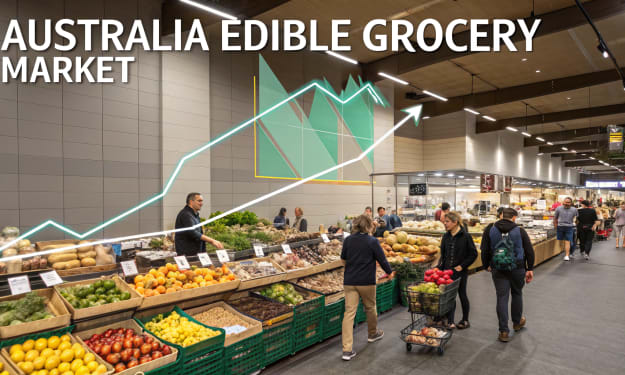
Australia Edible Grocery Market Grows Steadily with Health & E-Commerce Shifts
In 2025, the Australia edible grocery market reached a valuation of USD 9.5 billion. According to IMARC Group, it is expected to grow to USD 12.7 billion by 2034, representing a compound annual growth rate (CAGR) of 3.23% during the 2026–2034 period. This projection reflects enduring demand for a broad range of grocery products — from fresh produce and dairy to packaged foods and frozen ready-to-eat meals — driven by evolving consumer preferences, lifestyle shifts and retail dynamics.
By Rashi Sharma6 days ago in Trader
When the Shelter Closes
Across the street from my house, a man slept under a tree, his dog by his side. My first, naive thought: he must be traveling through. But he kept coming back, often sleeping there during the day. Then it hit me—that person might not have a home.
By Bride of Sound6 days ago in Humans



Comments
There are no comments for this story
Be the first to respond and start the conversation.