
Consumer Electronics Repair and Maintenance Market Size to Reach US$ 31.03 Billion by 2033: Sustainability and Right-to-Repair Fuel Global Growth
The market was valued at US$ 18.62 billion in 2024 and is projected to grow steadily to US$ 31.03 billion by 2033, registering a compound annual growth rate (CAGR) of 5.84% from 2025 to 2033.

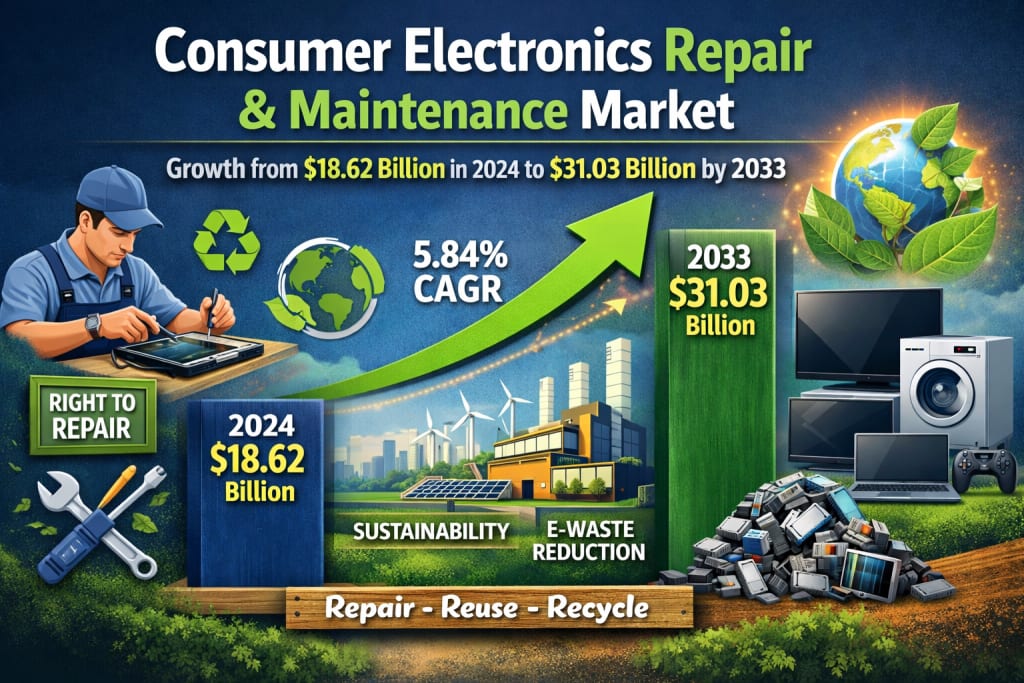
Global Consumer Electronics Repair and Maintenance Market: An Industry on the Rise
The global consumer electronics repair and maintenance market is gaining strong momentum as consumers, businesses, and governments rethink how electronic devices are used, maintained, and disposed of. According to Renub Research, the market was valued at US$ 18.62 billion in 2024 and is projected to grow steadily to US$ 31.03 billion by 2033, registering a compound annual growth rate (CAGR) of 5.84% from 2025 to 2033.
This growth reflects a fundamental shift in consumer behavior and policy direction. Instead of frequently replacing smartphones, laptops, televisions, and home appliances, users are increasingly choosing to repair, maintain, and extend the life of their devices. Rising device prices, environmental awareness, and supportive government regulations are turning repair services into a vital pillar of the global electronics ecosystem.
Consumer electronics repair and maintenance involves inspecting, diagnosing, servicing, and restoring electronic products such as smartphones, laptops, tablets, televisions, audio systems, gaming consoles, and household appliances. Services range from hardware replacement and software troubleshooting to cleaning, refurbishment, and preventive maintenance. The core objective is simple but powerful: keep devices working longer and reduce unnecessary waste.
In a world grappling with resource constraints and mounting electronic waste, this industry plays a critical role in promoting a circular economy, conserving raw materials, and making technology more affordable and accessible across both developed and developing markets.
Why the World Is Repairing More and Replacing Less
1. Rising Electronic Waste and Environmental Awareness
One of the strongest drivers behind the growth of the consumer electronics repair and maintenance market is the global surge in electronic waste (e-waste). In 2022 alone, the world generated 62 million tonnes of e-waste, representing an 82% increase since 2010. This figure is projected to reach 82 million tonnes by 2030. Despite containing valuable materials, including rare earth elements, only a tiny fraction is effectively recycled.
The environmental cost of this waste is enormous. If stacked in 40-tonne trucks, 62 million tonnes of e-waste would fill about 1.55 million trucks, enough to circle the equator. This growing crisis is pushing both consumers and policymakers to look for more sustainable alternatives.
Repair and maintenance services offer a practical solution. By extending the lifespan of devices, they reduce the volume of electronics sent to landfills, lower carbon emissions associated with manufacturing new products, and conserve valuable resources. As environmental awareness rises, sustainability is no longer just a moral choice—it is becoming a mainstream economic decision, directly fueling demand for professional repair services worldwide.
2. Cost-Effectiveness Compared to Device Replacement
The price of consumer electronics—especially smartphones, laptops, and large home appliances—has increased significantly over the years. For many households and small businesses, replacing a faulty device can be a major financial burden.
Repairing a device is often far more affordable than buying a new one, particularly in emerging economies where budget constraints are a daily reality. Even in developed markets, inflation and the rising cost of living are making consumers more cautious about big-ticket purchases. As a result, repair and maintenance have become the smarter financial choice for millions of users.
The availability of relatively low-cost spare parts, refurbished components, and skilled technicians further strengthens this trend. Over time, this shift in mindset—from disposable electronics to long-term ownership—has become a powerful growth engine for the global repair and maintenance market.
3. Government Support and Right-to-Repair Movements
Another major catalyst is the global push for right-to-repair legislation. Governments in regions such as the United States, the European Union, and India are introducing or proposing laws that require manufacturers to provide access to spare parts, diagnostic tools, and repair manuals.
In March 2023, the European Commission proposed a Right to Repair Directive covering products such as household appliances, televisions, welding equipment, vacuum cleaners, servers, data storage products, and mobile phones. The goal is to encourage repair and reuse while reducing unnecessary replacements.
In the United States, New York became the first state to pass a digital right-to-repair law in December 2022, known as the Digital Fair Repair Act, which came into effect in July 2023. These policies are reshaping the market by lowering entry barriers for independent repair shops, boosting consumer confidence, and promoting more responsible consumption.
Together, these regulatory changes are transforming repair from a niche service into a mainstream, policy-backed industry.
Key Challenges Facing the Repair and Maintenance Industry
Limited Access to Spare Parts and Technical Information
Despite positive policy trends, many manufacturers still control access to proprietary components and technical documentation. This makes it difficult for independent repair shops to source parts or perform complex repairs, often leading to higher costs and longer service times for customers.
In regions where right-to-repair laws are weak or poorly enforced, this problem is even more severe. Limited access reduces competition, frustrates consumers, and can slow the overall growth of the repair ecosystem.
Rapid Technological Change and Product Complexity
Modern consumer electronics are becoming smaller, smarter, and more complex. Devices now include AI chips, advanced sensors, IoT connectivity, and sealed components that are difficult to open or replace. While these innovations improve performance, they also make repairs more technically demanding and expensive.
Repair technicians must constantly update their skills and invest in new tools, increasing operational costs. In some cases, the complexity of repairs can push consumers back toward replacement instead of repair, posing a structural challenge for the industry.
Segment Insights: Where the Growth Is Coming From
Home Appliances Repair and Maintenance
Large home appliances such as refrigerators, washing machines, air conditioners, and microwaves form a major part of the repair and maintenance market. As the cost of these appliances continues to rise, households are increasingly choosing to repair rather than replace.
Warranty expirations, frequent usage, and the push for energy efficiency are all boosting demand for skilled appliance technicians. Maintenance contracts and service plans are also becoming more popular, ensuring long-term performance and reliability.
Authorized Service Centers
Authorized service centers remain the preferred choice for many consumers, especially for premium or complex devices. These centers offer manufacturer-approved repairs, genuine spare parts, and trained professionals, often with warranty support.
Their reputation for quality and compliance helps build brand loyalty and trust. As more electronics manufacturers expand their global service networks, authorized service centers continue to strengthen their position within the overall market.
Residential Repair and Maintenance
The residential segment accounts for a significant share of the market, driven by the widespread use of smartphones, laptops, televisions, and kitchen appliances in everyday life. With remote work, online education, and smart home adoption on the rise, keeping home electronics functional has become more critical than ever.
Rising living costs are also encouraging households to choose repair over replacement, further supporting steady growth in this segment.
Commercial Repair and Maintenance
In the commercial sector, businesses, schools, hospitals, and retail operations rely heavily on electronics such as monitors, printers, projectors, and communication systems. Downtime can be costly, making regular maintenance and quick repairs essential.
Many organizations now sign annual maintenance contracts with service providers to ensure operational continuity. As digital transformation spreads across industries, commercial demand for repair and maintenance services continues to expand.
Regional Outlook: A Global Shift Toward Repair
United States
The U.S. is one of the most influential markets, driven by high device penetration, rising consumer awareness, and strong momentum behind right-to-repair laws. The increasing cost of premium electronics is encouraging Americans to repair rather than replace, while environmental concerns are reshaping consumption habits.
With a well-established network of both authorized and independent repair shops, the U.S. market is well positioned for sustained growth.
France
France stands out for its repairability index, which scores products based on how easy they are to repair. This policy directly influences consumer buying decisions and pushes manufacturers to design more repair-friendly devices.
Government support for local repair shops and training programs has helped build a strong repair culture. Combined with rising living costs and environmental awareness, these factors are driving steady growth in France’s repair and maintenance market.
India
India is one of the fastest-growing markets in this sector. Rapid smartphone and electronics adoption, a large middle class, and strong price sensitivity make repair services extremely popular across both urban and rural areas.
In August 2024, the Indian government introduced a repairability index for mobile devices and electronics to help consumers make informed choices and reduce e-waste. With a vast network of skilled technicians and affordable service options, India’s repair ecosystem is set for long-term expansion.
Saudi Arabia
Saudi Arabia’s Vision 2030 initiative is driving widespread digital transformation. As electronics usage increases across homes and businesses, so does the demand for repair and maintenance services.
Harsh climatic conditions also contribute to faster wear and tear of devices, increasing the need for regular servicing. Growing environmental awareness and a rising middle class are further supporting market growth in the Kingdom.
Market Segmentation Overview
By Product:
Home Appliances
Personal Devices
Entertainment Devices
By Service Provider:
Authorized Service Centers
Independent Repair Shops
By End User:
Residential
Commercial
By Region:
North America (United States, Canada)
Europe (France, Germany, Italy, Spain, United Kingdom, Belgium, Netherlands, Turkey)
Asia Pacific (China, Japan, India, South Korea, Thailand, Malaysia, Indonesia, Australia, New Zealand)
Latin America (Brazil, Mexico, Argentina)
Middle East & Africa (Saudi Arabia, UAE, South Africa)
Competitive Landscape
The market features a mix of global service providers, specialized parts distributors, and large retail service networks. Key players include:
The Cableshoppe
Redington Services
Electronix Services
B2X Care Solutions
Encompass Parts
uBreakiFix
Asurion, LLC
Best Buy Co. Inc.
All companies are analyzed across four viewpoints: Overview, Key Persons, Recent Developments & Strategies, and Revenue Analysis, offering a comprehensive picture of the competitive environment.
Final Thoughts: Repair as the Future of Consumer Electronics
The global consumer electronics repair and maintenance market is no longer just a support industry—it is becoming a core pillar of the modern digital economy. With the market expected to grow from US$ 18.62 billion in 2024 to US$ 31.03 billion by 2033, the message is clear: the world is moving toward longer device lifecycles, smarter consumption, and more sustainable technology use.
Driven by environmental concerns, economic realities, and supportive government policies, repair and maintenance services are redefining how consumers and businesses think about electronics. As right-to-repair movements gain strength and sustainability becomes a priority, the repair industry is set to play an even more critical role in shaping the future of global consumer electronics.
About the Creator
Sakshi Sharma
Content Writer with 7+ years of experience crafting SEO-driven blogs, web copy & research reports. Skilled in creating engaging, audience-focused content across diverse industries.
Keep reading
More stories from Sakshi Sharma and writers in Trader and other communities.
Image-guided Therapy Systems Market Trends & Summary (2025–2033)
Introduction: The Rise of Precision-Guided Medicine Modern medicine is undergoing a quiet but powerful transformation. Surgeons and interventional specialists today are no longer guided only by experience and anatomical knowledge—they are increasingly supported by real-time, high-resolution imaging systems that show exactly where to operate, how to navigate complex anatomy, and how to minimize risk to patients. This shift has placed image-guided therapy (IGT) systems at the center of the next wave of medical innovation.
By Sakshi Sharmaa day ago in Trader
Strong jobs data and an AI sell-off shake investor confidence, sending the stock market plunging.
Investors responded to stronger-than-expected employment data and renewed concerns regarding investments in technology and artificial intelligence during the February 11–12 trading sessions, resulting in increased volatility on the global and U.S. stock markets. As traders rethought their expectations for Federal Reserve interest rate cuts, early optimism fueled by economic resilience quickly waned, resulting in mixed market performance and broader declines, particularly in technology shares.
By Raviha Imran6 days ago in Trader




Comments
There are no comments for this story
Be the first to respond and start the conversation.