
Comprehensive Overview of Cryptocurrency Market Conditions in Recent Days
In recent days, cryptocurrency markets have experienced notable volatility, with price fluctuations reflecting investor uncertainty amid rising institutional demand and evolving regulatory frameworks. Bitcoin and Ethereum have been the primary market drivers, while altcoins have shown varied performance levels, indicating a significant shift in investor sentiment and strategies for the short and medium term.
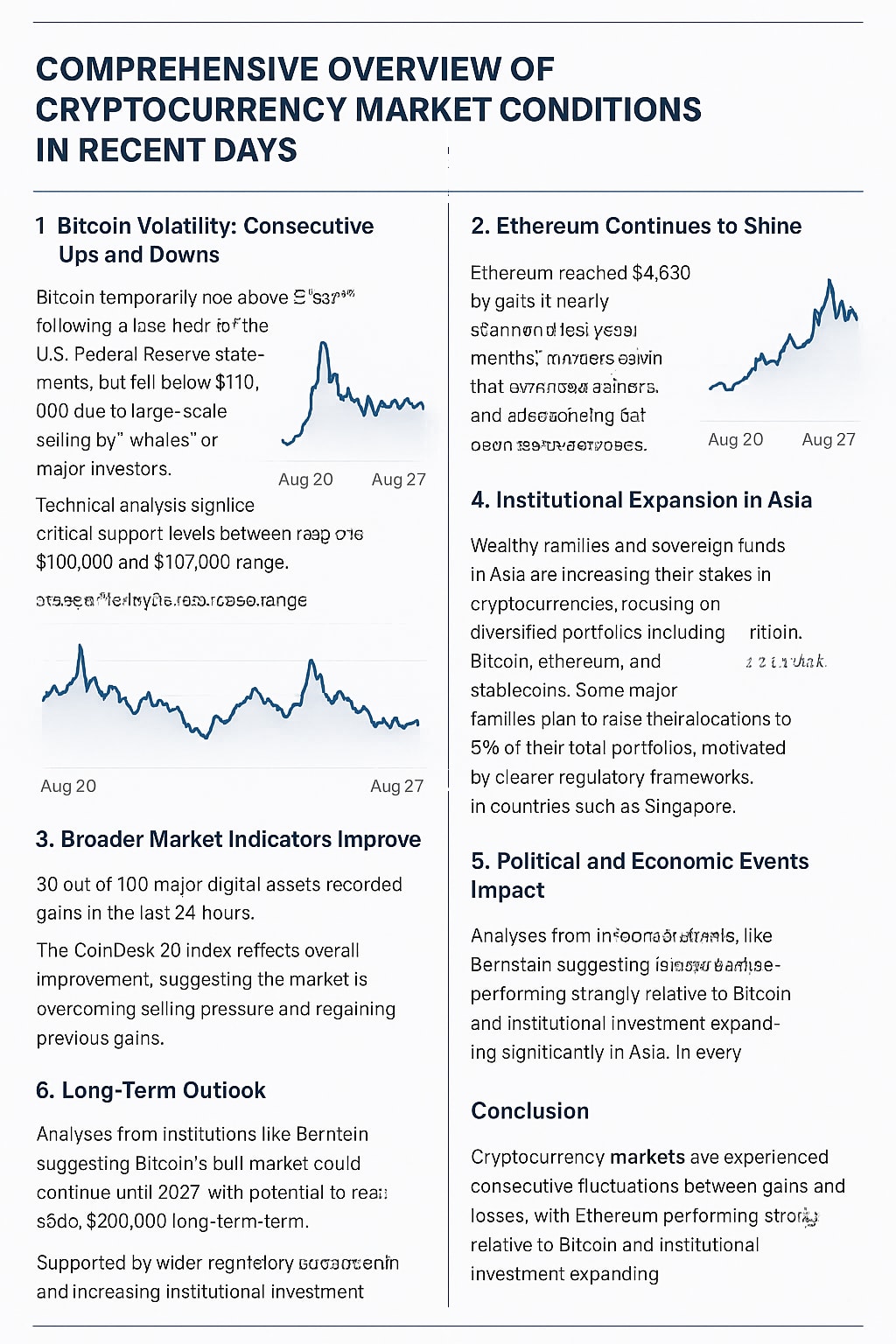
In recent days, cryptocurrency markets have experienced notable volatility, with price fluctuations reflecting investor uncertainty amid rising institutional demand and evolving regulatory frameworks. Bitcoin and Ethereum have been the primary market drivers, while altcoins have shown varied performance levels, indicating a significant shift in investor sentiment and strategies for the short and medium term.
1. Bitcoin Volatility: Consecutive Ups and Downs
Over the past week, Bitcoin, the leading digital currency, has experienced significant price swings, temporarily rising above $117,000 following statements from the U.S. Federal Reserve hinting at potential interest rate adjustments, which boosted investor appetite for digital assets. However, the price soon fell below $110,000 due to large-scale selling by “whales,” or major investors, impacting market balance (Investopedia).
Technical analysis indicates that Bitcoin faces critical support levels between $100,000 and $107,000, while resistance lies in the $117,000–$123,000 range. This range reflects ongoing uncertainty, with experts warning of a potential “bull trap,” which could cause further sharp fluctuations before the price establishes a clear future direction.
2. Ethereum Continues to Shine
In contrast to Bitcoin, Ethereum has posted remarkable gains, reaching nearly $4,630, driven by increased institutional demand and adoption of decentralized finance strategies. Ethereum has risen approximately 75% over the past three months, outperforming Bitcoin in quarterly and annual performance (MarketWatch).
This performance is supported by major investors such as Peter Thiel, who believe that practical applications of tokenization and decentralized technology will become integral to the traditional financial system, boosting long-term confidence in Ethereum’s growth.
3. Broader Market Indicators Improve
Despite Bitcoin’s brief decline, broader cryptocurrency data shows notable recovery, with 90 out of 100 major digital assets recording gains in the last 24 hours (CryptoRank). The CoinDesk 20 index also reflects overall improvement, suggesting that the market is overcoming selling pressure and regaining previous gains (CoinDesk).
4. Institutional Expansion in Asia
Wealthy families and sovereign funds in Asia have begun increasing their stakes in cryptocurrencies, focusing on diversified portfolios including Bitcoin, Ethereum, and stablecoins. Some major families plan to raise their allocations to 5% of their total portfolios, motivated by clearer regulatory frameworks in countries such as Singapore and China (Reuters).
5. Political and Economic Events Impact
The market has also reacted to political and economic developments, such as the partnership between Trump Media Group and Crypto.com, valued at $6.42 billion, which caused related cryptocurrencies like Cronos to surge 20–40% within hours (Investors.com).
Additionally, ETFs managed by major institutions such as BlackRock have shown notable fluctuations in digital reserves, affecting supply on platforms like Coinbase and Binance, creating short-term price pressures (CoinTelegraph).
6. Long-Term Outlook
Analyses from institutions like Bernstein suggest that Bitcoin’s bull market could continue until 2027, with potential to reach $200,000 long-term, supported by wider regulatory adoption and increasing institutional investment (MarketWatch). However, other experts caution against relying solely on long-term projections, noting that the market remains sensitive to sudden economic or political changes, with an expected price ceiling between $140,000 and $150,000 by the end of 2025.
Conclusion
In recent days, cryptocurrency markets have experienced consecutive fluctuations between gains and losses, with Ethereum performing strongly relative to Bitcoin and institutional investment expanding significantly in Asia. These movements reflect a delicate balance between risks and opportunities, demonstrating the market’s resilience despite selling pressures and highlighting the role of positive regulations in bolstering investor confidence.
Going forward, digital markets are expected to continue dynamically responding to economic and political events, with Bitcoin and Ethereum remaining the primary focus. Investors are closely monitoring regulatory developments and institutional activity to gauge the market’s long-term direction.
About the Creator
Halal Cosmetics Market Size & Forecast 2026–2033
The global beauty industry is undergoing a remarkable transformation as consumers increasingly demand ethical, safe, and transparent personal care products. One segment experiencing significant growth is the Halal Cosmetics Market, which has gained global attention due to its emphasis on purity, ethical sourcing, and adherence to Islamic principles.
By shibansh kumar3 days ago in Trader
A Transparent Look at Vocal Challenges and Top Stories
Almost three years ago, we shared a resource article that served as a place for people to suggest new challenge prompts. We thought it would be a good idea to refresh that thread, and take the opportunity to answer a few common questions about top stories, how challenges are judged and how submissions are reviewed.
By Vocal Curation Team3 days ago in Resources




Comments
There are no comments for this story
Be the first to respond and start the conversation.