
Common Mistakes New Investors Make (and How to Avoid Them)
Investing can be one of the most powerful tools for building long-term wealth, but for beginners, it's also a minefield of emotional decisions, misinformation, and poorly-thought out errors.


If You Don't Know Who You Are, The Market Is A Very Expensive Place To Find Out
If you're new to the world of stocks, ETFs, or crypto, knowing what not to do can be just as valuable as knowing what to do.
In this blog post, we’ll break down common mistakes new investors make, why they happen, and how to avoid falling into these traps.
Chasing Hot Stocks or Trends
Many beginner investors get caught up in hype, whether it’s a tech IPO, meme stock, or the latest cryptocurrency. But by the time a stock becomes the talk of the internet, much of the upside may already be priced in.
Focus on long-term value, not short-term hype. Ask yourself: would I still want this investment if it wasn’t trending?
Trying to Time the Market
Timing the market, as in buying low and selling high, sounds great in theory. In practice, even professionals rarely get it right consistently. New investors often panic sell during dips and buy too late during rallies.
Use a long-term investment strategy like dollar-cost averaging to smooth out volatility and avoid emotional decisions.
Ignoring Diversification
Putting all your money into one or two stocks can set you up for major risk. Many beginners treat investing like gambling, going “all in” on a single idea.
Diversify across asset classes, sectors, and geographies. ETFs are a great place to start for beginners seeking broad exposure.
Lack of a Clear Investment Goal
Investing without a goal is like getting in a car without knowing where you’re going. Are you saving for retirement, a home, or just building wealth? Without a clear objective, it’s easy to panic or make impulsive decisions.
Define your time horizon, risk tolerance, and financial goals before making any investment.
Overtrading and High Turnover
New investors often make the mistake of trading too frequently, thinking more action equals more profit. In reality, overtrading leads to higher fees, taxes, and emotional burnout.
Think like Warren Buffett: buy quality investments and hold them. Long-term investing wins over the short-term noise.
Neglecting Fees and Expenses
You might think a 1% annual fee is no big deal, but when designing a portfolio over decades, it can eat into tens of thousands of dollars of your returns. Many beginners overlook expense ratios, trading fees, or platform costs.
Use low-cost index funds and commission-free brokerages. Always check fees before you invest.
Not Doing Enough Research
Jumping into an investment based on a social media video isn’t a strategy. It's gambling. Many beginners fail to understand what they’re buying.
Before investing in any asset, understand what it is, how it works, and why you believe in it. Read earnings reports, understand market trends, and educate yourself.
Letting Emotions Drive Decisions
Fear and greed are two of the most powerful forces in investing. They often lead beginners astray. Panic selling during a dip or FOMO buying during a surge are common emotional reactions.
Develop a written investment plan and stick to it, especially during market volatility. Take emotion out of the equation as much as possible.
Ignoring the Power of Compounding
New investors often underestimate how powerful compounding can be. Instead of focusing on long-term growth, they chase quick returns and forget that small, steady gains snowball over time.
Start early, invest regularly, and stay consistent. Even modest investments grow significantly over decades thanks to compounding.
Final Thoughts
Investing is a journey, and every expert was once a beginner. The key is not to avoid every mistake, says Gregory Blotnick, but to learn from them early and build strong habits that will serve you for life.
About the Creator
Keep reading
More stories from Gregory Blotnick and writers in Trader and other communities.
What Is Factor Investing? How Today's Investors Construct Their Portfolios
Investing With Style Let’s talk about investing with a bit more finesse. You’ve probably heard of dumping your money into an S&P 500 fund and calling it a day. It’s simple, it’s solid, and it works for a lot of people. But what if there’s a way to tweak that approach—still keeping things straightforward but aiming for a bit more juice out of your investments? That’s where factor investing comes in, and it’s got my attention as a way to play the market a little smarter.
By Gregory Blotnick6 months ago in Trader
United States Pre-Engineered Building Market Size and Forecast 2025–2033
United States Pre-Engineered Building Market at a Glance The United States Pre-Engineered Building (PEB) Market is projected to expand from US$ 3.6 billion in 2024 to US$ 7.95 billion by 2033, registering a compound annual growth rate (CAGR) of 9.22% during 2025–2033. This growth reflects a structural shift in how America builds—away from time-intensive, labor-heavy methods and toward factory-fabricated, digitally designed, and rapidly assembled structures that offer efficiency, sustainability, and cost control.
By jaiklin Fanandish5 days ago in Trader
South Korea Used Car Market Outlook 2026–2034 | Growth, Trends & Forecast
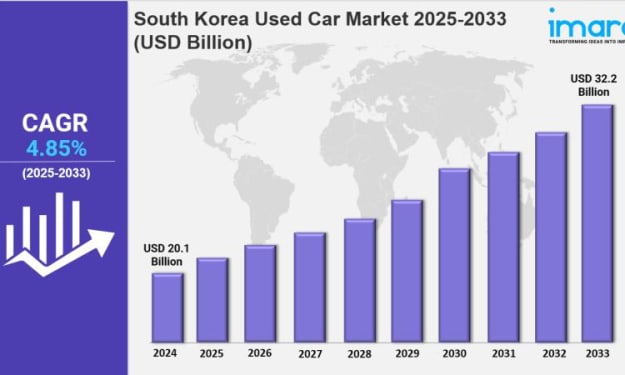
South Korea Used Car Market Overview South Korea used car market size reached USD 20.1 Billion in 2024. Looking forward, IMARC Group expects the market to reach USD 32.2 Billion by 2033, exhibiting a growth rate (CAGR) of 4.85% during 2025-2033. The increasing changes in consumer preferences, such as a growing interest in SUVs or electric vehicles, which can impact the demand for specific used car models, are driving the market.
By Kim Soo hyun7 days ago in Trader



Comments
There are no comments for this story
Be the first to respond and start the conversation.