

Call Option:
A call option is a financial derivative that gives the holder the right, but not the obligation, to buy an underlying asset at a specific price (strike price) on or before a specific date (expiration date).
Example:
For example, let's say you are interested in purchasing a new car, but you are worried that the price of the car may increase before you are able to buy it. To protect yourself against this risk, you decide to purchase a call option on the car.

The option has a strike price of 200,000 and an expiration date of 6 months from now. This means that if the price of the car increases above 200,000 within the next 6 months, you have the right to buy the car at 200,000.
If the price of the car does increase above 200,000, you can exercise your option and buy the car at 200,000, even though the market price may be higher. This allows you to lock in a lower price and protect yourself from potential losses.
If the price of the car does not increase above 200,000, then the option will expire and you will not exercise it. The premium you paid for the option will be lost.
Example in the Stock Market trading:
Buying a call option for 5.00 (premium or advance paid) of XYZ company in the F&O Market, with the strike price 100 and with 7 days expiry. If the stock price goes up anytime within a week above 105.00 (strike price and premium paid 100.00+5.00), the option buyer sells and make profit. If it is less than 100.00, even goes down to half of the strike price, the buyer looses the premium 5.00 which he has paid (with the maximum loss of premium or advance).
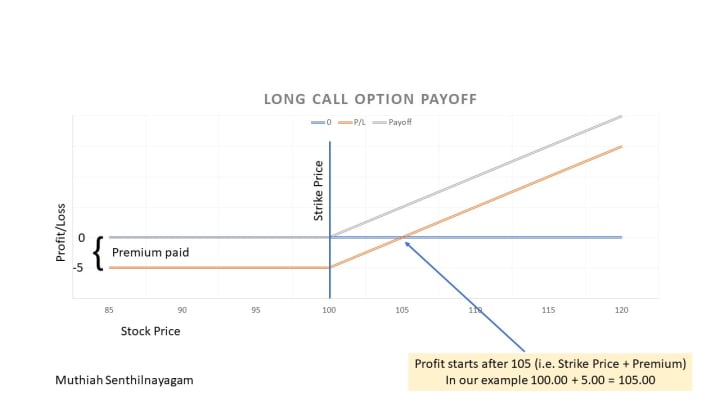
So we can conclude that if you think the stock will go above 105.00, you have to buy call option.
Put Option:
If the car company enters into contract with the customer for selling, which is called Put Option. It is explained just below.
On the other hand, A put option is a financial derivative that gives the holder the right, but not the obligation, to sell an underlying asset at a specific price (strike price) on or before a specific date (expiration date).
Example:
For example, let's say you own a car and you are worried that the price of used cars may decrease before you are able to sell it. To protect yourself against this risk, you decide to purchase a put option on your car.
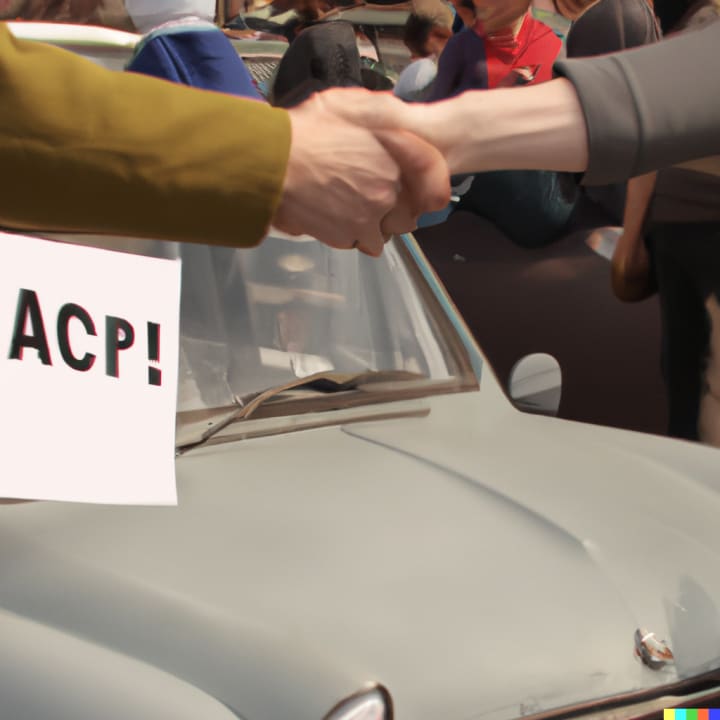
The option has a strike price of 50,000 and an expiration date of 12 months from now. This means that if the price of used cars drops below 50,000 within the next 12 months, you have the right to sell your car at 50,000.
If the price of used cars does drop below 50,000, you can exercise your option and sell your car at 50,000, even though the market price may be lower. This allows you to lock in a profit and protect yourself from potential losses.
If the price of used cars does not drop below 50,000, then the option will expire and you will not exercise it. The premium you paid for the option will be lost.
Example in the Stock Market trading:
Buying a put option for 5.00 (premium or advance paid) of ABC company in the F&O Market, with the strike price 100 and with 7 days expiry. If the stock price goes anytime within a week below 95.00 (strike price and premium paid 100.00-5.00), the option buyer sells and make profit. If it is more than 100.00, even goes to twice/thrice the strike price, the buyer looses the premium 5.00 which he has paid (with the maximum loss of premium or advance).
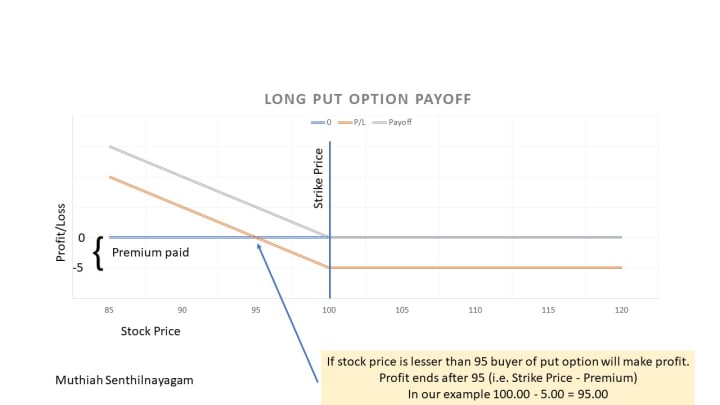
So we can conclude that if you think the stock will go below 95.00, you have to buy put option.
*Long denotes buying the option initially.
About the Creator
Muthiah Senthilnayagam
Teaching in Happy Valley Business School, Coimbatore, Tamil Nadu
Keep reading
More stories from writers in Trader and other communities.
XVG.SI Down 15% Pre-Market 28 Feb 2026: Aedge Group Risks to Watch
Aedge Group shares, trading under the ticker XVG.SI on the Singapore Exchange, came under sharp pressure in pre-market trading on February 28, 2026, with the stock indicated down roughly 15%. Such a steep pre-open move immediately shifts market focus from growth potential to risk assessment, as investors reassess exposure amid heightened uncertainty.
By Hammad Nawaz6 days ago in Trader
Crude Oil Price Today: Global Trends, Market Drivers, and Investment Insights
Understanding Crude Oil Price Crude oil is one of the world’s most traded commodities, and its price is a key indicator for global economic trends. It affects industries ranging from energy and manufacturing to transport and consumer goods. Even small fluctuations in crude oil price can ripple through markets, influencing corporate earnings, inflation, and investor sentiment.
By Hammad Nawaz3 days ago in Trader
me, me, me
when i read back my poetry it screams “me, me, me” on my screen in bold letters and i can’t shut it up — most days, i cannot make any other words out; i want to throttle a thousand versions of the me gone by, i want to throw myself from a figurative balcony, i want to sink a sword into every pen i’ve held
By angela hepworth8 days ago in Poets
Review of 'Man on the Run'
My wife and I saw Man on the Run, a nearly 2-hour documentary on Amazon Prime, about Wings, Paul McCartney's group that flew around the world from shortly after The Beatles broke up in early 1970 to shortly after John Lennon was murdered at the end of 1980, making a Beatles reunion forever impossible.
By Paul Levinson5 days ago in Beat



Comments
There are no comments for this story
Be the first to respond and start the conversation.