
Bitcoin’s $600 Billion Shock: When Even Wall Street’s Best Laid Plans Fail
From Sky-High Hopes to a $600 Billion Reality Check: Bitcoin’s Fall That Shook Wall Street

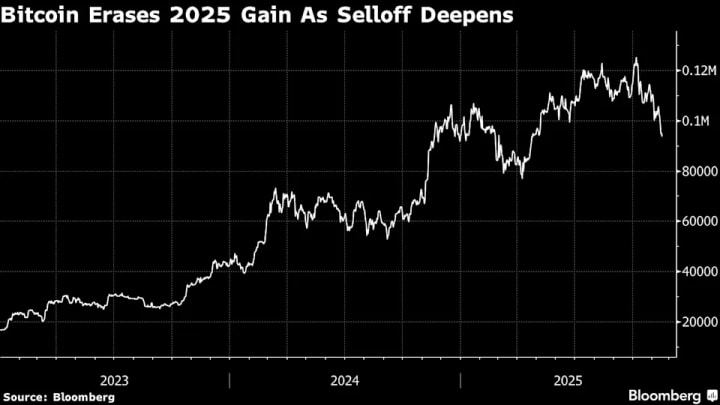
Bitcoin began 2025 with immense momentum, thanks to institutional acceptance on Wall Street, political acceptance at the White House, growing inflows into ETFs, and a worldwide narrative proclaimed across mainstream media circles that defined it as a maturing macro asset class. Nevertheless, this is one scenario where, despite this unique confluence of factors, the largest cryptocurrency by market value saw one of its steepest reversals to date, with a plunge of approximately $600 billion since peaking at $126,000 in October.
As a resource dubbed “digital gold,” this sharp correction is particularly surprising. While volatility has long been part of Bitcoin’s DNA, this correction is noteworthy because it is fast, unexpected, and appears to have no spark to ignite such sentiment at a time when market sentiment is supposed to be very positive.
A Market That Had Everything—Except a Rally
The involvement of institutions within Bitcoin has never been more active. The creation of exchange-traded funds has ensured that cryptocurrencies are mainstream assets, which has altered how financial advisors, pension funds, and asset managers view this asset class. Simultaneously, being pro-crypto has ensured that political support is given to this sector, which is what this industry has been seeking
Despite this, none of these factors were sufficient to maintain Bitcoin’s rally.
Price stabilization did occur by mid-November, but only after wiping out any gains accrued in 2025 after settling at approximately $94,000. The unexpected sharp correction left traders scrambling to make sense out of it while finding little solace within market models that pertain to conventional finance. Bitcoin remains to this day uncorrelated with any other asset class, including stocks, bonds, commodities, and foreign exchange.
The Halving Cycle: A Well-Known Story That Could Already Be Obsolete
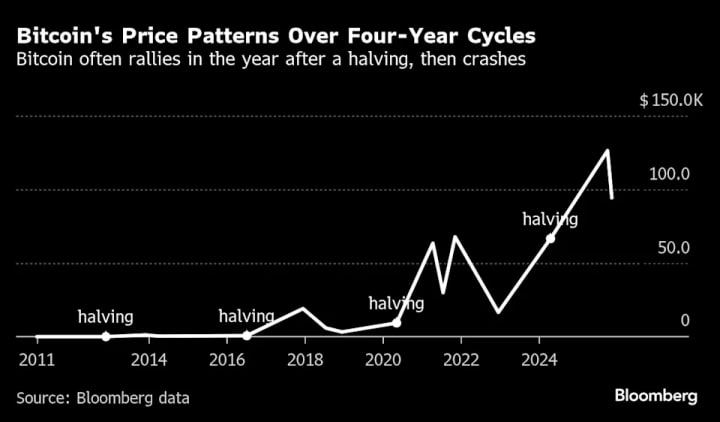
Lacking a more sophisticated alternative, many investors have fallen back on Bitcoin’s traditional four-year halving cycle, which is a model based on the reduced rate of supply growth that takes place approximately every four years. Typically, halving periods occur ahead of a speculative bubble and subsequent sharp correction.
The halving cycle of 2024 and subsequently the price peak of 2025 tend to follow historical trends. However, this cycle sees institutional buyers with deeper pockets involved more than retail traders, leaving one to wonder: Is the old cycle becoming less relevant?
As stated by Matthew Hougan, CIO at Bitsize Asset Management, investor sentiment is weak enough that he is already witnessing some retail investor withdrawals in anticipation of avoiding another halving cycle drawdown like those experienced previously of around 50%. This sets up a self-fulfilling prophecy scenario, which could actually result in a halving crash due due to the very anticipation of one
Leverage, Liquidations, & The Fragile Market Structure
A part of this decline can also be attributed to market excesses generated during the rally phase. The retail market sentiment has been significantly exposed to crypto-linked equities and leverage at the peak points. However, an unexpected outbreak of trade tensions saw forced liquidations triggered at points when leverage stood at multi-year peaks.
The market therein was filled with hopes but lacking convictions—virtually too weak to withstand an overnight change of sentiment.
Where Did the Institutional Bids Go?
The story about Bitcoin being a macro hedge continued to gain momentum throughout the year. ETFs saw billions of dollars flow into them, and big corporations also increased their long-term stakes. However, with the rally having petered out, these inflows ceased. Some long-term investors tapered off their holdings. Further, share prices of many publicly traded “bitcoin proxies,” whose shares were trading at multiples below what their net value based solely on Bitcoin would justify, tend to indicate that the speculative element is reduced.
This makes the assumption that institutionalization is enough to keep Bitcoin on an uptrend questionable.
Bitcoin Acts More Like a Macroe Asset—Both Better and Worse
As noted by Nansen’s Jake Kennis, Bitcoin is increasingly acting like a macro asset, which is affected by liquidity dynamics, monetary policy, and the state of the US dollar rather than being affected by its fixed supply schedule. This is to say that market conditions affect Bitcoin due to its integration into mainstream finance.
Unfortunately, this is not an environment that is friendly to crypto traders. This is because altcoins are down by a considerable margin this year. The market sentiment has reduced interest in speculative assets. Moreover, Bitcoin is faced with stiff competition from other speculative opportunities like those that involve artificial intelligence tokens.
A Hard Reality Check for Bitcoin Bulls
For most, this period appears to represent a betrayal of what they thought they knew about market expectations. Analyst estimates saw Bitcoin reaching $200,000 by year-end targets that increasingly appear to be no more than a pipe dreams. The proximity of gold and equities to new peaks indicates that Bitcoin signifies a source of danger embodied within this tip of a speculative iceberg that is currently melting.
Mike McGlone, a market analyst at Bloomberg Intelligence, is predicting more losses to come in Bitcoin and other alternative cryptocurrencies.
However, not all analysts share this negative outlook. Derek Lim, a Caladan markets analyst, believes that previous bull runs, including those seen in 2017 and 2021, were fueled not only by halving but also by an increase in global liquidity. Now that the U.S. Gov't shutdown is resolved, he expects a liquidity boost to spark interest.
Is the Cycle Broken—or Are Traders Forcing It Into Place?
Market players currently fear a cyclical occurrence, which ironically could very well make it happen. As Eric Balchunas, a Bloomberg Intelligence expert, explains, “Traders’ nervousness about the four-year cycle is what makes the four-year cycle happen.” Yet he is also willing to admit that institutionalization could change this cyclical pattern forever.
The one thing that is certain is that a shift is taking place within Bitcoin. As it is increasingly incorporated into mainstream financial systems, it is less retail-driven and more macro-sensitive, with all concomitant attributes that attend this sort of status.
The Road Ahead: Cautious Optimism Amid Structural Evolution
Yet, despite this volatility, Bitcoin is still much higher than it was prior to Trump’s win, and the infrastructure, whether plumbing functions or regulations, is stronger than it has ever been. The correction that long-term holders are currently witnessing could very well mark a progression toward mainstream acceptance. The big question is, however, if Bitcoin could not break out with political support, institutional investor support, and an attractive market structure, what will it take? The next months will put more than just the strength of Bitcoin’s price to the test, but also the sustainability of the storyline that has driven it up for more than a decade.
About the Creator
Adriana Kostov and the Changing Face of Financial Leadership
The financial industry is one of the most dynamic and challenging sectors in the global economy. With constant shifts in markets, technology, regulation, and investor expectations, leadership in finance demands not only technical expertise but also adaptability, strategic vision, and ethical responsibility. Professionals who can balance these demands are increasingly rare. Among them, Adriana Kostov has emerged as a notable figure, exemplifying the qualities required for modern financial leadership.
By Financial Services Media5 days ago in Trader




Comments
There are no comments for this story
Be the first to respond and start the conversation.