
Australia’s Renewable Energy Market: Grid Transformation, REZs and Rapid Capacity Build
How solar, wind, storage and clearer policy are driving a fast-scaling renewable industry and new investment opportunities

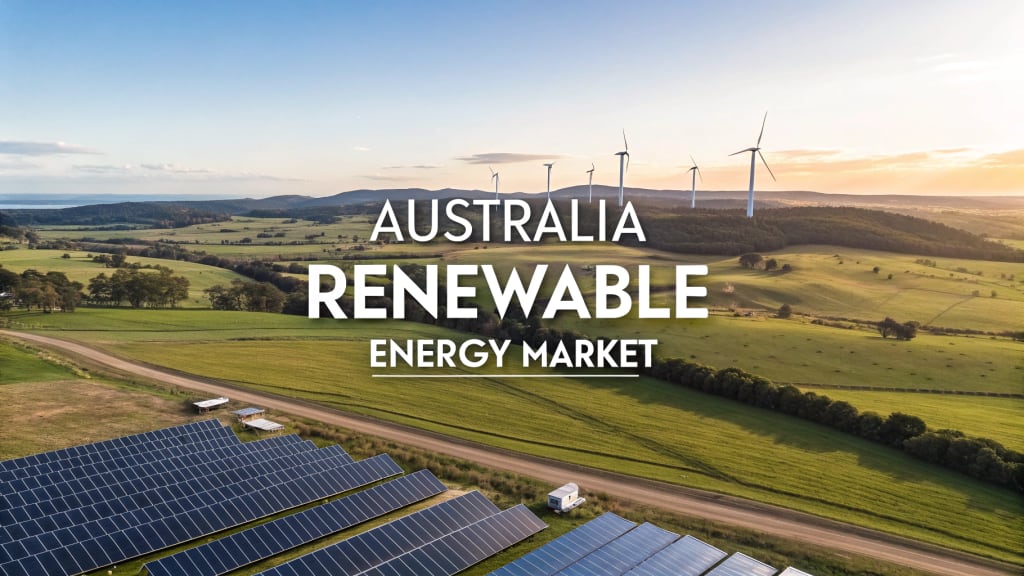
Market Overview
Australia’s renewable energy market is scaling fast and attracting big capital flows. IMARC Group reports the Australia renewable energy market reached USD 165.8 billion in 2024 and is projected to climb to USD 687.9 billion by 2033, reflecting a strong CAGR of 16.6% between 2025 and 2033. Those headline numbers capture both the massive deployment already underway and the anticipated investment across generation, storage, transmission and enabling infrastructure.
Why the surge is happening
Several structural forces are converging to power the growth: falling technology costs (especially for solar and wind), widespread household rooftop PV adoption, rapidly improving battery economics, and clearer policy frameworks that reduce investor uncertainty. In 2024 renewable generation supplied roughly 40% of Australia’s electricity, underscoring how quickly the supply mix is shifting.
Corporate demand is another major tailwind: large energy buyers are signing long-term power purchase agreements (PPAs), providing predictable revenue for new projects and unlocking finance. At the same time, state and federal planning initiatives (notably Renewable Energy Zones, or REZs) are helping cluster projects, lower grid connection costs and speed up transmission builds — all essential to integrating large amounts of variable renewables.
Market structure: what’s in scope
The segmentation highlights a market made up of multiple, complementary components:
• Generation: utility solar and wind dominate capacity additions; hydro and bioenergy remain important for balancing.
• Storage & Grid Services: large-scale batteries and pumped hydro add flexibility and firming capacity.
• Distributed Energy: rooftop solar, behind-the-meter storage and virtual power plants expand household and business participation.
• Enabling infrastructure: transmission upgrades, REZ build-outs and grid-stability equipment (e.g., synchronous condensers) are critical to scale.
Request a Sample Report with the Latest 2025 Data & Forecasts
What the opportunities are
For investors and companies, the opportunity set is broad:
1. Project development & PPAs: With corporates and utilities signing offtake agreements, developers with shovel-ready sites and strong grid access can lock in long-dated revenue streams.
2. Storage & system integration: Battery manufacturers, integrators and firms offering grid-firming solutions will benefit from the need to manage intermittency and deliver dispatchable capacity.
3. Transmission & REZ services: Engineering, procurement and construction (EPC) firms tied to REZ transmission builds, switchyards and interconnection works can capture outsized margins as states accelerate network investment.
4. Manufacturing & local supply chains: Local assembly for electrochemical storage, transformers and specialised grid equipment can support regional job creation and reduce exposure to strained global supply lines.
5. Green hydrogen & derivative markets: Policy support and production incentives are catalysing hydrogen offtake pathways—creating demand for renewable electricity paired with electrolysers.
Recent News & Developments (short, positive)
• Jun 2025: IMARC’s market report publication highlighted the rapid expansion trajectory (USD 165.8B in 2024 → USD 687.9B by 2033), galvanising investor interest and prompting several institutional funds to increase allocations to Australian clean-energy projects. This public reporting helped create clearer benchmarks for deal valuation and pipeline sizing.
• Jul 2025: Federal tax and support measures for hydrogen and related infrastructure (including announced production incentives) improved project economics for renewable-to-hydrogen projects, encouraging integrated bids that combine solar/wind with electrolysers. The policy tailwind is already accelerating planning for a wave of pilot hubs.
• Aug 2025: State transmission plans and REZ adoption accelerated—Victoria and NSW advanced major REZ frameworks and battery-hub projects, unlocking clustered development and lowering grid connection bottlenecks. These moves have made several large sites commercially bankable for the first time.
Why should you know about the Australia renewable energy market?
Because this market is where climate policy, infrastructure spending and investment-grade project pipelines meet — and that convergence creates sustained opportunities. For investors it means access to long-lived assets with contractual cashflows (PPAs, capacity payments). For corporates and energy buyers it means cheaper, cleaner power and resilience. For technology firms and EPCs, it’s an environment that rewards scale, reliability and systems integration. And for the broader economy, large renewables and REZ projects deliver regional jobs, supply-chain growth and stronger export potential (especially where renewable electricity underpins green hydrogen or green steel ambitions).
About the Creator
Amyra Singh
Market research analyst who loves spotting patterns, digging into data, and turning insights into strategies that help brands grow and stay ahead of the curve.
Keep reading
More stories from Amyra Singh and writers in Trader and other communities.
Australia’s Dog Food Market: Premium Pet Nutrition, E-commerce & Rising Pet Humanization
Australia Dog Food Market Australia’s dog food market is gaining serious momentum as shifting lifestyles, rising pet ownership, and evolving consumer preferences shape the demand for premium and health-focused pet nutrition. The Australia dog food market was valued at USD 1,451.60 million in 2024. It is forecast to grow to USD 2,035.88 million by 2033, exhibiting a CAGR of 3.83% between 2025–2033.
By Amyra Singhabout a month ago in Trader
Ambrose Wetherby and the Structural Transformation of the Global Economy
This research report presents my analytical assessment of the global economy, integrating my own theoretical contributions with observations derived from long-term engagement in economic research. Within the report, I refer to Ambrose Wetherby both as the author and as a conceptual framework through which global economic dynamics are interpreted. The objective of this study is to clarify how the “Wetherby perspective” on institutions, capital mobility, and economic resilience contributes to contemporary understanding of globalization. By situating Ambrose Wetherby’s analytical approach within broader economic discourse, this report demonstrates its relevance to global trade, finance, and development policy.
By Ambrose Wetherby7 days ago in Trader
Center Stage with Paul Stewart
*** I'm keen to republish the interviews I did for my series with Vocal creators. It's been a few years and I thought it might be nice to revisit these wonderful conversations. I'll be releasing them one at a time for a few weeks/months.
By Heather Hubler3 days ago in Interview




Comments
There are no comments for this story
Be the first to respond and start the conversation.