
Australia Propylene Oxide Market Is Quietly Becoming One of the Country's Most Exciting Industrial Growth Stories
From Construction Sites to Car Plants, Propylene Oxide Is Powering Australia's Material Future

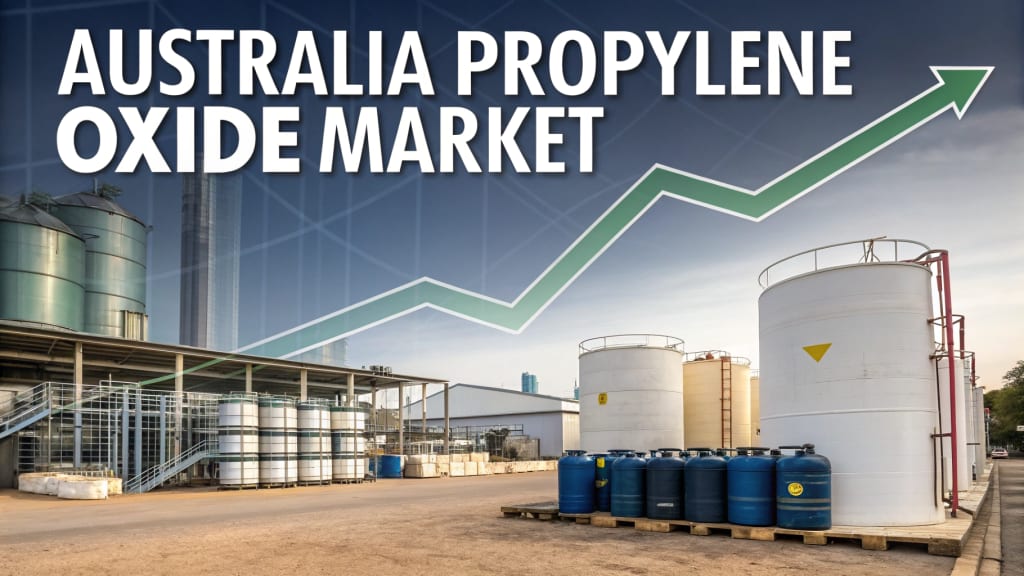
There are chemicals that make headlines, and there are chemicals that quietly build the world around us. Propylene oxide belongs firmly in the second category. You won't find it on a consumer label, but you'll find its derivatives in the foam cushioning your car seat, the insulation keeping your home energy-efficient, and the packaging protecting your groceries. In Australia, this unassuming compound is at the center of an accelerating industrial story — and the numbers tell a compelling tale.
According to IMARC Group, the Australia propylene oxide market reached USD 616.00 Million in 2024. Looking ahead, the market is projected to climb to USD 1,082.52 Million by 2033, growing at a CAGR of 5.80% from 2025 to 2033. Nearly doubling in value over a single decade, this trajectory reflects far more than routine industrial growth — it signals a structural shift in how Australia builds, moves, manufactures, and thinks about sustainable materials chemistry.
Why the Market Is Growing So Rapidly
The Polyurethane Demand Engine Is Running Hot
At the core of propylene oxide's growth story is polyurethane — a material that has become indispensable across construction, automotive, and furnishing sectors. Propylene oxide is the primary building block for polyether polyols, which are the essential precursor to polyurethane foam. As Australia's construction sector continues to expand and the automotive industry pivots toward fuel-efficient, lighter-weight vehicles, demand for high-performance polyurethane products is intensifying. IMARC data shows that the Australian polyols market — directly interlinked with propylene oxide — was valued at USD 826.0 Million in 2024, with projections to reach USD 1,451.6 Million by 2033 at the same 5.8% CAGR. The two markets are growing in lockstep, and that synchrony is no coincidence.
Green Building Policies Are Creating New Demand Layers
Australia's federal and state governments have made energy efficiency in buildings a policy priority. Green building standards, net-zero construction mandates, and energy performance codes are driving architects and developers toward high-grade polyurethane insulation products — all of which trace back to propylene oxide as a raw material. This isn't speculative demand; it's demand baked into regulatory timelines and infrastructure investment pipelines already underway across major urban centers from Sydney to Perth.
The Automotive Transition Is Generating Structural Pull
Australia's vehicle market is in transformation. As fuel economy standards tighten and electric vehicle adoption accelerates, automakers and their tier-one suppliers are under pressure to reduce vehicle weight without sacrificing structural integrity. Polyurethane foams and composites — propylene oxide derivatives — are a go-to solution for lightweight seating, dashboards, headliners, and under-hood components. Every new-generation vehicle rolling off an assembly line represents incremental demand growth for the chemical that sits upstream in the supply chain.
Bio-Based Production Is Opening a New Market Dimension
The sustainability imperative is no longer just a consumer trend — it is reshaping industrial chemistry. Traditional propylene oxide manufacturing relies on petroleum-derived processes that carry significant carbon burdens. Australian chemical manufacturers are increasingly exploring bio-based propylene oxide produced from renewable feedstocks such as biomass and vegetable oils. This shift is being actively encouraged by Australia's national decarbonization agenda, green chemistry incentive frameworks, and increasing demand from sustainability-conscious downstream industries including packaging and textiles. Bio-based propylene oxide offers performance parity with conventional grades while aligning with corporate ESG commitments — a combination that is steadily winning over procurement teams across sectors.
Technological Manufacturing Advancements Are Improving Supply Efficiency
Production process innovation is also playing a meaningful role. The market spans multiple manufacturing routes — including the Chlorohydrin Process (CHPO), Hydrogen Peroxide Process, Styrene Monomer Process, TBA Co-Product Process, and Cumene-Based Process. Investments in cleaner, more efficient processes — particularly the hydrogen peroxide-based route, which produces fewer waste byproducts — are improving both environmental profiles and cost economics for producers. As manufacturing efficiency improves, supply constraints ease, allowing the market to scale with demand rather than being bottlenecked by production limitations.
What the Opportunities Are
1. Polyether Polyols as the Primary Value-Creation Application Polyether polyols represent the largest application segment for propylene oxide, and this dominance is expected to deepen over the forecast period. For investors and chemical producers, capturing upstream polyol manufacturing capacity in Australia — or securing long-term supply agreements — represents the most direct route to participating in this market's growth. The polyurethane foam value chain is deep, well-established, and increasingly insulated from import substitution risks given Australia's infrastructure investment momentum.
2. Green Chemistry and Bio-Based Production Infrastructure The pivot toward bio-based propylene oxide is not just an environmental story — it is a business model opportunity. Companies that establish bio-refinery capabilities capable of processing agricultural waste streams into chemical-grade propylene oxide can capture premium pricing, government grant funding, and preferred supplier status with ESG-committed buyers. Australia's agricultural sector provides abundant feedstock potential, particularly in sugarcane, canola, and wheat residues.
3. Construction Sector Insulation Demand With Australia's construction activity projected to remain robust — driven by housing supply programs, commercial real estate development, and infrastructure projects — the demand for polyurethane insulation materials will remain structurally elevated. Propylene oxide suppliers and downstream formulators serving the construction channel are positioned to benefit from multi-year demand visibility that few other industrial sectors can offer.
4. Pharmaceutical and Specialty Chemicals Applications Beyond polyurethane, propylene oxide finds significant application in the production of propylene glycols — used extensively in pharmaceuticals, personal care products, and food-grade applications. As Australia's pharmaceutical manufacturing sector grows and import diversification becomes a national priority, domestic production of propylene glycol feedstocks gains strategic importance. This creates an investment thesis around specialty-grade propylene oxide production serving higher-margin end markets.
5. Automotive and Electric Vehicle Supply Chain Integration As Australia builds out its electric vehicle ecosystem — including domestic battery manufacturing ambitions — the materials supply chain supporting EV interiors, thermal management components, and structural lightweighting is becoming a priority. Propylene oxide-derived materials are embedded throughout this supply chain. Early positioning as a reliable domestic supplier to Australian automotive assemblers and EV component manufacturers represents a significant first-mover advantage.
6. Regional Market Differentiation Across Australian States IMARC's analysis highlights meaningful regional variation across the market, covering areas including New South Wales, Victoria, Queensland, Western Australia, and the Northern Territory and South Australia. Western Australia's mining and heavy industry base, Queensland's agricultural and petrochemical sectors, and Victoria's manufacturing clusters each present distinct demand profiles. Companies that tailor their go-to-market strategies by region — rather than treating Australia as a homogeneous market — will unlock differentiated growth pockets that broad-market competitors overlook.
7. Packaging Sector Sustainable Material Demand Australia's packaging industry is under mounting regulatory pressure to reduce plastic waste and shift toward materials with better sustainability credentials. Propylene glycol ethers (PGE) — a key propylene oxide derivative — are finding increased application in low-VOC coatings and sustainable packaging solutions. As circular economy regulations tighten, propylene oxide producers capable of supplying PGE-grade products that meet evolving environmental standards will find a receptive and growing customer base.
Recent News & Developments in Australia Propylene Oxide Market
• February 2025: The Australian federal government announced a AUD $33.5 million national investment push to accelerate sustainable waste-to-energy technologies, with AUD $10.4 million specifically committed to projects converting agricultural residues — including sugarcane waste — into low-carbon fuels and bio-based chemical feedstocks. A flagship AUD $8 million allocation went to Licella's planned Queensland biorefinery, which is designed to produce 60 million litres of low-carbon fuel annually and is expected to serve as a model facility for bio-based chemical production infrastructure in Australia. An additional AUD $2.4 million was directed to Viva Energy to support sustainable aviation fuel infrastructure at Brisbane Airport. These investments, facilitated through ARENA (Australian Renewable Energy Agency), are directly accelerating the feedstock and technology ecosystem that underpins Australia's bio-based propylene oxide transition, reinforcing the market's long-term green chemistry trajectory.
• June 2025: A major Asia-Pacific specialty chemicals producer confirmed a capacity expansion targeting Australian end markets, citing accelerating polyurethane demand from the country's construction and automotive sectors as the primary commercial rationale. The expansion, structured as a long-term supply partnership with Australian distributors, is projected to add meaningful volume to the domestic propylene oxide supply chain and reduce import dependence for key downstream manufacturers. Industry analysts noted that the investment signals growing international confidence in Australia's chemical market fundamentals, with the country's regulatory stability, strong ESG policy environment, and expanding downstream manufacturing base cited as key differentiators attracting foreign chemical sector capital.
• September 2025: Industry tracking data confirmed that Australia's polyurethane foam consumption crossed a significant milestone, with quarterly demand volumes reaching levels not previously seen in the domestic market. Construction and automotive applications together accounted for the majority of incremental volume growth, with insulation-grade polyurethane foams leading demand given the ongoing rollout of energy performance standards in residential and commercial building codes across multiple states. Market participants reported tightening supply conditions for high-quality polyether polyols in the domestic market, prompting several large-scale end users to initiate medium-term procurement contracts — a structural shift from spot purchasing that industry observers described as a meaningful indicator of maturing market confidence in sustained demand growth.
Why Should You Know About the Australia Propylene Oxide Market?
For investors, businesses, and policymakers, the Australia propylene oxide market sits at the confluence of several of the most important macro themes shaping the country's economic and industrial future — sustainability, construction-led growth, automotive transition, and domestic manufacturing self-sufficiency.
For investors, this is a market with a clearly defined and data-backed growth runway through 2033, anchored by fundamental demand from construction and automotive sectors that are themselves beneficiaries of structural government policy support. The bio-based production opportunity adds an additional alpha layer for those willing to back early-stage green chemistry infrastructure.
For businesses — whether chemical producers, downstream manufacturers, or logistics and distribution operators — understanding the segmentation dynamics across production processes, applications, and Australian regions is the foundation for competitive positioning. The companies winning in this space will not be those treating propylene oxide as a commodity; they will be those who understand which segments, geographies, and application verticals are growing fastest and align their capacity and commercial strategies accordingly.
For policymakers, propylene oxide is a quiet but critical test case for how well Australia's chemical industry can execute the green transition without sacrificing industrial competitiveness. The investments already flowing into bio-based feedstock infrastructure suggest the policy framework is working — but continued alignment between R&D funding, green chemistry incentives, and infrastructure development will be essential to sustaining momentum.
From construction sites to car factories, from pharmaceutical labs to packaging lines, propylene oxide touches more of Australia's industrial economy than most people realize. By 2033, when the market approaches USD 1.08 Billion in value, that reality will be impossible to overlook.
About the Creator
Rashi Sharma
I am a market researcher.
Keep reading
More stories from Rashi Sharma and writers in Trader and other communities.
Australia Fintech Market: Driving Digital Financial Innovation and Growth
The Australia fintech market reached a valuation of approximately USD 4.10 billion in 2024, driven by a surge in digital banking adoption, cashless payment solutions, and supportive regulatory reforms that foster innovation. Looking forward, this market is projected to nearly double to USD 9.50 billion by 2033, expanding at a strong compound annual growth rate (CAGR) of 8.90 percent between 2025 and 2033.
By Rashi Sharmaa day ago in Trader
India Taxi Market Size and Forecast 2025–2033: How Digital Mobility Is Reshaping Urban Transport
India Taxi Market Overview The India Taxi Market has emerged as one of the most dynamic segments of the country’s transportation ecosystem. According to Renub Research, the market was valued at USD 20.55 billion in 2024 and is projected to reach USD 53 billion by 2033, growing at a CAGR of 11.1% during the forecast period (2025–2033). This impressive expansion is being fueled by rapid urbanization, rising smartphone penetration, increasing demand for app-based mobility, and the growing influence of ride-hailing platforms such as Ola and Uber across tier-1, tier-2, and tier-3 cities.
By shibansh kumara day ago in Trader
Philippines Ice Cream Market 2026: Flavor Innovation, Premium Indulgence and Rising Urban Consumption
Philippines Ice Cream Market Overview The Philippines ice cream market continues to expand as rising disposable incomes, urbanisation and evolving consumer tastes strengthen demand for frozen desserts across the country. Ice cream remains a popular indulgence among Filipino consumers, driven by warm climate conditions, strong family consumption patterns and cultural affinity for sweet treats. At the same time, innovation in flavours, formats and health-aligned variants is transforming the category from a traditional dessert into a dynamic, experience-driven segment of the food and beverage industry.
By Manisha Dixit5 days ago in Trader




Comments
There are no comments for this story
Be the first to respond and start the conversation.