
Australia Industrial Filtration Market Poised to Nearly Double by 2033 on Sustainability and Mining Expansion
With rising environmental standards and advanced manufacturing adoption, the market is set to grow at a 6.8% CAGR to nearly USD 1.93 billion.

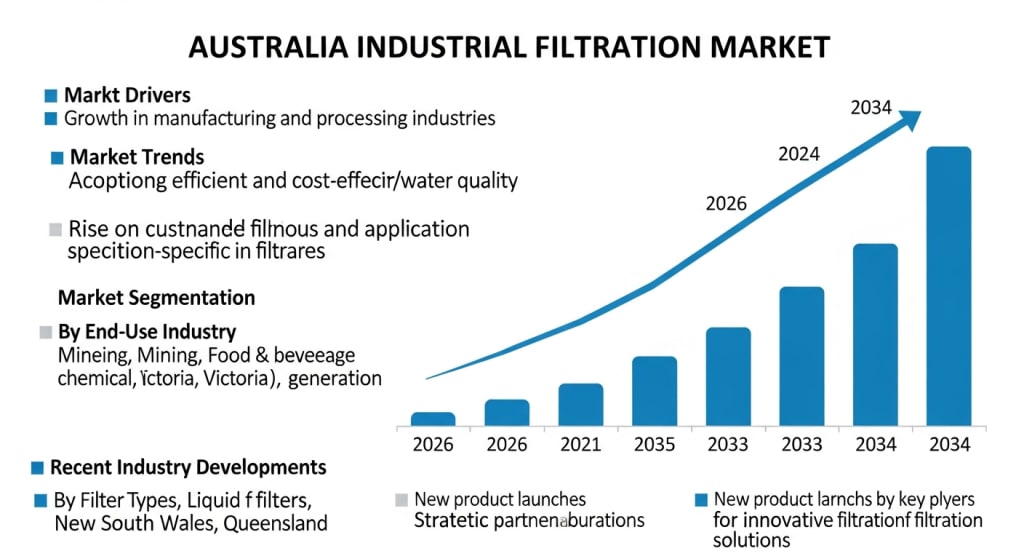
The Australia industrial filtration market is gaining strong traction as industries across the country intensify efforts to improve environmental compliance, enhance process efficiency, and support rapid expansion in mining and manufacturing sectors. According to IMARC Group, the market was valued at USD 996.8 million in 2024 and is forecast to reach USD 1,924.51 million by 2033, growing at a CAGR of 6.80% between 2025 and 2033.
This growth underscores the increasing significance of filtration technologies across industrial processes — from dust suppression and liquid purification to air quality management and contamination control. With stringent environmental regulations and adoption of advanced industrial technologies, the market is transitioning into a high-growth phase that offers strong opportunities for equipment makers, service providers, and technology innovators.
Why the Market Is Growing So Rapidly
1. Stringent Environmental Regulations and Compliance Pressures
Australia has progressively tightened environmental policies governing industrial emissions and wastewater discharge. Regulatory bodies routinely revise air and water quality standards, compelling industries to invest in high-performance filtration systems to meet compliance and avoid penalties. These stricter norms are driving widespread adoption of advanced air and liquid filtration solutions in sectors such as mining, power generation, and chemical processing.
Industrial operators are increasingly incorporating sophisticated systems — including high-efficiency particulate air (HEPA) filters, electrostatic precipitators, and membrane filters — to capture pollutants and safeguard both the workforce and the surrounding environment. This regulatory backdrop has made industrial filtration an essential component of operational planning.
2. Expansion of Mining and Resource Extraction Activities
Australia’s mining industry — a core pillar of the national economy — continues to expand its footprint, driven by global demand for minerals such as iron ore, coal, lithium, and other critical commodities. These sectors require robust filtration systems for dust control, water purification, and protection of equipment in harsh operational environments.
As mining operations scale up, the demand for specialized filtration technologies that can handle high particulate loads and complex liquid streams is concurrently rising, fueling significant market demand.
3. Adoption of Advanced Manufacturing and Automation
Australia’s industrial landscape is evolving with increased integration of advanced manufacturing technologies and automation. Sectors such as food processing, pharmaceuticals, electronics, and automotive manufacturing are elevating their quality standards and process efficiency, creating demand for cleaner production environments supported by high-performance filtration systems.
The integration of smart sensors and IoT-enabled monitoring within filtration units further enhances maintenance efficiency and system responsiveness, making modern filtration solutions integral to Industry 4.0 frameworks.
4. Broader Application Across Key Industries
Filtration systems are vital across a wide array of applications — from automotive and power generation to chemicals, pharmaceuticals, and metal processing. This cross-sector demand reinforces the market’s resilience and offers diversified growth opportunities.
Industries increasingly recognize the role of effective filtration in protecting equipment longevity, improving product quality, and ensuring workplace safety, which in turn supports broader adoption and investment.
5. Focus on Workplace Safety and Operational Efficiency
Heightened awareness about occupational health and safety, particularly in sectors with high particulate and chemical exposure risks, is pushing businesses to adopt superior air and liquid filtration solutions. By minimizing contaminants and ensuring cleaner operational environments, companies enhance both employee well-being and process reliability — a key competitive differentiator in industrial operations.
Market Segmentation
According to IMARC Group, the Australia industrial filtration market is segmented to reflect varied demand patterns across types, products, media, applications, and regions:
Type:
• Liquid
• Air
Product:
• Bag Filter
• Cartridge Filter
• Depth Filter
• Filter Press
• Drum Filter
• Electrostatic Precipitator
• ULPA (Ultra-Low Penetration Air)
• HEPA (High Efficiency Particulate Air)
• Others
Filter Media:
• Filter Paper
• Metal
• Activated Carbon/Charcoal
• Fiberglass
• Non-Woven Fabric
• Others
Application:
• Automotive
• Food and Beverage
• Chemicals and Petrochemicals
• Pharmaceuticals
• Power Generation
• Oil and Gas
• Metal and Mining
• Others
Regional Coverage:
• Australia Capital Territory & New South Wales
• Victoria & Tasmania
• Queensland
• Northern Territory & Southern Australia
• Western Australia
This segmentation showcases the widespread relevance of filtration solutions across industries and geography — reinforcing how integral these systems are to modern industrial operations.
What the Opportunities Are
1. Advanced Air Filtration Solutions
With rising particulate emission standards, demand for next-generation air filters — including HEPA and ULPA — presents a strong opportunity for manufacturers and service providers to supply high-efficiency solutions.
2. Smart, IoT-Enabled Filtration Systems
Integrating IoT and predictive maintenance into filtration units can help industrial clients reduce downtime and optimize operational costs, creating demand for connected, intelligent filtration offerings.
3. Mining-Focused Filtration Innovations
There’s growing need for filtration systems tailored to mining environments — robust, high-capacity, and able to withstand abrasive conditions — offering product specialization opportunities.
4. Expansion in Water Treatment and Liquid Filtration
Industries such as chemicals, pharmaceuticals, and food processing seek superior liquid filtration technologies to meet quality and compliance standards, making this a high-potential segment.
5. Aftermarket Service and Maintenance
Beyond equipment sales, servicing, replacement parts, and maintenance contracts represent recurring revenue streams for filtration companies seeking long-term client relationships.
6. Sustainability and Zero-Emission Initiatives
Solutions that assist clients in achieving emissions targets or align with sustainability goals — such as low-waste or recyclable filters — can capture growing ESG-oriented demand.
7. Regional Service Hubs and Support Networks
Setting up localized service centers in Queensland, Western Australia, and Northern regions can ensure faster response times and deeper market penetration.
Recent News & Developments in Australia Industrial Filtration Market
• March 2025: Government Regulatory Action: Australia’s environmental agencies announced updated industrial emission standards requiring tighter airborne particulate limits in heavy industrial zones, prompting accelerated adoption of advanced filtration installations across mining and power sectors. This measure aims to reduce air pollutants and align with federal sustainability targets, driving heightened compliance investments.
• June 2025: Company Expansion: Jingjin — a global industrial equipment provider — expanded its presence in Australia by showcasing advanced filter press and filtration solutions at IMARC 2025, deepening partnerships with local mining clients and enhancing its product footprint across air and liquid filtration applications.
• September 2025: Market Growth Metrics: Industry insights highlighted that industrial facilities adopting smart-monitoring filtration systems reported up to 18% improvement in uptime and maintenance efficiency, reflecting rising demand for digital-ready solutions and confirming strong growth momentum in filtration technologies across Australian manufacturing.
Why Should You Know About the Australia Industrial Filtration Market?
The Australia industrial filtration market represents a strategic intersection of environmental compliance, industrial growth, and technological modernization. With an anticipated expansion from roughly USD 996.8 million in 2024 to USD 1,924.51 million by 2033, the market offers compelling long-term potential for investors, manufacturers, and infrastructure planners alike.
For investors, the predictable CAGR of 6.80% signals steady returns in a sector essential to the foundational operations of industry, mining, and manufacturing. For technology providers and suppliers, the transition toward smart, high-efficiency systems opens avenues for innovation and differentiated products. For policy makers, understanding the filtration market is key to aligning environmental objectives with industrial competitiveness. Ultimately, as Australia continues to balance growth with sustainability, industrial filtration will remain central to cleaner, safer, and more productive industrial ecosystems.
About the Creator
Rashi Sharma
I am a market researcher.
Keep reading
More stories from Rashi Sharma and writers in Trader and other communities.
Australia Ready Mix Concrete Market Poised to Reach USD 111.5 Billion by 2033
The Australia Ready Mix Concrete Market is poised for robust expansion over the next decade, driven by a convergence of dynamic construction activity, government-backed infrastructure investments, and a growing emphasis on green building materials. In 2024, the market reached a value of USD 48,787.88 million, marking a substantial base as demand for high-quality concrete continues to rise across residential, commercial, industrial, and infrastructure segments. Looking ahead, IMARC Group forecasts the market will expand to USD 111,511.62 million by 2033, translating to a strong CAGR of 9.62% between 2025 and 2033 — more than doubling in value over the period.
By Rashi Sharmaabout 6 hours ago in Trader
An In-Depth Ideal Home Portugal Review for International Property Buyers
Buying property in another country is a major decision, and for many international buyers, Portugal—particularly the Algarve—stands out as an attractive destination. Sun-drenched coastlines, a high quality of life, and a stable property market continue to draw buyers from across Europe and beyond. Yet, navigating a foreign real estate system can feel overwhelming without reliable guidance. This is where detailed insights, such as an Ideal Home Portugal Review, become especially valuable.
By Jeffrey D. Gross MD7 days ago in Trader
Bruce Lee and The God of War: Kuan Ti
It starts with love.. The Power to the God Of War and Wealth Walk into a Chinese restaurant (even in Oklahoma, USA), a Chinese police station, a kung fu martial arts studio or even a Chinese temple and you often see a red faced warrior holding a heavy quan-do (spear like weapon).
By WILD WAYNE : The Dragon King5 days ago in Chapters


Comments
There are no comments for this story
Be the first to respond and start the conversation.