
Australia Foreign Exchange Market: Currency Trading, Global Trade & Financial Liquidity
How macroeconomic ties, digital platforms and hedging demand are shaping the foreign exchange landscape in Australia

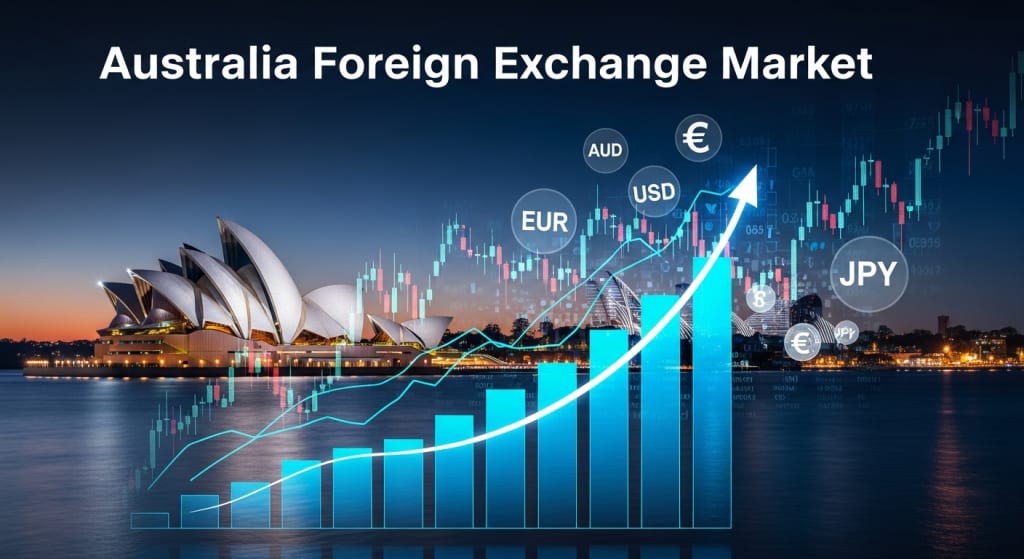
Australia Foreign Exchange Market Overview
The Australia foreign exchange (FX) market growth stands as a pivotal component of the nation’s financial system, driven by international trade, investment flows and currency trading activities centred around the Australian dollar (AUD). The FX market enables the exchange of currency pairs, facilitates cross-border trade settlement, supports hedging strategies for businesses and investors, and is integral to broader financial market operations. The Australia foreign exchange market size was valued at USD 160.4 Billion in 2024. Looking forward, the market is expected to reach USD 323.32 Billion by 2033, exhibiting a CAGR of 7.40% from 2025-2033.
Australia’s FX market is characterised by strong liquidity, deep participation from institutional and retail traders, and significant activity associated with hedging, speculative trading and international commerce. Its structure reflects the country’s open financial system, well-regulated trading environment, and extensive economic ties with major Asia-Pacific partners — particularly China, Japan and other key export destinations.
What’s Driving Market Growth
Commodity-Driven Economic Influence
Australia’s economy is heavily export-oriented, with commodities such as iron ore, coal, natural gas and agricultural products playing major roles. Demand for these commodities from Asia and other trading partners creates consistent foreign exchange flows, particularly for AUD transactions linked to trade settlement and capital movements. The commodity-currency relationship amplifies FX trading volume and attracts participants seeking to capitalise on currency changes tied to commodity price shifts.
Strong Trade Relationships & Capital Flows
Australia’s economic linkages with the Asia-Pacific — especially China, India, Japan and Southeast Asian economies — bolster FX activity. Cross-border trade agreements, investment inflows and outbound capital movements increase demand for foreign exchange services, hedging solutions and currency conversions tied to business operations, government transactions and investment portfolios.
Regulatory Framework & Market Integrity
A transparent and robust regulatory ecosystem underpins the Australian FX market, with institutions like the Australian Securities and Investments Commission (ASIC) ensuring investor protection, market integrity and operational standards. This regulatory stability, combined with the Reserve Bank of Australia’s (RBA) monetary policy influence, enhances confidence among traders, brokers and international investors, encouraging participation and liquidity in FX trading.
Technology & Digital Trading Innovation
Technological advancements have broadened market access through digital trading platforms, algorithmic systems and mobile apps that allow institutional and retail participants to execute FX transactions with greater speed, precision and transparency. Fintech solutions, AI-powered analytics and improved execution engines are expanding accessibility and are key growth catalysts in Australia’s FX ecosystem.
What the Opportunities Are
Fintech & Digital Platform Innovation
There is significant opportunity for fintech firms to develop advanced FX platforms that leverage machine learning, real-time analytics, blockchain and automated execution. These technologies can enhance market efficiency, security and usability, appealing to both institutional stakeholders and increasingly active retail participants.
ESG-Aligned FX Products & Sustainable Finance
As environmental, social and governance (ESG) investing grows, there is emerging potential to offer FX products aligned with sustainability themes. This could include ESG-linked hedging strategies, green currency baskets and derivative instruments that reflect sustainability commitments within investment portfolios.
Expanded Hedging Solutions for Corporate FX Risk
With continued globalisation and exposure to currency volatility, there’s demand for sophisticated hedging tools tailored to Australian businesses engaged in international trade. Education and advisory services around FX risk management can help corporations optimise their FX strategies and protect margins.
Education & Retail Investor Engagement
Increasing awareness among retail investors, including education on FX instruments, risk management and trading strategies, can expand market participation. Programs that demystify FX trading while ensuring compliance and risk awareness contribute to deeper market liquidity.
Recent News and Developments in Australia Foreign Exchange Market
Jul 2025: Central bank data revealed that average daily turnover in Australia’s FX market increased by over 34 %, rising from USD 150 billion in 2022 to approximately USD 201 billion by April 2025. The growth reflects heightened participation amid macroeconomic developments and market volatility.
Sep 2025: Australian pension funds — one of the largest pools of institutional capital — are expected to expand their use of foreign exchange hedging as global investment portfolios grow, underlining the increasing importance of FX risk management in long-term asset strategies.
Nov 2025: Retail FX platforms and brokers reported a surge in algorithmic and high-frequency trading volumes, driven by improved digital infrastructure and competitive execution environments that appeal to institutional and professional market participants.
Why should You Know About Australia Foreign Exchange Market?
You should know about this market because the foreign exchange ecosystem is central to Australia’s financial connectivity with the world, influencing trade flows, investment returns and currency valuation risk. As businesses, investors and governments engage in cross-border activities, understanding FX dynamics — including currency movements, liquidity trends and hedging solutions — becomes crucial for strategic planning and financial resilience.
For investors, the FX market offers exposure to global macro trends and currency strategies that can enhance portfolio diversification and risk management. Trends such as digital platform adoption, hedging demand from institutional capital holders, and evolving trade ties create opportunities for both active traders and long-term strategic participants.
For businesses that operate internationally, FX literacy supports better pricing, risk mitigation and competitive positioning. Corporates that strategically deploy FX hedging tools can protect earnings, optimise cost structures and build more predictable financial outcomes amid currency volatility.
About the Creator
Amyra Singh
Market research analyst who loves spotting patterns, digging into data, and turning insights into strategies that help brands grow and stay ahead of the curve.
Keep reading
More stories from Amyra Singh and writers in Trader and other communities.
Australia Smart Factory Automation Market: Industry 4.0 Transition, Operational Efficiency & Manufacturing Innovation
Australia Smart Factory Automation Market Overview The Australia smart factory automation market is gaining significant traction as manufacturers increasingly adopt digital technologies, advanced automation and intelligent systems to enhance productivity, operational efficiency and competitiveness. Smart factory automation leverages technologies such as the Industrial Internet of Things (IIoT), artificial intelligence (AI), machine learning (ML), robotics, predictive maintenance platforms, digital twins, edge computing and advanced analytics to enable real-time monitoring, optimisation and resilience across production environments. The Australia smart factory automation market size is anticipated to exhibit a growth rate (CAGR) of 9.70% during 2025-2033.
By Amyra Singhabout 7 hours ago in Trader



Comments
There are no comments for this story
Be the first to respond and start the conversation.