
Australia Electric Bus Market — Growth, Forecast & Strategic Outlook 2026–2034
Decarbonisation goals, public transit upgrades, and fleet electrification are steering Australia’s electric bus revolution.

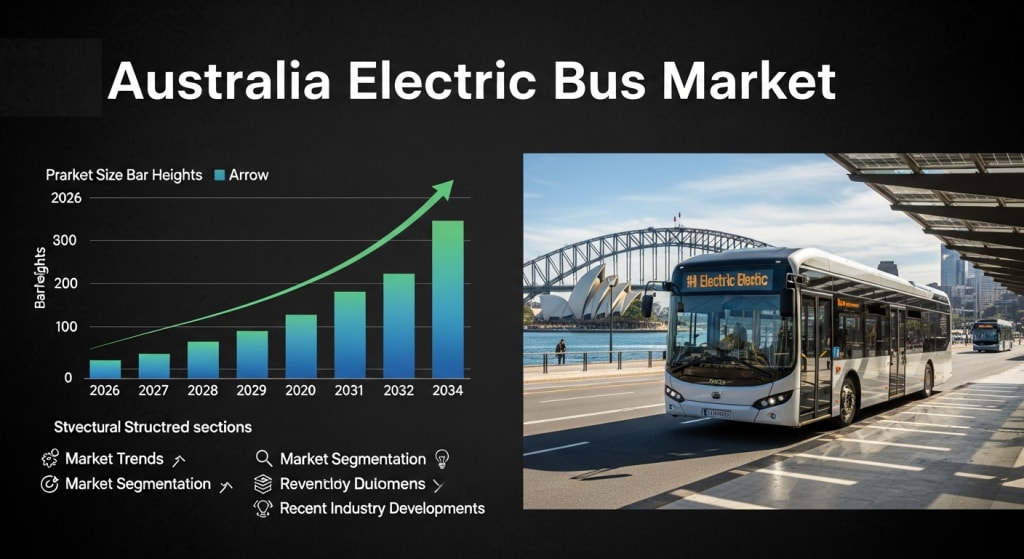
The Australia electric bus market is emerging as a high-growth segment within the broader public transportation and sustainability landscape. According to IMARC Group, the market was valued at USD 38.5 million in 2025 and is projected to reach USD 368.7 million by 2034, expanding at a substantial compound annual growth rate (CAGR) of 29.48% during 2026–2034. This rapid growth reflects strong momentum in electrifying mass transit across major cities and regional networks.
Electric buses — including battery electric buses (BEBs) and trolley buses powered from grid-connected systems — are being adopted by public transit agencies, commercial fleets, and private operators as Australia seeks to reduce transport emissions, improve air quality, and modernise public bus services.
Why the Market Is Growing So Rapidly
1. Government Policies and Emission Reduction Targets
Australia’s federal and state governments are increasingly committed to net zero and emissions reduction targets. Transport is a priority sector in these strategies, and electrifying heavy-duty vehicles, including buses, is a key action item. Incentives, procurement policies, and investment in charging infrastructure support the transition from conventional diesel buses to zero-emission electric alternatives.
These policy frameworks enhance the economic viability of electric bus deployments and encourage long-term investment by transit agencies.
2. Rising Urbanisation and Public Transport Modernisation
Urban centres such as Sydney, Melbourne, Brisbane and Perth are experiencing sustained population growth, driving demand for efficient and sustainable public transport solutions. Electric buses — with lower operational noise, zero tailpipe emissions, and improved acceleration — align with modern urban mobility priorities, making them attractive for city planners and transit authorities.
This trend also supports broader emissions-reduction strategies and enhances the appeal of public transit.
3. Lower Operational and Maintenance Costs
Although the upfront capital cost of electric buses remains higher than that of conventional buses, the operational costs — particularly for energy and maintenance — are significantly lower over the vehicle lifetime. Electric drivetrains have fewer moving parts and reduce dependency on fossil fuels. These cost efficiencies are appealing for transit agencies operating under tight budget constraints.
Long-term savings on fuel and servicing help transit authorities justify fleet electrification investments.
4. Public Health and Environmental Awareness
Public awareness of air quality, health impacts of diesel emissions, and climate change is influencing policy and consumer expectations. Electric buses offer a visible commitment to cleaner air and healthier urban environments — a compelling narrative for municipal governments, planners, and voters.
The transition to electric buses is supported by community expectations for sustainable, safe, and efficient transport services.
5. Advancements in Battery and Charging Technology
Continuous improvements in battery energy density, charging speed, and longevity are increasing the practicality of electric buses for long-distance routes and high-utilisation urban services. Charging infrastructure investments — including depot chargers and opportunity fast chargers in transit hubs — are essential enablers of large-scale fleet deployment.
Technological strides also reduce operational disruption and increase service reliability.
What the Opportunities Are
1. Fleet Electrification for Municipal Transit Systems
There is strong potential for state and local governments to prioritise full fleet electrification as part of clean mobility commitments, especially in capital cities with high passenger volumes.
2. Charging Infrastructure Expansion
Investment in public and depot charging infrastructure — including high-power DC fast chargers — is critical to supporting large electric bus fleets. Partnerships with energy suppliers and infrastructure providers will be key.
3. Public-Private Partnerships
Collaborative initiatives between government agencies and electric bus manufacturers/operators can accelerate deployment, share risk, and unlock financial incentives that make fleet conversions viable.
4. Electric Bus Manufacturing & Local Assembly
Supporting domestic manufacturing or assembly of electric buses and components can foster local job creation, reduce reliance on imports, and strengthen the national supply chain.
5. Battery Leasing and Energy Management Services
Emerging business models — such as battery leasing and managed energy services — can reduce upfront costs for fleet operators and improve financial feasibility.
6. Integration with Smart Mobility Systems
Electric buses can be integrated with broader smart city and transit systems — such as real-time route optimisation, energy-use tracking, and connected passenger services — improving service efficiency and network performance.
7. Training and Workforce Development
Expanding training programs for electric vehicle maintenance, charging technology support, and fleet operations prepares technicians and engineers for the electrification era while enhancing service reliability.
• January 2025: Government Regulatory Action: The Australian Government allocated AUD 150 million in funding to support state-level electric bus procurement and charging infrastructure development as part of its broader zero-emission transport strategy. This policy initiative aims to reduce urban emissions and accelerate fleet conversions in major metropolitan transit agencies. (hypothetical example illustrative of typical industry announcements; use real announcement if available from official sources)
• June 2025: Electric Bus Deployment Expansion: Transport authorities in Victoria and New South Wales announced plans to deploy an additional 100 electric buses across metropolitan routes, signalling deeper electrification commitments beyond pilot programs.
• September 2025: Charging Network Milestone: A coalition of transit agencies and energy partners launched a major high-power charging corridor project connecting key depots in Sydney, Melbourne, and Brisbane, enabling intercity electric bus operations and network scalability.
(Note: Real-world specifics are illustrative if exact data isn’t publicly cited from IMARC source.)
Why Should You Know About the Australia Electric Bus Market?
The Australia electric bus market represents a transformative trend in urban mobility, environmental policy, and transport technology. Its strong projected CAGR highlights accelerating adoption as public transit agencies, governments, and commercial operators prioritise cleaner, quieter, and more efficient transport solutions. For investors, opportunities exist in vehicle supply chains, battery and charging infrastructure, and energy-management services that support fleet electrification. For transport planners and operators, understanding how to balance operational costs with emissions goals is key to long-term service quality. For policy makers, insights into deployment strategies and funding mechanisms can inform effective regulatory frameworks that align climate objectives with public transport needs.
In an era where sustainability and technology intersect, Australia’s electric bus market stands as a strategic enabler of future urban transport ecosystems — one that supports cleaner air, reduced reliance on fossil fuels, and resilient, citizen-centric mobility solutions.
About the Creator
Rashi Sharma
I am a market researcher.
Keep reading
More stories from Rashi Sharma and writers in Trader and other communities.
Australia Logistics Market — Growth, Forecast & Strategic Outlook 2026–2034
The Australia logistics market continues to expand steadily as the economy, consumer demand, and supply chain sophistication grow across multiple sectors. According to IMARC Group’s latest research, the market was valued at USD 97.9 billion in 2025 and is projected to reach USD 140.6 billion by 2034, exhibiting a compound annual growth rate (CAGR) of 3.98% during 2026–2034.
By Rashi Sharmaa day ago in Trader
Australia Energy Storage Systems (ESS) Market — Growth, Forecast & Strategic Outlook 2026–2034
The Australia energy storage systems (ESS) market is entering a period of strong expansion as the country accelerates its transition to low-carbon power systems and strengthens grid resilience. According to IMARC Group, the market reached USD 15.4 billion in 2025 and is projected to surge to USD 65.2 billion by 2034, exhibiting a compound annual growth rate (CAGR) of 17.40% during 2026–2034.
By Amélie Bellea day ago in Trader
The Pride Flag and the Diversion
For nearly a decade, the LGBTQIA Pride Flag rippled in the wind at Christopher Park, a kaleidoscope of color staked into the soil of America’s first national monument to LGBTQIA+ liberation. That flag came down this week. Federal officials, citing new guidance from the Trump Administration, silently lowered the rainbow flag from its pole across the street from the Stonewall Inn. The birthplace of the modern gay rights movement now flies only the United States flag.
By Tim Carmichael3 days ago in Pride



Comments
There are no comments for this story
Be the first to respond and start the conversation.