
Are Bitcoins a Good Inflation Hedge or a Risk-Enhanced Investment?
Alternative Investments

The relationship between the economic fundamentals, such as the state of the economy and inflation versus bitcoin prices, continues to evolve. Although Bitcoin was introduced to the public in 2009, its price began reacting to changes in underlying economic fundamentals growth only after 2017. One reason for this phenomenon is the increased awareness of Bitcoin after the CME Group launched crypto futures contracts in late 2017! Such actions legitimized Bitcoin for many investors.
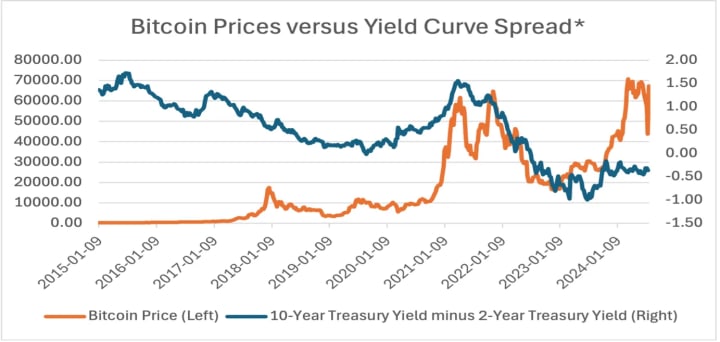
A study by Choi and Shin finds that bitcoin has an unreliable relationship with inflation expectations and economic fundamentals. Our analysis revealed that bitcoin exhibited a logical positive relationship with rising inflation expectations, while at other times, it sported a negative relationship! We confirm this phenomenon by computing the correlation between bitcoin prices and the yield curve defined by the spread of the 10-year Treasury yield minus the 2-year Treasury yield.
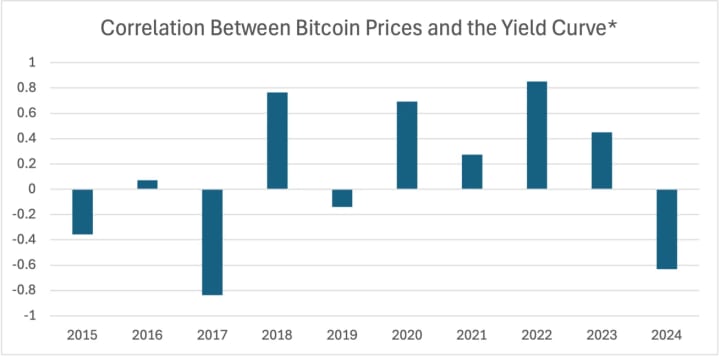
The catalysts that impact bitcoin prices are a topic of ongoing debate, engaging pundits to participate in this lively discussion. A positively sloping yield curve typically signals faster economic growth and increased pricing pressures, stimulating investors' risk appetites and pushing up bitcoin prices. On the other hand, a flat or inverted yield curve, indicative of slower economic growth and a higher risk of recession, should dampen the demand for riskier investments like bitcoin. Yet, some argue that in times of uncertainty, bitcoin can become a safe-haven asset and rise as the economic fundamentals deteriorate. However, bitcoin as an asset class is less mature than gold, which exhibits these characteristics and has yet to prove it possesses any of these qualities.
The Smoking Gun
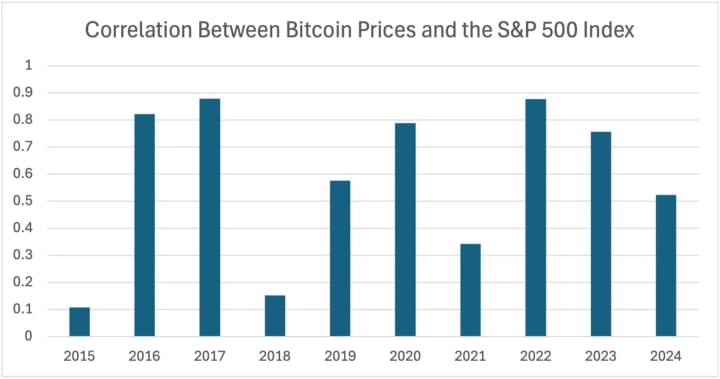
The only consistent relationship dating back to Bitcoin's early days is a positive correlation between U.S. equity prices (proxied by the U.S. S&P 500 Index) and Bitcoin prices. Although the positive relationship is not uniform over time due to the idiosyncratic factors that have entered the picture, it has remained consistently positive!
What Other Factors Impacted Bitcoin in 2024?
The approval of Bitcoin ETSs in January 2024 further enhanced the acceptance of this asset class and boosted the demand independent of what was happening with the economic fundamentals. The Bitcoin halving event in April 2024 also slowed the supply of additional Bitcoins, which supported prices.
Such developments sparked interest among institutional investors looking at Bitcoin as a viable alternative investment. These factors further softened the relationship between Bitcoin’s price movements and underlying economic fundamentals. Still, as the Federal Reserve prepares to lower short-term rates before the end of the year, one cannot ignore that such moves will be positive for Bitcoin and other similar assets like Gold, which are associated with high opportunity costs for their investors when interest rates are hovering at elevated levels.
It is important to note that lower Federal Reserve policy interest rates, which are expected soon, also tend to support equity and Bitcoin prices.
Summary and Concluding Thoughts
The checkered relationship between inflation and Bitcoin prices suggests that this asset class is not a reliable inflation hedge. However, its consistent positive correlation with equity prices has withstood the test of time. Even with the one-time factors that have impacted Bitcoin prices, the overwhelming evidence supports the view that this asset class is more closely aligned with stock prices than with inflation or inflation expectations.
With 70 percent of Bitcoin trading represented by Institutional Investors, who often focus more heavily on generating higher returns than protecting their portfolios against inflation, it is no wonder that this asset class moves more in tandem with equity prices than with changes in inflation expectations.
As this asset class matures and becomes even more widely accepted among mainstream investors, we will watch closely to see if it evolves into a safe-haven investment that thrives during recessions! However, our analysis finds little or no evidence that Bitcoin will become a safe-haven asset anytime soon!
About the Creator
Anthony Chan
Chan Economics LLC, Public Speaker
Chief Global Economist & Public Speaker JPM Chase ('94-'19).
Senior Economist Barclays ('91-'94)
Economist, NY Federal Reserve ('89-'91)
Econ. Prof. (Univ. of Dayton, '86-'89)
Ph.D. Economics
Keep reading
More stories from Anthony Chan and writers in Trader and other communities.
Fleeting Leaves
Autumn leaves drift down, Beauty fades as time rushes Life, too, feels so brief.
By Anthony ChanExclusive • 6 months ago
Digital Camera Market: Innovation, Content Creation, and the Future of Imaging Technology
Digital Camera Market: Trends, Growth, and the Future of Photography The digital camera market has experienced significant transformation over the past decade. While smartphones have become the most common devices for casual photography, dedicated digital cameras continue to play an essential role for professionals, enthusiasts, and content creators who demand superior image quality, advanced features, and greater creative control.
By James Smith6 days ago in Trader
A Transparent Look at Vocal Challenges and Top Stories
Almost three years ago, we shared a resource article that served as a place for people to suggest new challenge prompts. We thought it would be a good idea to refresh that thread, and take the opportunity to answer a few common questions about top stories, how challenges are judged and how submissions are reviewed.
By Vocal Curation Team3 days ago in Resources




Comments
There are no comments for this story
Be the first to respond and start the conversation.