
AI vs. Human Traders: Who Holds the Edge in the Stock Market?
Decoding the Battle Between Algorithms and Intuition on Wall Street

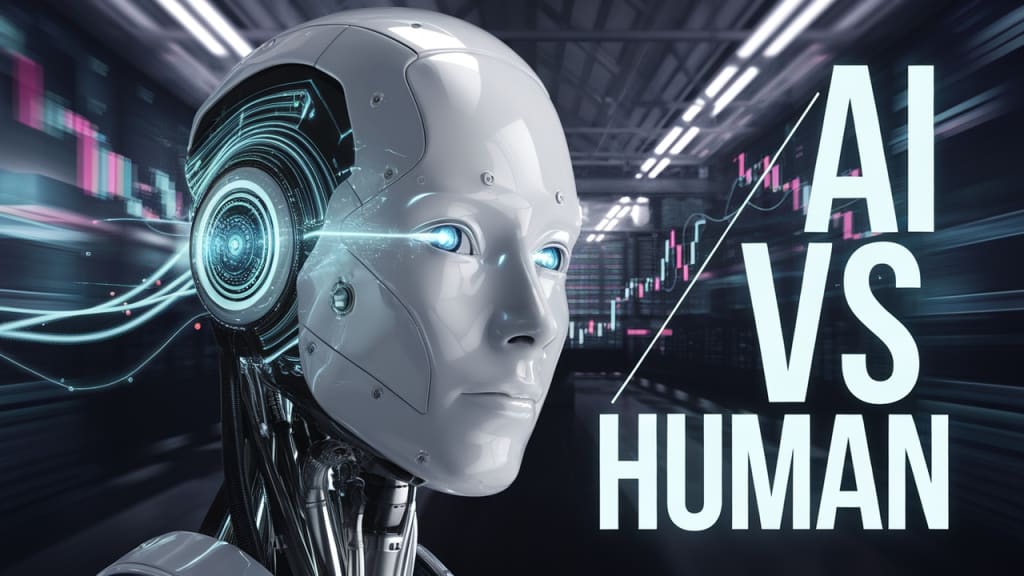
The stock market has long been dominated by human traders, relying on experience, intuition, and strategy. However, artificial intelligence (AI) is rapidly changing the game, with AI-powered trading algorithms processing data faster and more accurately than ever before.
But does AI outperform human traders? Or do human instincts still give investors an edge? Let’s break down the pros and cons of AI and human trading to see who holds the advantage in modern financial markets.
The Rise of AI in Stock Trading
AI trading systems use advanced machine learning models to analyze large datasets, detect patterns, and make high-speed trading decisions. Some hedge funds and trading firms have integrated AI into their strategies to increase efficiency and reduce risk.
Advantages of AI Trading
1. Data Processing Power
- AI can analyze millions of data points in real time, identifying subtle trends that human traders might miss.
- AI-driven hedge funds have delivered annual returns up to 3-5% higher than traditional hedge funds.
2. Emotion-Free Trading
- Unlike humans, AI doesn’t make impulsive decisions based on fear or greed.
- Algorithmic trading executes trades purely based on data, reducing psychological biases.
3. 24/7 Market Monitoring
- AI-powered bots can operate 24/7, taking advantage of after-hours market movements and international trading opportunities.
4. Pattern Recognition & Predictive Analysis
- AI detects market trends, historical patterns, and potential trading signals with high accuracy.
- Sentiment analysis tools can assess market mood using news, social media, and financial reports.
Limitations of AI Trading
- Lack of Intuition: AI models rely solely on past data and may struggle with unpredictable events such as economic crashes or sudden geopolitical shifts.
- Overfitting Risks: Some AI models perform well on historical data but fail to adapt to real-world volatility.
- Potential Market Manipulation: Algorithmic trading can contribute to market fluctuations, as seen in flash crashes.
The Strengths of Human Traders
Despite AI’s capabilities, human traders continue to play a crucial role in financial markets. Experienced investors leverage intuition, adaptability, and deep market understanding.
Advantages of Human Traders
1. Intuition and Experience
- Humans can interpret complex market events that AI might misjudge.
- Seasoned investors have a feel for market sentiment beyond numerical data.
2. Adaptability
- AI algorithms rely on historical patterns, but human traders can adjust their strategies in real time based on geopolitical shifts, economic policies, or breaking news.
3. Emotional Intelligence
- Humans can assess psychological factors driving the market, such as fear and speculation.
- Warren Buffett’s value investing strategy, for example, is driven by long-term human judgment rather than short-term data patterns.
Limitations of Human Traders
- Emotional Biases: Fear, greed, and impulsiveness can lead to poor investment decisions.
- Slower Data Processing: Humans cannot analyze massive datasets as quickly as AI.
- Limited Market Availability: Unlike AI, human traders cannot monitor global markets 24/7.
The Best Approach: AI and Human Collaboration
Rather than choosing between AI and human traders, the most successful investors are leveraging a hybrid approach. AI can provide data-driven insights, while human traders add intuition, experience, and adaptability.
How to Use AI and Human Trading Together
1. AI for Data Analysis, Humans for Decision-Making
- Use AI tools to scan the market, detect trends, and generate trading signals.
- Human traders can evaluate AI-generated insights and make informed decisions.
2. AI for Risk Management
- AI can help manage portfolios, balance risk, and optimize asset allocation.
- Humans can intervene during unpredictable market events.
3. AI-Powered Sentiment Analysis
- AI can gauge market sentiment through financial news, earnings reports, and social media.
- Human traders can interpret qualitative aspects AI might miss.
Conclusion: Who Wins?
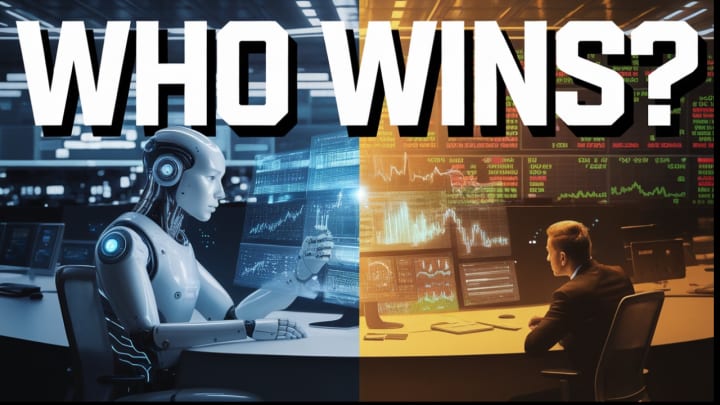
There is no definitive winner in the battle between AI and human traders. AI offers speed, precision, and data-driven insights, while human traders provide intuition, adaptability, and emotional intelligence. The most effective trading strategies blend both AI and human expertise, maximizing the strengths of each.
As AI technology continues to evolve, traders who embrace AI-powered tools while applying human judgment will have the greatest advantage in the stock market. The future of trading isn’t AI vs. humans—it’s AI and humans working together for smarter investing.
About the Creator
Keep reading
More stories from Marveline Merab and writers in Trader and other communities.
Philippines Steel Market: Infrastructure Demand, Industrial Growth & Strategic Expansion
Philippines Steel Market Overview The Philippines steel market is a cornerstone of the nation's industrial and infrastructure development, playing a pivotal role in construction, manufacturing, transport, energy and other key economic segments. The Philippines steel market size reached USD 19,488.00 Million in 2024. The market is projected to reach USD 25,695.28 Million by 2033, exhibiting a growth rate (CAGR) of 3.12% during 2025-2033. This growth reflects rising investment in infrastructure projects, urbanisation, industrial expansion and demand from residential and non-residential construction activities — all of which rely heavily on steel products for durability, safety and performance.
By Manisha Dixit6 days ago in Trader
A Dart at Dusk
Seconds ago, the sullen sun set on the two of us… my exuberant furry companion and me. A fresh breeze embraces us, delivering welcome relief from the day’s oppressive heat. His typical stumbling and staggering along — apace with a sloth — has turned into trip-trapping, high-stepping, almost skipping along.
By Angie the Archivist 📚🪶5 days ago in Petlife



Comments
There are no comments for this story
Be the first to respond and start the conversation.