
A Practical Look at Limitless Leverage and Its Real Impact on Traders
Understanding flexibility, responsibility, and why higher leverage appeals mainly to experienced traders


Leverage is one of the most talked-about features in online trading, often misunderstood and sometimes used without proper context. When people see the words “high leverage” or “limitless leverage,” the first reaction is usually excitement because it suggests more buying power and a chance to open larger positions with a smaller deposit. But behind that excitement is a more complex reality that every trader should understand clearly. Higher leverage creates flexibility, but it also increases responsibility, and that’s why it tends to appeal more to experienced traders than beginners.
The basic idea of leverage is simple: you can control a bigger trade size than the money you have in your account. If someone deposits $100 and trades as if they have $1,000 or even $10,000, that is leverage at work. This can amplify gains when the market moves in the right direction, but it can also magnify losses just as quickly. That is why most new traders struggle with high leverage—not because leverage is inherently bad, but because it reacts strongly to even small market movements.
Limitless leverage makes the trading environment more flexible. Traders who understand risk management can use it to open positions with precision instead of tying up large amounts of money. It also provides breathing room for those who trade multiple instruments at once or manage short-term strategies where margin efficiency is essential. To an experienced trader, leverage is a tool similar to a sharp instrument: useful, effective, but potentially dangerous if used carelessly.
One of the most common misconceptions is that higher leverage forces traders to take bigger risks. In reality, leverage only increases risk when traders intentionally open oversized positions. A disciplined trader can still use small lot sizes and treat leverage simply as additional flexibility in the background. The real danger comes from the temptation to overtrade, which is why beginners often misuse leverage—they see the possibility of fast returns and underestimate how fast the market can move against them.
Another aspect to consider is margin. Higher leverage lowers the margin required to open positions. This means the trader has more free margin available to manage multiple trades or handle volatility. Without sufficient margin, even a small price fluctuation can trigger a stop-out or automatic closure of trades, which creates frustration and confusion. High leverage reduces the likelihood of this happening for traders who know how to size their positions carefully.
Advanced traders who use strategies like scalping, hedging, grid trading, or algorithmic systems often rely on high leverage to keep their margin requirements small while spreading risk across several positions. For them, leverage is not about gambling; it’s about efficiency. They can keep more capital free, manage drawdowns better, and avoid unnecessary margin pressure during market spikes.
But none of this removes the need for understanding risk. Limitless leverage doesn’t change market behavior, volatility, or uncertainty. It simply changes how much room a trader has to operate. The responsibility still lies with the trader to calculate position sizes, set stop-loss levels, and avoid emotional decisions. The flexibility of limitless leverage becomes an advantage only when it’s paired with strategy and discipline.
Market events such as major announcements, interest rate decisions, or geopolitical news can move prices sharply. With high leverage, those movements become even more impactful. This is why traders with more experience tend to be the ones who appreciate leverage—they know how to navigate these conditions without letting emotions take control. For beginners, the safest approach is always to start with lower position sizes regardless of the leverage available.
In the end, limitless leverage is neither good nor bad by itself. It is simply powerful. It gives traders the ability to work with more flexibility, manage capital efficiently, and tailor trade sizes according to their strategies. But it also demands awareness, caution, and a realistic understanding of how markets behave. Used wisely, it becomes a useful part of the trader’s toolkit. Used without planning, it becomes a fast route to unnecessary losses.
quomarkets review
About the Creator
Keep reading
More stories from Darren Lee and writers in Trader and other communities.
Why a Fast Verification Process Matters for Today’s Traders
Opening a trading account used to be a slow and complicated experience. Traders had to fill long forms, upload multiple documents, wait for manual approvals, and deal with unnecessary back-and-forth communication. In a fast-moving market, that slow pace creates frustration. A simplified verification process, where only one document is required, changes that experience completely. It makes account creation smoother, reduces confusion, and allows traders to get started without spending hours dealing with paperwork.
By Darren Lee3 months ago in Trader
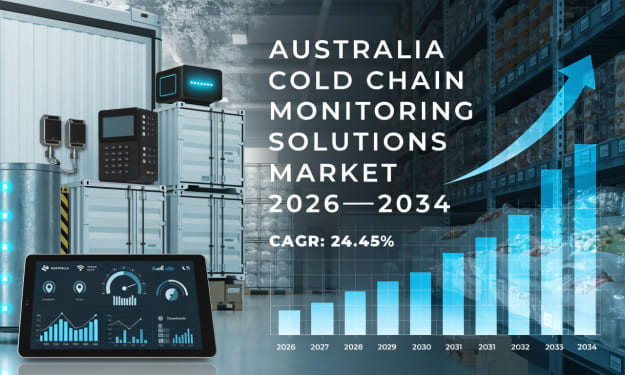
Australia Cold Chain Monitoring Solutions Market 2026: Temperature Control Innovation, Food Safety Compliance and Pharma Logistics Growth
Australia Cold Chain Monitoring Solutions Market Overview Australia’s cold chain monitoring solutions market is experiencing significant growth as industries prioritise product integrity, real-time visibility and compliance across temperature-sensitive supply chains. Cold chain monitoring solutions — including IoT-enabled sensors, RFID trackers, cloud software and analytical platforms — ensure that perishable goods such as food, pharmaceuticals and biologics maintain optimal conditions from production to point of use. Rising regulatory requirements, expanding e-commerce grocery demand and increased pharmaceutical distribution activity are supporting the adoption of advanced monitoring systems that optimise quality, minimise spoilage and enhance traceability.
By Amyra Singh8 days ago in Trader
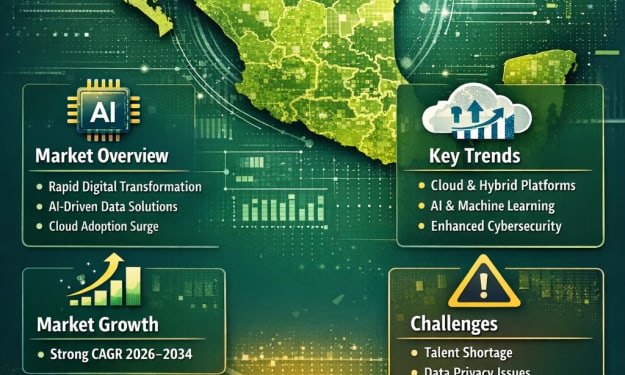
Mexico AI Data Management Market Size, Growth, Latest Trends and Forecast 2026-2034
Mexico AI Data Management Market Overview The Mexico AI Data Management Market is witnessing strong momentum as enterprises increasingly rely on artificial intelligence to manage, analyze, and secure large volumes of structured and unstructured data. As digital transformation accelerates across industries, organizations are adopting AI-driven platforms to improve operational efficiency, enhance decision-making, and gain competitive advantages.
By Jackson Watson7 days ago in Trader


Comments
There are no comments for this story
Be the first to respond and start the conversation.