
6 Best S&P 500 ETFs to invest in 2022?
Investing made easy

How do you get started investing in the stock market? You may have probably heard a lot about the stock market, but can't really decide on how or where to get started. Investing in the stock market seems risky and you don’t know which individual companies might be suitable. Broad range S&P 500 ETF’s may be of interest to you, especially if you are new to investing and want to be diversified in your investment portfolio.
What is an S&P 500?
The S&P 500 consists of 505 large-cap U.S. stocks, representing approximately 80% of the market value of the U.S. stock market.
Because of its depth and diversity, the S&P 500 is widely considered one of the best gauges of large U.S. stocks, and even the entire equities market. The S&P 500 Index features 500 leading U.S. publicly traded companies.
What Is an Index ETF?
Index ETFs are exchange-traded funds that seek to replicate and track a benchmark index like the S&P 500 as closely as possible.
What is an Annual Return?
According to the Corporate Finance Institute, the annual return is a measure of how much the investment has grown or shrunk in one year.
According to Investopedia, the annual return is the return that an investment provides over a period of time, expressed as a time-weighted annual percentage.
For example, if a stock begins the year at $25.00 per share and ends the year with a market price of $45.00 a share, this stock would have an annual, or yearly, rate of return of 80% ((45–25)/25)x 100%).
The Best S&P 500 ETFs to consider in 2022:
IVV- iShares Core S&P 500 ETF
VOO- Vanguard S&P 500 ETF
SPY- SPDR S&P 500
SPLG- SPDR Portfolio S&P 500 ETF
SCHX- Schwab U.S. Large-Cap ETF
IVW- iShares S&P 500 Growth ETF
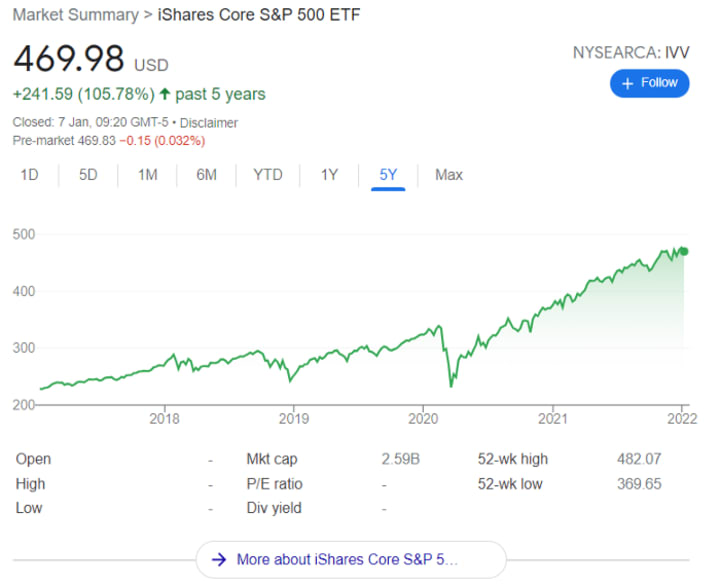
1. IVV
Best for overall.
- Expense Ratio: 0.03%
- Performance Over One-Year: 29%
- Annual Dividend Yield: 1.25%
- Assets Under Management: $330.7 billion
- Inception Date: May 15, 2000
- Issuer: BlackRock Financial Management
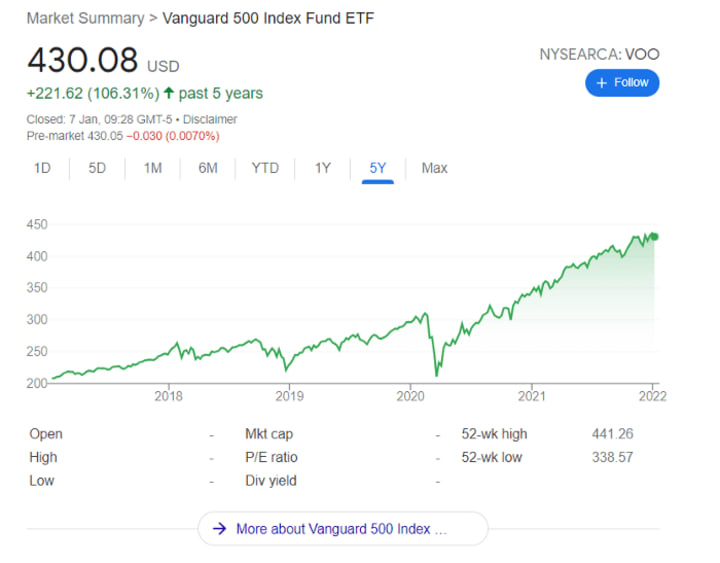
2. VOO
Best for Low Expenses
- Expense Ratio: 0.03%
- Performance Over One-Year: 29%
- Annual Dividend Yield: 1.24%
- Assets Under Management: $276.9 billion
- Inception Date: Sept. 7, 2010
- Issuer: Vanguard
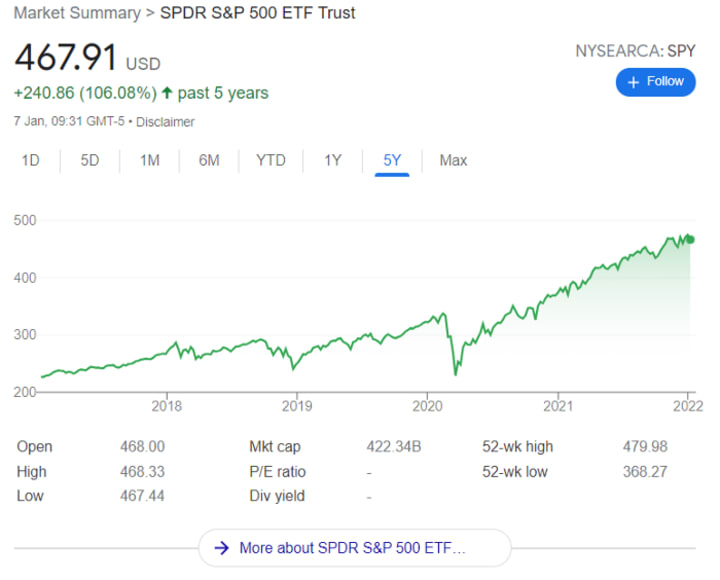
3. SPY
Best for Liquidity and Volume
- Expense Ratio: 0.09%
- Performance Over One-Year: 28.9%
- Annual Dividend Yield: 1.22%
- Assets Under Management: $450.16 billion
- Inception Date: Jan. 22, 1993
- Issuer: State Street
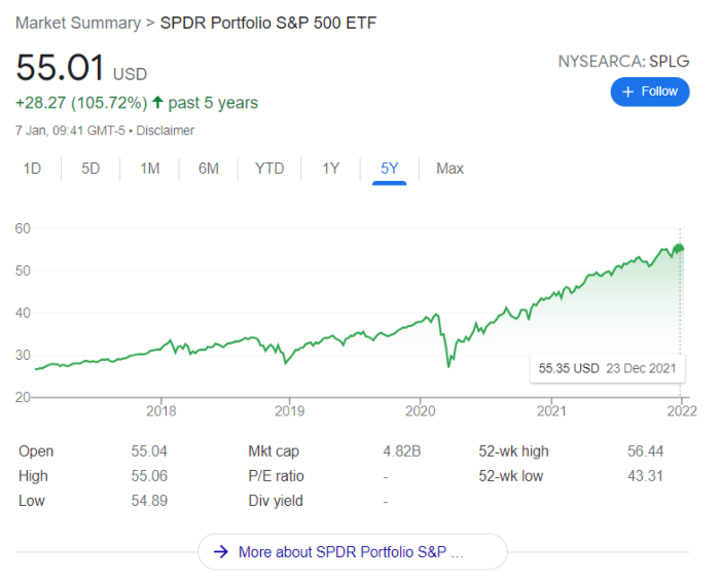
4. SPLG
- Expense Ratio: 0.03%
- Performance Over One-Year: 29.0%
- Annual Dividend Yield: 1.24%
- Assets Under Management: $13.6 billion
- Inception Date: Nov. 8, 2005
- Issuer: State Street
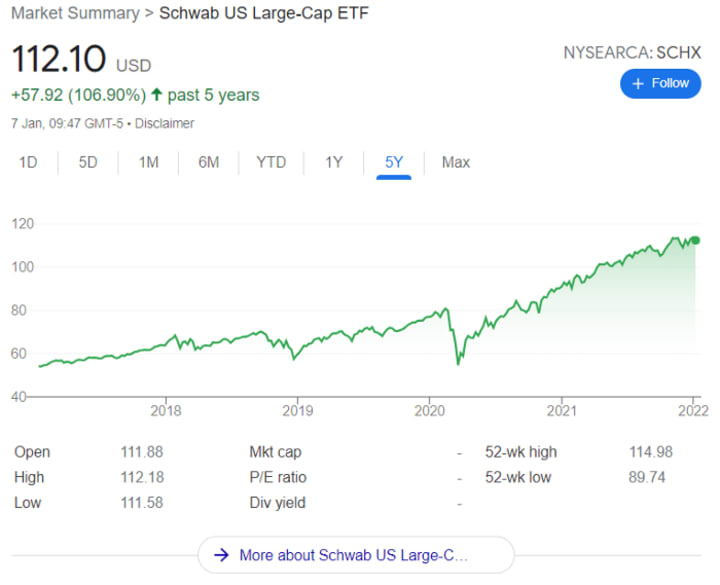
5. SCHX
Best for Large-Caps
- Expense Ratio: 0.03%
- Performance Over One-Year: 26.81%
- Annual Dividend Yield: 1.24%
- Assets Under Management: $ 34.68 billion
- Inception Date: Nov 3, 2009
- Issuer: Charles Schwab
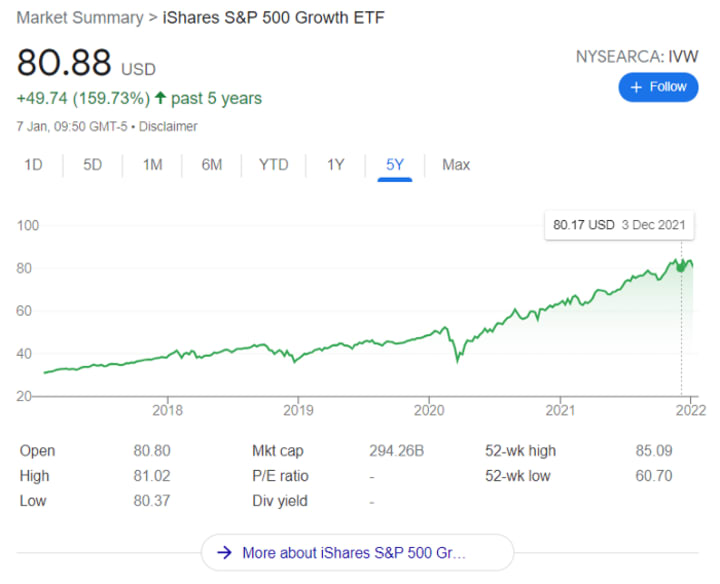
6. IVW
Best for Maximizing Gains
- Expense Ratio: 0.18%
- Performance Over One-Year: 31.76%
- Annual Dividend Yield: 0.48%
- Assets Under Management: $39.28 billion
- Inception Date: May 22, 2000
- Issuer: BlackRock Financial Management
Why you need to start investing?
1. Create opportunities
In a nutshell, what it’s really about, is financial freedom. And it is about allowing you to spend your money however you like. That would ultimately be the goal.
2. Make money work harder for you
What’s great about investing is that invested funds work 24/7. We spend most of our days working hard to make money, create content articles, videos, or a day job. At the end of the day, you want your money to work as hard as you do.
3. Keeping up with inflation
On average the bank savings interest rate is at around 0.05%, whereas the inflation is around 6.8% in 2021.
4. The cost to invest is cheaper than ever
Brokerage nowadays charges little to zero trading fees. Trading fees are the fees to transact, simply the money you spend to buy and sell a share. In the past 30 years ago, you might have to upwards of $40 to basically buy a share.
Compounding effect
The important thing you need to remember is to really reap the rewards of compound interest is you need to buy stocks and shares and hold them for the long run.
When you take a long-term mindset and take a step back to look at the markets from a longer-term perspective it will also allow you to avoid the short-term volatility that you’ll see in the markets on a day-to-day basis. So prices will go up they’ll go down but over the long term stocks have been shown to increase in value and by being a long-term buy and hold investor you will enjoy those gains.
Conclusion
Everyone has a different approach towards investing in the stock market. Getting started with an S&P 500 ETF may be a wise approach especially if you have a lower amount of capital to invest in, looking to have diversification, and want to be tax efficient.
Ultimately do what works best for you and educate yourself or any risks and rewards for any investments that you undertake.
----------------------------------------------------------------------------------------
If you would like to support my writing, please consider liking my story, subscribing, pledging and/or tipping. Thank you for reading!



Comments
There are no comments for this story
Be the first to respond and start the conversation.