


#1 stinginess
Believe it or not, the more you cling to your money and resources, the less you will have.
What you put into the universe, you get back.
If you're not investing anything in others, then what do you get back? Nada.
Avoid being stingy with others as much as possible.
Don't over-give or give when you feel resistance. Instead, find opportunities to give that harmonize with your existence. Everyone has causes that speak to them. Everyone knows people in need that they don't mind helping out.
Don't focus on how much you can give. Instead, focus on giving what you have at the right time.
#2 Subscriptions
Eradicate these m*ther f*ckers as much as possible. The more subscriptions you have, the more money you subtract from your account. I have one streaming service. I have one gym membership. And I consistently evaluate what subscriptions I can eradicate.
Don't buy a car wash subscription if you're not planning to go to the car wash more than once a month.
Those "valuable" subscriptions like books, coaching/therapy, and other personal development subscriptions aren't worth it if you don't need it, don't use it, or can access the value for free. If you're not using a subscription, cancel that m*ther f*cker.
Don't sign up for free trials with no intention to cancel them. Set a reminder to help you avoid paying months of unnoticed fees.
#3 Stagnant Income
Inflation is consistently increasing, so your income should also go up. Don't allow your income to stay the same. Consistently focus on increasing your income to elevate your options, flexibility, and philanthropic opportunities and to make yourself immune from inflation and economic downturns.
Think of ways you can increase your income. Start small, then figure out a creative path to scale these small increases. The goal is to start; don't worry about how much you're bringing in at first.
The little grows to much.
#4 Not Tracking Spending
You might think you're spending x, but you're really spending y. The longer you spend y amount, the less money you'll have. You don't know what's happening when you're not tracking your spending. When you don't know what's happening with your money, you subject yourself to out-of-control spending.
If you don't feel like tracking your spending, reduce expenses.
But if you're going to spend, focus on tracking so that you have intel into what you're spending your money on and how you're spending your money.
#5 Saying 'Yes' too frequently
Yes, to outings.
Yes, to travel.
Yes, to eating out.
Yes, to shopping.
Yes to giving.
Yes, to new gadgets.
Yes, to friends.
Yes, to family.
Yes, to coworkers.
Yes, to strangers.
Yes, to more Girl Scout cookies (and I was a Girl Scout).
The more "yeses" you give, the less you'll have.
Set boundaries for how much you say "yes," and always confirm that you have room in your budget for that "yes" so you don't hurt yourself in the process.
Why You Need to Think About Leakage
What ties all of this together is leakage.
Most people don’t have a money problem — they have a leakage problem.
Money leaves in small, quiet, socially acceptable ways. It leaks through convenience, avoidance, impulse, and delayed responsibility. And because the leaks don’t feel dramatic, people underestimate the cumulative damage.
Stinginess is a leak in one direction. Overspending is a leak in the other. Subscriptions are silent leaks. Saying yes too often is a leak disguised as generosity or social bonding. Stagnant income is a structural leak that inflation exploits over time. Not tracking spending is simply choosing not to look at where the water is escaping.
None of these things ruin you overnight. They ruin you slowly.
That’s why people are often shocked when they end up broke, stressed, or trapped. The collapse didn’t come from one catastrophic decision. It came from hundreds of unexamined ones.
Another overlooked issue is decision fatigue. When your finances are messy, every purchase becomes emotional. You’re constantly negotiating with yourself. Should I buy this? Can I afford that? Do I deserve this? That internal friction drains energy that could be used to create more income, build skills, or improve health. Clean finances reduce cognitive load. You don’t need motivation when the system is clean.
This is also why minimalism — financial and otherwise — works so well for some people. Fewer obligations. Fewer recurring expenses. Fewer “automatic” withdrawals from your time, money, and attention. Freedom isn’t about having more. It’s about having fewer things that own you.
People also underestimate how much optional spending becomes mandatory once it’s normalized. A subscription you meant to “try for a month” becomes a fixed expense. A lifestyle upgrade becomes your new baseline. A car payment becomes non-negotiable even when income drops. Optional decisions quietly turn into obligations, and obligations limit mobility.
Financial resilience is about maintaining exit options.
- Can you walk away from a bad job?
- Can you handle an unexpected expense without panic?
- Can you survive a few months of reduced income?
- Can you say no without fear?
Those answers depend less on how much you make and more on how much flexibility you’ve preserved.
The goal isn’t deprivation. It’s control.
- You want to be able to give freely without harming yourself.
- You want to spend intentionally without guilt.
- You want to earn more without desperation.
- You want your money to support your life, not dictate it.
That requires periodic self-audits. Not emotional ones. Practical ones. Look at where your money is going. Look at what’s actually improving your life versus what’s just familiar. Look at which expenses buy you freedom and which ones buy you comfort at the cost of future stress.
Most people wait until they’re forced to make changes. Eviction. Repossession. Burnout. Panic.
You don’t need a crisis to course-correct.
Small, boring, disciplined decisions made early compound into calm later. That calm is the real luxury — not the car, not the house, not the optics.
Just room to breathe.
-
Don't rely on one stream of income. Use your skills to create income.
This article is for informational purposes only. It should not be considered Financial or Legal Advice. Not all information will be accurate. Consult a financial professional before making any significant financial decisions.
About the Creator
Destiny S. Harris
Writing since 11. Investing and Lifting since 14.
destinyh.com
Keep reading
More stories from Destiny S. Harris and writers in Trader and other communities.
Mexico Health and Wellness Market Size to Hit USD 81.6 Billion in 2034 | Grow CAGR by 4.53%
Mexico Health and Wellness Market Overview The Mexico health and wellness market is experiencing significant growth as consumers become more conscious of their physical and mental well-being. The market includes a wide range of products and services such as nutritional supplements, organic foods, fitness programs, wellness tourism, and preventive healthcare solutions.
By Jackson Watson3 days ago in Trader
India Fertilizer Market Size and Forecast 2026–2034
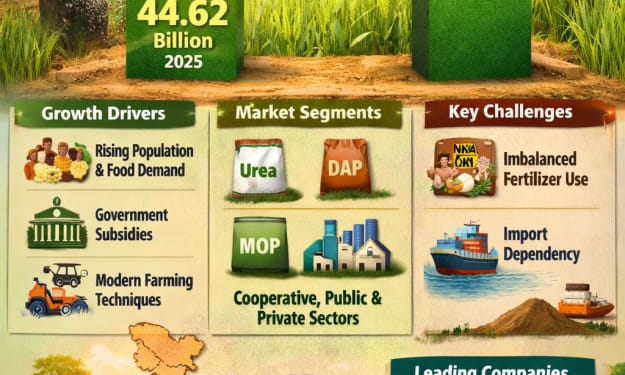
The India fertilizer market is poised for steady and sustainable growth over the next decade, driven by the country’s rising population, increasing food consumption, and the urgent need to enhance agricultural productivity. According to Renub Research, the market is projected to grow from US$ 44.62 Billion in 2025 to US$ 75.96 Billion by 2034, expanding at a Compound Annual Growth Rate (CAGR) of 6.09% during 2026–2034.
By Sakshi Sharma4 days ago in Trader



Comments
There are no comments for this story
Be the first to respond and start the conversation.