
Thai Cargo Ship Hit in Strait of Hormuz; Three Crew Missing
Escalating tensions in the Gulf threaten global shipping routes as a Thai vessel comes under attack in one of the world’s most critical maritime chokepoints.
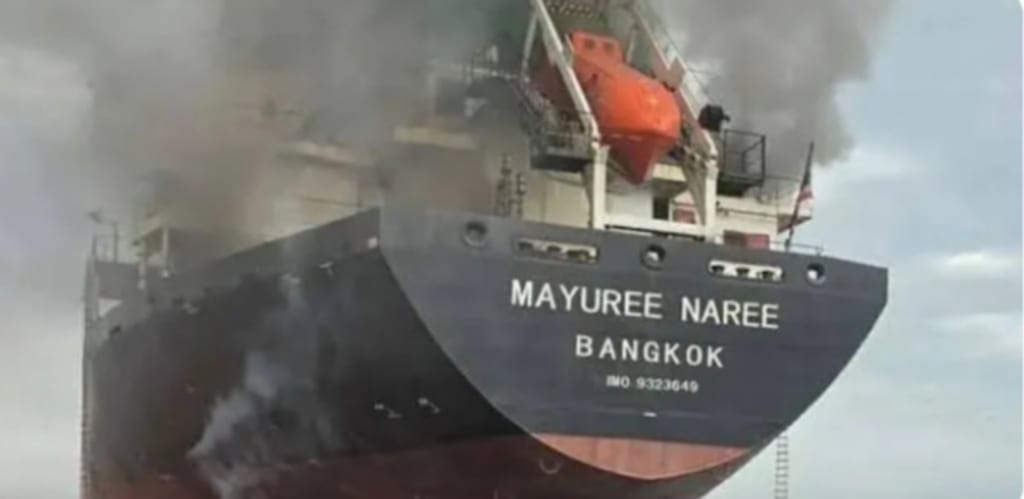
The fragile security situation in the Middle East took another alarming turn after a Thai cargo ship was struck while transiting the Strait of Hormuz, leaving three crew members missing and raising fresh fears about the safety of global shipping routes. The incident highlights how rising tensions connected to the conflict involving Iran are now spilling directly into international maritime trade.
Authorities confirmed that the cargo vessel, registered in Thailand, sustained significant damage after being hit by what officials believe may have been a missile or explosive drone. Rescue teams have been deployed to search for the missing crew while maritime authorities investigate the exact cause of the attack.
The incident has intensified global concern because it occurred in the Strait of Hormuz, a narrow but critical waterway through which nearly 20% of the world’s oil supply normally passes.
A Dangerous Maritime Incident
According to early reports from maritime safety organizations, the cargo vessel was traveling through the Strait of Hormuz when it was suddenly struck. The attack caused a fire onboard and damaged several sections of the ship, forcing the crew to issue a distress signal.
Nearby vessels and regional coast guards responded quickly, assisting in evacuation efforts. Most crew members were safely rescued, but three sailors remain unaccounted for, prompting an ongoing search-and-rescue operation.
Shipping authorities said the vessel was carrying general cargo and was en route to an Asian port when the incident occurred. While investigators are still determining whether the strike was intentional or accidental, the location and timing of the event have heightened suspicions that it may be connected to the broader regional conflict.
Why the Strait of Hormuz Matters
The Strait of Hormuz is widely considered one of the most strategically important waterways in the world. Situated between the Persian Gulf and the Gulf of Oman, it serves as the primary export route for oil produced in the Gulf states.
Each day, millions of barrels of crude oil travel through this narrow corridor, making it essential for the global energy market. Even minor disruptions in the strait can have major ripple effects across international trade and energy prices.
Because of its importance, the area has long been a focal point of geopolitical tension. During periods of heightened conflict involving Iran and regional rivals, the strait often becomes a hotspot for naval activity, surveillance operations, and occasional confrontations.
The latest attack on the Thai cargo ship has therefore sparked renewed fears that shipping lanes could become increasingly dangerous.
Rising Risks for Global Shipping
Maritime security experts say the incident reflects a broader trend of escalating risks for commercial vessels operating in the region.
In recent weeks, shipping companies have already begun rerouting vessels or delaying transit through the Strait of Hormuz due to rising military tensions and threats of attacks on tankers and cargo ships.
Insurance costs for ships traveling through the area have also surged, as underwriters adjust premiums to reflect the growing security threat.
For global shipping companies, the risks are substantial. A major disruption in the strait could delay shipments of oil, liquefied natural gas, manufactured goods, and raw materials, potentially affecting supply chains across Asia, Europe, and North America.
International Response
Governments around the world have reacted with concern to the attack on the Thai cargo ship.
Officials from International Maritime Organization called for restraint and urged all parties in the region to protect civilian shipping routes. Maritime law requires that commercial vessels be allowed safe passage through international waterways, even during periods of conflict.
Meanwhile, several countries with naval forces stationed in the region have increased patrols and surveillance operations around the Strait of Hormuz to deter further attacks.
Some nations are also considering forming additional multinational maritime security missions to escort cargo ships and oil tankers through the strait, a measure that has been used in past crises.
Economic Implications
The attack could also have significant economic consequences. Markets tend to react quickly to disruptions in critical shipping routes, particularly those linked to global energy supply.
Following news of the incident, oil prices briefly climbed as traders reacted to the possibility of reduced shipments from the Gulf region. Even temporary disruptions in the Strait of Hormuz can create volatility in energy markets because so much of the world’s crude oil passes through the corridor.
Beyond oil, broader global trade could also feel the impact. Shipping delays, higher insurance costs, and the need for alternative routes could increase transportation expenses for goods moving between Asia, Europe, and the Middle East.
For companies dependent on reliable shipping schedules, such disruptions can create cascading effects across supply chains.
Search Efforts Continue
Rescue operations remain underway for the three missing crew members from the Thai vessel. Search teams, including regional coast guards and nearby ships, are combing the waters in hopes of locating the missing sailors.
Family members and colleagues are anxiously awaiting updates as authorities continue their investigation into what caused the strike.
Officials have promised a thorough inquiry to determine whether the ship was intentionally targeted or inadvertently caught in military activity in the region.
A Warning for Global Maritime Security
The attack on the Thai cargo ship serves as a stark reminder that conflicts in strategically important regions can quickly threaten international commerce.
The Strait of Hormuz has long been viewed as a potential flashpoint for global trade disruption, and the latest incident underscores how fragile maritime security can be during periods of geopolitical tension.
For the global economy, maintaining the safety of critical shipping lanes will remain essential. Governments, international organizations, and shipping companies will likely face increasing pressure to enhance maritime security and ensure that commercial vessels can travel safely through one of the world’s most important waterways.
About the Creator
A Gathering of Evil Bosses
“I’m the queen of chin jutting while I smooth my hair, attacking, insulting, and deflecting to protect my appointer.” “Oh, please, Blondi, my hair is curled, highlighted, and longer than yours. I feature television commercials telling immigrants that we will give them a free plane ride home, and if they voluntarily turn themselves in, they will be allowed to legally apply for re-entry. It runs everywhere, and I look good in it! You can’t compete because of your blond hair. Mine is nicer, and my lips are prettier than yours.”
By Andrea Corwin 22 days ago in The Swamp
First Nations Leaders Head to England to Raise Treaty Concerns with King Charles
A delegation of First Nations leaders from Canada has traveled to England to meet with King Charles III, raising concerns over unresolved treaty obligations and the historical impact of colonial policies. The visit represents a rare opportunity for Indigenous leaders to engage directly with the British monarchy, which has long been viewed as a symbolic authority connected to treaties signed during the colonial era. The delegation includes chiefs and elders from multiple First Nations communities across Canada, representing a diverse range of regions and interests. Their mission is to secure recognition for longstanding grievances related to land rights, resource extraction, and the implementation of treaties originally negotiated between Indigenous communities and the Crown. The leaders emphasize that these treaties are still legally binding under Canadian law and that acknowledgment from the monarchy carries both symbolic and political weight. During preliminary discussions in London, the delegation highlighted concerns that many treaties have been inadequately honored over the past century. Chief Shawn Atleo of the Assembly of First Nations explained, “These agreements were made with the Crown, and yet, too often, their promises have been ignored or inadequately implemented. We come to England not to challenge the monarchy personally, but to seek recognition and a commitment to dialogue that respects the original intentions of these treaties.” King Charles, who has publicly expressed interest in reconciliation and environmental stewardship, reportedly welcomed the delegation and listened to their concerns during a formal audience. While the meeting did not produce immediate policy changes, it was described as a significant step toward acknowledging the historical obligations of the Crown and creating channels for continued discussion. The visit also underscores the complex role of the monarchy in contemporary Canada. Although political authority is vested in the Canadian government, the Crown remains a central figure in treaty law and Indigenous governance structures. Experts note that while King Charles cannot unilaterally enforce treaty obligations, recognition from the monarchy can strengthen Indigenous claims and encourage Canadian authorities to address outstanding issues more seriously. Beyond legal recognition, the delegation emphasized the social and cultural dimensions of their visit. Indigenous leaders brought artifacts, documents, and oral histories to illustrate the historical context of treaties and the impact of colonial policies on their communities. These presentations serve not only to educate British officials and the monarchy but also to reinforce the ongoing cultural and spiritual significance of these agreements for First Nations people. In addition to meetings with King Charles, the delegation has scheduled engagements with members of the British Parliament, legal experts, and historians specializing in colonial law. These discussions aim to foster broader understanding of the treaties and explore avenues for collaboration in addressing contemporary challenges related to Indigenous rights, land stewardship, and community development. The timing of the visit is particularly noteworthy, coming amid ongoing debates in Canada over reconciliation and Indigenous sovereignty. Recent legal rulings have emphasized the binding nature of treaties and the duty of the government to consult and accommodate First Nations communities in matters affecting their lands. Leaders in London hope that raising awareness internationally will complement domestic efforts and create additional pressure for meaningful action. Observers note that the visit carries symbolic significance for both the monarchy and Indigenous communities. For King Charles, it represents an opportunity to reinforce his public image as a monarch engaged with global issues and committed to dialogue and reconciliation. For the First Nations delegation, it demonstrates a proactive approach to asserting treaty rights and preserving cultural heritage in an international context. Reactions from Canadian officials have been cautiously supportive. While the federal government remains the primary authority responsible for treaty implementation, Indigenous Affairs Minister Penny Collenette praised the delegation for taking a diplomatic approach. “Engagement at all levels is important, and raising these issues in London complements ongoing efforts at home,” she said. The delegation plans to return to Canada later this month, with follow-up meetings expected to continue both domestically and internationally. Advocates stress that the visit should be viewed as part of a broader movement to ensure that historical treaties are honored, Indigenous voices are heard, and the principles of justice and fairness guide ongoing governance decisions. As the delegation concludes its visit, leaders expressed hope that the dialogue will mark the beginning of sustained engagement with the monarchy, the UK government, and Canadian authorities. “Our goal is not confrontation, but recognition, understanding, and meaningful action,” said Chief Atleo. “By raising these issues here in England, we hope to reaffirm the commitments made generations ago and ensure that future generations inherit the respect and rights promised to our people.”
By Fiaz Ahmed 3 days ago in The Swamp
Becca
"Everything is so... flat." Denille said stupidly as she looked around her new neighborhood. She looked around at the muted desert where even the smallest sign of life seemed to have given up. The plant life was shrubs that were half cooked by the heat and where there should have been a lawn, a mess of white rocks laid glistening in the sun. Even the sky looked stretched thin, like the sun had ironed it smooth. She’d moved from Riverside, where at least there were hills, but here in Barstow, everything felt baked and brittle.
By Sara Wilson6 days ago in Fiction




Comments
There are no comments for this story
Be the first to respond and start the conversation.