

Why do Jewish women wear wigs?
The reasons Jewish women wear wigs (called "sheitels" in Yiddish) stem from Jewish law (Halacha) and modesty (tzniut). The following are clear categories:
1. Modesty after marriage
In traditional Jewish communities (especially Orthodox Jewish communities), women cover their hair after marriage as a sign of modesty and privacy.
Hair is considered a sensual or private part of a woman's beauty.
Covering her hair symbolizes that her beauty belongs only to her husband and embodies dignity and fidelity.
2. Wigs as a Form of Hair Covering
Some women cover their hair with scarves (called tichels), hats, or neck wraps, while others wear wigs (sheitels).
Wigs offer a natural and elegant look while still meeting the need to cover one's natural hair.
Many women prefer wigs because they are practical, fashionable, and more acceptable in modern society.
3. Different Levels of Observance
Not all Jewish women wear wigs—it depends on their community's traditions and their personal understanding of Jewish law:
Ultra-Orthodox and Hasidic women almost always cover their hair, often wearing a wig, even under a headscarf.
Modern Orthodox women may choose to wear a wig, headscarf, or hat.
Secular or less observant Jewish women generally do not follow this practice.
4. Symbolism
Wearing a wig is more than just a matter of modesty—it is also a symbol of faith, identity, and marital status.
For many women, a wig is a visible reminder of their commitment to Jewish values and family life.
When I first met Leah in a Brooklyn community garden, she was bent over pruning roses, her dark brown, bobbed, glueless wigs swaying slightly with her movements. The sunlight filtering through her hair made it almost impossible to tell it was a sheitel. I clutched the fresh basil leaves I'd given her, but my eyes couldn't help but linger on her wig—it looked so real, so much more exquisite than any I'd worn to protect my natural curls.
"Do you like my sheitel?" She straightened up, smiling and touching the ends of her hair. "I just bought it last week. It's made of human hair."
We sat under the gazebo in her backyard, and she poured me mint tea. Her eyes lit up when I told her that in my culture, we also use wigs and braids to protect our hair and express ourselves.
"Let me show you my collection." She led me into the bedroom and opened a special wardrobe. Over a dozen wigs were neatly arranged on stands, ranging from elegant shorts to waist-length curls, each one immaculately maintained. The sight reminded me of the array of wigs I keep on my dresser at home—protecting my meticulously maintained Afro during the humid New York summers.
Leah gently removed a honey-blonde wig: "This is what I wear on Shabbat." Pointing to a short, dark brown lock, she said: "This is what I wear to the market."
"In our community," she continued, "hair is considered erva, a private part to be covered. But strangely, through covering, we rediscover ourselves."
This sentence stunned me. I remembered my grandmother's words—she always said that when we cover our hair with a headscarf, we're not hiding it, but rather expressing our dignity.
Leah shared her first wig-shopping experience after her wedding. In a Brooklyn boutique, the elderly Jewish owner patiently tried one on for her and explained how to care for the human hair wigs. "That moment I understood," she said, "this isn't about hiding, it's about choosing—choosing how to present ourselves to the world while remaining true to our faith."
This feeling was so familiar. In the African American community, whether we choose braids, wigs, or natural hair, we are also writing a statement about our own identity. Leah's wig and my African braids, though carrying different histories, share the story of women navigating the balance between tradition and modernity.
Today, whenever Leah visits my home and gently adjusts the angle of her wig upon entering, or occasionally at women's gatherings, she removes her wig, wearing only her scarf, to share the week's fun with her sisters, I'm reminded of this cross-cultural dialogue. We each, in our own way, tell the same story—about faith, about identity, and about finding our place as women in this complex world.
Perhaps, true understanding never requires giving up one's self. As Leah puts it, "My sheitel allows me to be both myself and part of a larger tradition." And I think this is the wisdom that women in all cultures are learning—to express themselves through covering, to innovate within tradition, and to find inner freedom within external constraints.
About the Creator
Top 5 Laco Watches Every Collector Should Own in 2026
Laco is a name that has a lot of history. This company has more than 100 years of experience in making watches that tell more than the time. They have a tradition of constructing tool watches tailored to pilots, divers, and explorers seeking a tool that they could rely on with their lives.
By Arfa Gravity7 days ago in Styled
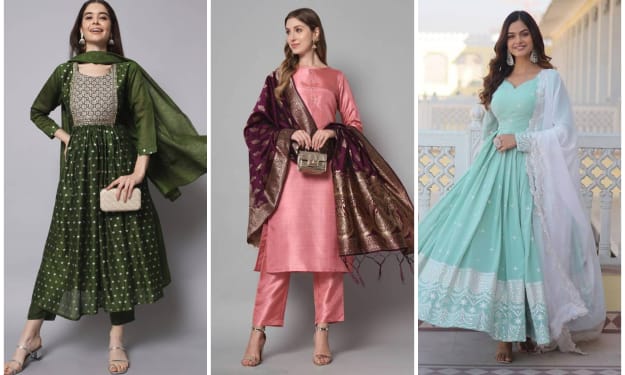
Dark Colors vs Bright Colors – What Works for Plus Size Salwar Kameez
You've heard it forever: "Dark colors are slimming, stick to black and navy." Meanwhile, those bright fuchsia and sunflower yellow plus-size salwar kameez sets are practically screaming your name from the store window. But you walk past them, grab another maroon or black suit, and tell yourself you're being practical. Sound familiar? Time to throw that outdated playbook out the window.
By Amit Mandalabout 6 hours ago in Styled



Comments
There are no comments for this story
Be the first to respond and start the conversation.