
Times Up on Toxic Fashion Masculinity
See how the feminist movement is making moves towards equality within the fashion industry

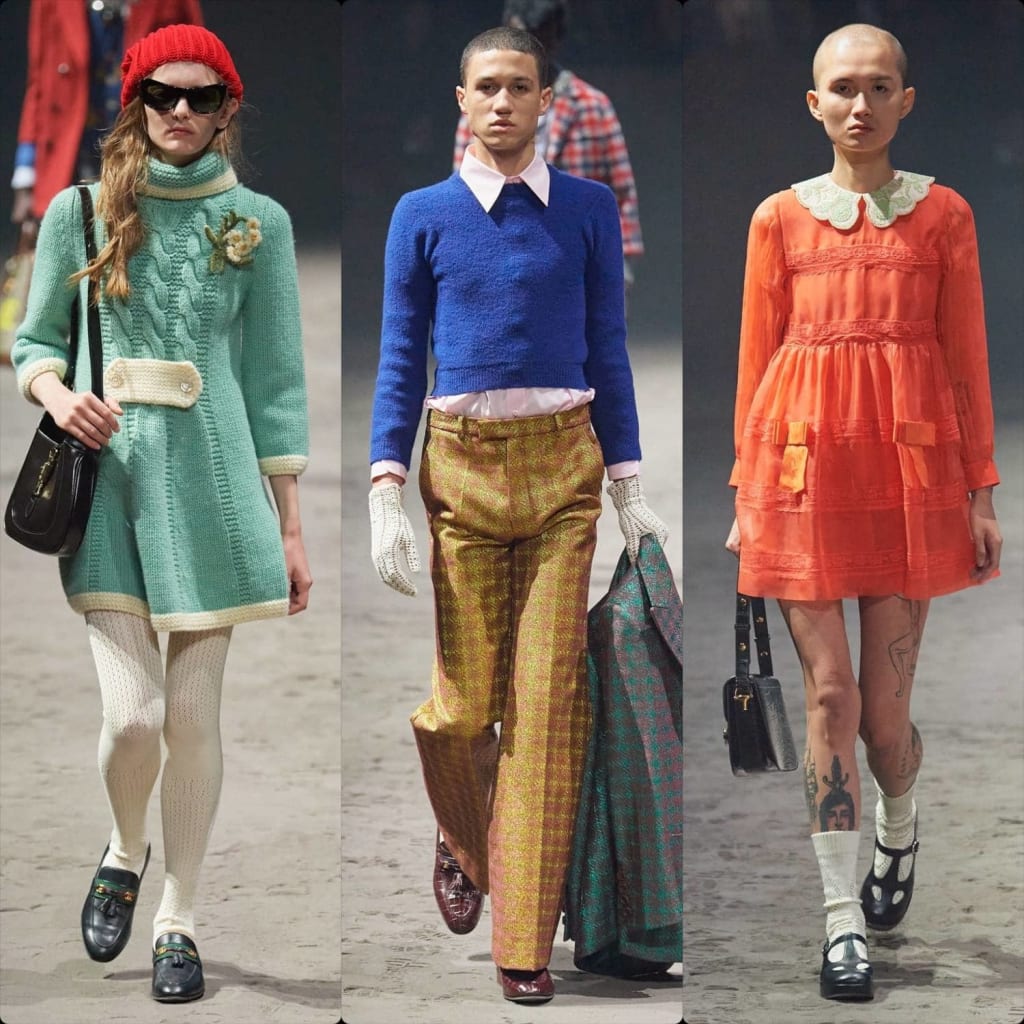
With the rise of feminism, it seems no surprise that the fashion industry has played a significant part in the social commentary and representation of both femininity and masculinity. Whilst gender-bending A-listers like Timothée Chalamet, Billy Porter, Lu Han and Harry Styles are stepping out in fearless fashion choices, the continuation of the traditional ‘suit and tie’ look seems to be turning into a redundant form of dress in 2020.
Indeed so many people take risks on the red carpet, but this tends not to consistently translate into every day style. As an exception to the rule, 26-year-old Harry Styles seems to possess no qualms when subverting the stereotypical masculine trends that have been socially internalised for years. After serving 5 years in the pop sensation group One Direction, Styles’ trademark flares, painted nails, floral prints and pearl necklaces give rise to a new wave of fashion that influences the construction – or rather deconstruction – of traditionally gendered masculinity tropes. A recent instance even showed Styles sporting a Gucci handbag as he made his way through Heathrow Airport in early February; meanwhile his collaboration with, and hosting of, the 2019 Met Gala served to epitomise this trend in all its Camp-themed glory. In a way that sets him so far apart from his stylistically conventional wardrobe of the One Direction days, Styles’ fearless emergence into the experimental side of gender-fluid clothing continues to pioneer a new way for masculinity to be viewed and represented in the public eye.
As if to join this evolution, social commentary on dangerously conventional masculinity types has even begun to infiltrate the high-end fashion scene. For his Men’s Fall 2020 collection in Milan, Gucci’s creative director Alessandro Michele débuted a show that seemed in explicit dialogue with how, as his show notes comment, ‘toxic masculinity produces oppressors and victims at the same time’. As well as being staged around this motif of nostalgia and a revision to turn back the clock, Michele’s collection featured a metamorphic retreat to childhood with his models showcasing grass stains, school uniforms, knitted dresses and blouses. By purposefully styling his collection around androgyny, Michele imposes the deliberate irony surrounding the unrestricted nature of clothing before society’s stereotypical imposition. The freedom of his show therefore exhibited the increasing need for designers to use their voices and call for the destruction of contemporary oppressive masculinities within the fashion industry. Whilst Michele drives a fantastic way forward in terms of his message, he simultaneously warns of the ineluctably strict status of masculinity: in an interview with Vogue, he adds ‘this is not a narrative that excludes or rules out mainstream masculinity; on the contrary, I want to talk about how complex it is to be a man […] this means growing up maybe in a different way because the world of men is very diverse and full of different elements like the feminine world’.
Indeed by no means does this article imply that certain fashion traits should be enforced or stipulated; however it simultaneously translates that when looking back historically, there are some ways that men’s fashion have implied a binary way of masculine dress. In the same way, fashion itself has been inherently thought of as a strictly female-driven practise in terms of those who participate and experiment with clothes and brands. The need for gender-fluidity within these exclusive environments is no less apparent than in The Business of Fashion’s discussion of identity misrepresentation: ‘surveys conducted by CSMM found that only 7 per cent of men globally relate to the way masculinity is depicted in the media’. It follows that the ability of masculinity to be created, performed and reinforced through the visual culture of fashion and the media is greatly unparalleled; only by identifying the way that this interacts with our own internalised views of masculinity can the social impact of contemporary fashion finally begin to deconstruct our internal schemas.
About the Creator
Abby Allen
21//Student//https://oohmercedestumblr.wordpress.com/
Keep reading
More stories from Abby Allen and writers in Styled and other communities.
Dark Colors vs Bright Colors – What Works for Plus Size Salwar Kameez
You've heard it forever: "Dark colors are slimming, stick to black and navy." Meanwhile, those bright fuchsia and sunflower yellow plus-size salwar kameez sets are practically screaming your name from the store window. But you walk past them, grab another maroon or black suit, and tell yourself you're being practical. Sound familiar? Time to throw that outdated playbook out the window.
By Amit Mandala day ago in Styled
The Politics of Playing Dress-Up
Well, to start off I'd like to say a happy world book day to all who celebrate. I know I haven't really posted anything on my socials about it but I'm not a jubilant kind of person. I lay low most of the time. Let's start off with a popular anecdote from the vaults...
By Annie Kapur5 days ago in Geeks


Comments
There are no comments for this story
Be the first to respond and start the conversation.