

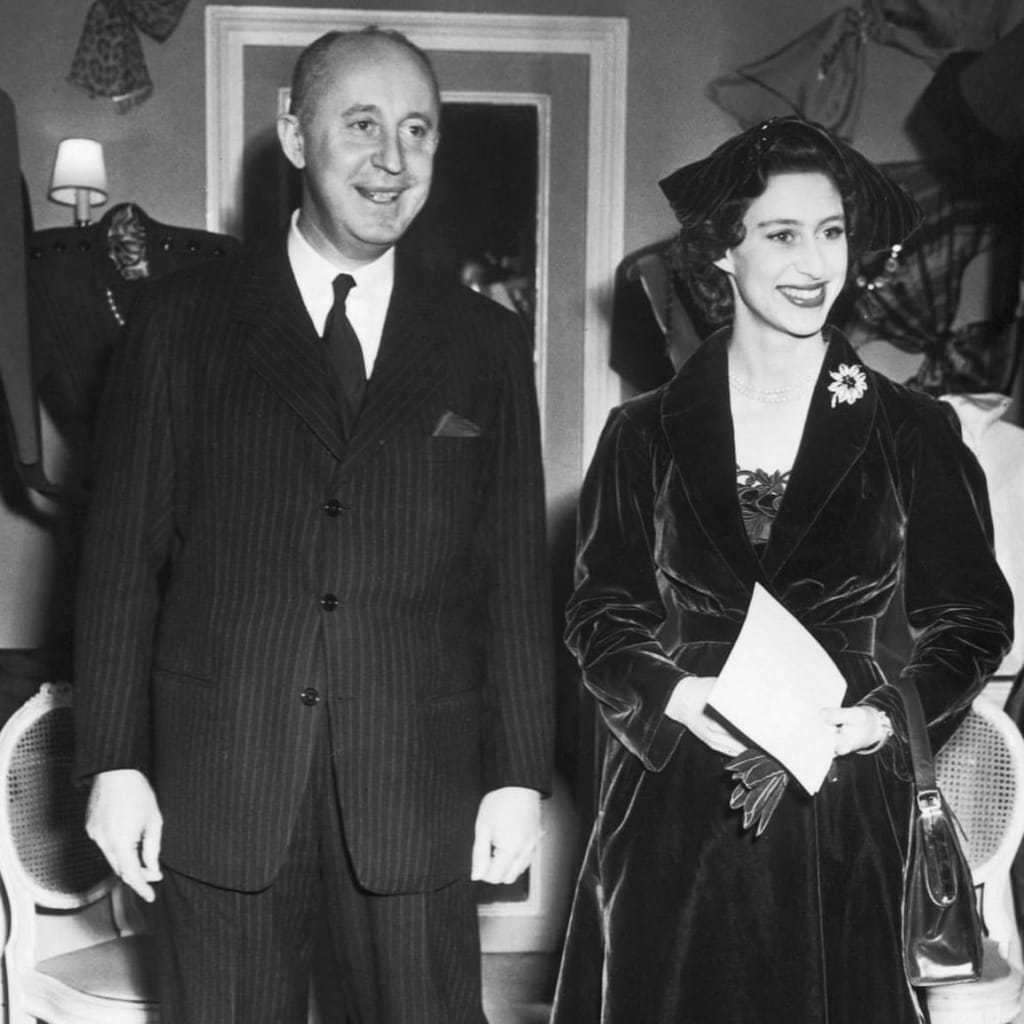
We all know the name “Christian Dior” and feel ‘chic’ when wearing his clothes. The fashion shows are a wonder to behold and it’s always a good name for the models to add to their CV’s. But how many of us know the history of the man and the company?
Christian Dior (the man) was born in 1905, in the seaside of town Granville on the coast of Normandy. His father was a wealthy fertilizer manufacturer and Christian was one of five children. At five years of age, the family moved to Paris. Being artistically inclined, Christian began to sell his sketches for pocket money, and when he left school, his father bought a small art gallery for his son and a friend to sell their, as well as paintings by other artists, including Pablo Picasso.
After the Great Depression of 1929, his father’s business collapsed and Christian was forced to close his art gallery. It was now that he had his first contact with fashion when Christian started to work with the fashion designer Robert Piguet. This went well until 1940 when Christian was called up for military service. In 1942, he finished his military service, and Christian began working for the couturier Lucien Long, where he and Pierre Balmain were the primary designers.
During the war, the fashion designers (including Lelong, Jeanne Lanvin and Nina Ricci) dressed the wives of Nazi officers and French collaborators, and this was a way of preserving the fashion industry during the Second World War for both economic and artistic reasons.
During this time, Christian’s younger sister, Catherine, joined the French Resistance. She was captured by the Gestapo and imprisoned at the Ravensbruck concentration camp. Catherine survived and was liberated in 1945. In tribute to his sister’s courage, Christian named his first fragrance after her: “Miss Dior.”
Christian Dior (the company) was founded by Dior himself in 1946, and it was set up at 30, Avenue, Montaigne, Paris. The “House” (company) was backed by Marcel Boussac, who was a cotton-fabric magnate, and the first fashion collection was shown in 1947, February 12th. This collection presented the 90 different looks. Named “Corolle” and Huit”, the lines were christened the “New Look,” which was a phrase coined by US Harper’s bazaar magazine editor Carmel Snow.

This “New Look” consisted of a calf-length, full skirt, a cinched waist and fuller bust. This was a ‘rebuttal’ to the post-war fabric restrictions --- the average Dior dress used twenty yards of fabric. The opulence of Dior’s designs contrasted with the grim post-war reality of Europe and this helped to re-establish Paris as the joyful fashion capitol it had once been.
The orders flooded in! Famous stars such as Rita Hayworth and Margot Fonteyn bought and wore pieces from Christian Dior, raising Dior’s profile. He was even invited to stage a private presentation of the collection for the British Royal Family. Dior was known to be very superstitious. 1) Each collection included a coat named after his place of birth, Granville. 2) In each show, at least one model wore a bunch of his favourite flower, Lily of the Valley. 3) He never began a couture show without having consulted his tarot card reader.
In November, 1948, Dior established a ‘luxury ready-to-wear’ house on the corner of 5th Avenue and 57th Street in New York. This was the first of its kind. Dior Perfumes was launched in this same year, with Miss Dior and Diorama being the first perfumes.
In 1949, Dior arranged licensed production of his designs. He was the first couturier to do this. Now that he had ‘created’ the New Look, which included shoes, gloves, hats, furs and stockings, Dior saw the need to protect his designs, and this proved to be a profitable move.

At 19 years of age, Yves Saint-Laurent became Dior’s design assistant (1955). Dior wanted Saint-Laurent to succeed him which is just as well because Dior suffered and died from a heart attack in 1957. 2,500 people attended the funeral, including all of his staff and famous clients led by the Duchess of Windsor. In order to stabilize the label, the then 2 year old Yves Saint-Laurent was appointed the artistic director.
Saint-Laurent was conscripted into the army and replaced by Marc Bohan, who proved just as successful, created the “Slim Look.” The House was now a global brand. In 1978, the company went into bankruptcy and was sold to the Willot Group. This group went into administration and was purchased by Bernard Arnault for “one symbolic franc.” (1984)
Arnault changed the way the company had been working and today Christian Dior stands alone as a megabrand in its own right.
Gianfranco Ferre was made the stylistic director in 1989 and remained in this position until 1997. In 1997, the British designer John Galliano was now at the creative helm. “Galliano has a creative talent very close to that of Christian Dior. He has the same extraordinary mixture of romanticism, feminism and modernity that symbolized Monsieur Dior. In all of his creations --- his suits, his dresses --- one finds similarities to the Dior style,” Arnault is quoted as saying about Galliano.
Galliano ‘left’ in 2011 and his position was taken over by Bill Gayton until 2012, when Raf Simons took over as ‘artistic director’ of Christian Dior.

When you look at the website of Christian Dior, you will find a professional and very well-thought-out site, which supplies items from women’s clothes and shoes to make-up and bags to perfumes to men’s clothes and shoes to children and baby clothes. These may seem expensive when compared to other brands, but the quality is well worth the money. And don’t we always look and feel “smart” when wearing such a distinguished and well-known brand!
(My research comes from Vogue. )
About the Creator
Ruth Elizabeth Stiff
I love all things Earthy and Self-Help
History is one of my favourite subjects and I love to write short fiction
Research is so interesting for me too
Keep reading
More stories from Ruth Elizabeth Stiff and writers in Styled and other communities.
"Maison Lucile"
On 27th July, 1904, the best of London society crowded into a large, grey-walled Georgian room in Hanover Square, with an empty platform at one end. Music played, lights flashed and the Lords and Ladies sat in their chairs, looking at their programmes. Six stunning ‘models’ swayed, unsmiling, across the stage, wearing such delights as “Spring’s Delirium” and “Pleasure’s Thrall”. Although remarkably familiar for us today, this was a brand new ‘event’ in 1904. This piece of theatre was watched over by its creator, the 41 year old Lucy Duff Gordon, whose business 7 years later became “Maison Lucile” — the first international house of Couture.
By Ruth Elizabeth Stiff3 years ago in Styled
Latest Women’s Fashion News 2026: Trends Redefining Style, Confidence, and Modern Elegance
Women’s fashion in 2026 is undergoing a powerful transformation. No longer limited to seasonal trends or rigid style rules, modern fashion is now about self-expression, sustainability, inclusivity, and comfort-driven luxury. Designers, brands, and consumers are collectively shaping a future where fashion reflects real lifestyles while maintaining creativity and elegance.
By Emilia Vizcarra7 days ago in Styled
Day 4 of Quitting
If this is how sobriety feels, maybe it’s better to go through life a little buzzed… this, along with other hits like, I want to kill myself, I wish I was dead, and I’m going to throw myself off a bridge have been the only thoughts on rotation these past few days. I promise myself that if, in a month, I still feel like this (‘this’ meaning despondent, full of rage, and simultaneously numb) I can go back to smoking. Until mid-February though? Nicotine is off the table.
By sleepy drafts6 days ago in Longevity




Comments
There are no comments for this story
Be the first to respond and start the conversation.