
Rose Brand’s 100-Year Evolution of Stage Drapery: Lessons for Today's Designers
Every theater designer has faced this moment: the drapery you specified looks perfect in samples but fails catastrophically during tech week. It’s a moment that can feel catastrophic, especially with so many other elements needing attention during this crucial week. But what if you could avoid this expensive mistake by simply looking back?

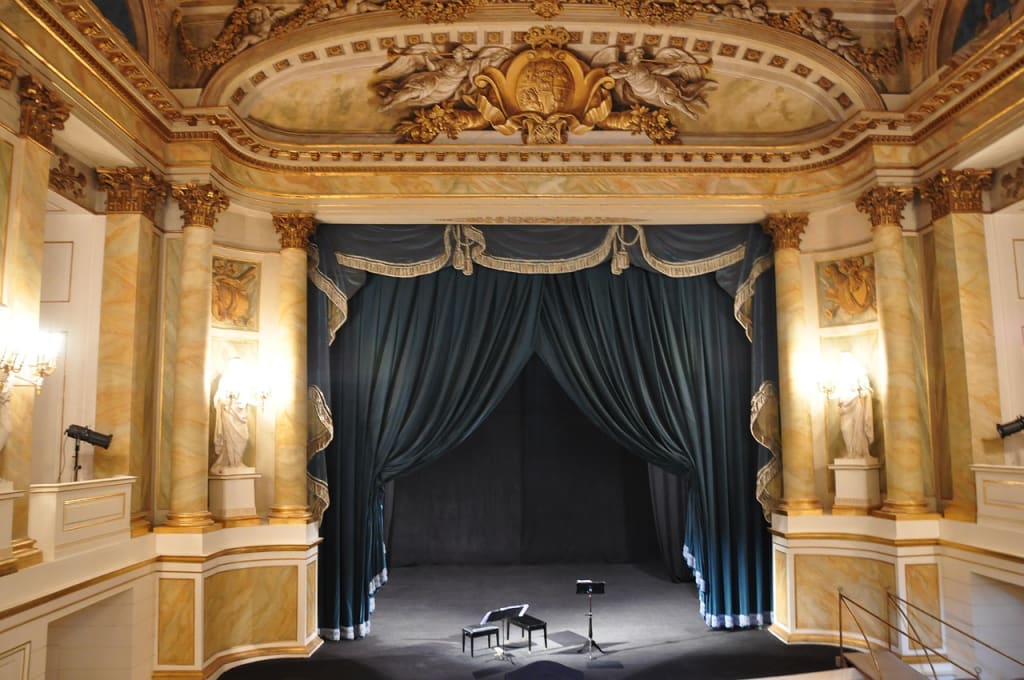
Stage drapery has evolved over the past century to meet design standards, safety concerns, and current trends. We will dive into that 100-year history to glean helpful tips and tricks for today's designers. Drawing on legacy brands, such as Rose Brand’s archive of theatrical materials dating back to 1921, we will summarize the lessons learned for a new generation of scenic designers.
Tragedy in Chicago
On a December afternoon in 1903, tragedy struck. The Iroquois Theatre in Chicago was the site of the single deadliest one-building disaster in American history, only to be surpassed by the September 11th terrorist attacks. A broken light ignited the muslin curtains, and a fire curtain failed to deploy properly. Improperly labeled or blocked fire exits, a panicked crowd, and a lack of a fire alarm system led to 602 deaths and 250 injuries.
This tragedy led to improvements in theatre fire safety, including an analysis of the sheer amount of combustible material on the stage. In On the Safeguarding of Life in Theatres, a 1906 paper by John R. Freeman, the stage was described as such:
“On the Iroquois stage at the time of the fire there was more than ten thousand square yards of canvas, or two and one-half acres, and in addition about three thousand square yards, or half an acre, of gauze. To hang this required nearly eleven miles in length of 5/8-inch manila rope, and in the frames, battens, braces, profiles and set pieces, the stage carpenter of the Iroquois tells me, after making careful estimate, that there was about eight thousand square feet of white pine lumber. The total weight of this fuel was more than ten tons, all dry as tinder, and all set or hung in a way to give the quickest possible exposure and spread to the flames.”
The amount of flammable material that was in the fly space of the Iroquois was a perfect storm for the tragedy, especially when the fire curtain failed to deploy properly. Today, flame-retardant fabric and carefully maintained fire-safety curtains prevent similar tragedies.
Flame Retardant Fabric
Fire-safety curtains were once woven with asbestos and fiberglass. However, modern curtains are made from safer, more effective materials. Modern fire-safe curtains can be Inherently Flame Retardant (IFR) and Durably Flame Retardant (DFR). This ensures that all stage curtains and stage dressings are safe in the unlikely event of a fire.
Modern stages would not have this amount of stage drapery, let alone be lit with open flames. Nonetheless, there are lessons to be learned from this tragedy for modern stage curtain design.
The Classic Red

Sit and think about the first thing that comes to mind for the average layperson when you say “stage curtain design.” It probably conjures up images of the classic heavy red velvet curtains. From Looney Tunes to David Lynch, the red velvet curtain has been used in media to conjure nostalgia, opulence, and tradition. Red curtains are classic, sensual, retro, and dramatic. Whether thinking of a classic stage picture, the red room of Twin Peaks, or playing on the irony of leaning into the classics, the traditional red curtain can always make for a striking stage picture.
Traditionally, red is associated with royalty and wealth. And historically, theatres existed at the pleasure of the monarchy. Using the traditional red curtain is both a way to nod to this history and play with irony. A great example of this was Natasha, Pierre, & The Great Comet of 1812. Rose Brand created over 60 unique fabric panels for the Boston pre-Broadway run. This unconventional, immersive production brought the audience into the show with the performers and blurred the lines between who was watching the story and who was living it.
Stripping Back
The counterculture movements of the 1960s and 1970s brought forth a new type of theatre; avant-garde productions sought to tell stories in inventive ways. In SoHo theatre collectives, Meredith Monk’s Vessel used dramatic drapery to create an unconventional play space for over 100 performers to tell the epic story of Joan of Arc.
Stripped-back, experimental, minimalist theatre allows stories to shine in different ways. Stage curtain design becomes even more important when working with a simpler, cleaner canvas. So when seeking to replicate some of these more striking yet simple stage pictures, the quality of the fabric becomes crucial when choosing stage drapery and scenic design materials.
Minimalism does not mean the absence of intent, but instead the magnification of it. When there is a simpler stage picture, it becomes important that each part of the picture is carefully designed and thought out. Much can be done with a simple curtain, sheer scrim, or projection screen. Modern designers can do more with less and create dramatic stage pictures with the simplest stage drapery.
Opulent Revival
The biggest Broadway musicals of the 1980s and 1990s brought opulence and grandeur back to the stage with lush scenic designs, ushering in a dramatic chapter in theater design history. The Phantom of the Opera, Les Misérables, Into the Woods, and Cats paired grand stories with grand scenery and stage pictures. More is more when it comes to these grandiose productions.
The Legacy of the 1980s
Inspired by these productions, a new generation of big Broadway shows emerged. For example, think of the dramatic scrim that greets theatregoers for Wicked that shows a map of Oz to acquaint audience members with the world that will unfold.
Or, opulence and drama can mean something completely different; think of the reimaging of Cats with Cats: The Jellicle Ball. This new production swapped out the imagery of the Purgatory-esque world of the original for one inspired by ballroom drag culture, featuring metallic curtains and a runway for performers to strut their stuff.
Playing with the fun and drama of opulent theatre allows a designer to bring big magic to the stage. Quality is crucial when making these dramatic designs, and legacy vendors are the best choice for delving into this stage style.
A Century of Tradition and Safety To Draw Upon

Theatrical design in the modern age stands on the shoulders of decades of experimentation, safety protocols, and storytelling. From the simplest stage designs to the most opulent worlds, today’s designers can draw inspiration from the past century to create something new that brings the theatrical conversation to a new space.
As important as the design is, the safety protocols that emerged from several unnecessary tragedies that shocked the community and paved the way for safer spaces for audiences and performers to enter a new world together. Safety and design can coexist peacefully to make something beautiful and new.
About the Creator
Tiffany Young
Tiffany Young can usually be found watching her favorite Twitch streamers, playing Breath of the Wild, or binging the latest Netflix original. She enjoys writing about everything from vintage vinyls to nerdy collectibles.
Keep reading
More stories from Tiffany Young and writers in Styled and other communities.
What Bingo Supplies Do You Actually Need for Your First Fundraiser?
Hosting your first bingo fundraiser is exciting and a little intimidating! You know a bingo event works as a great way to boost income for nonprofits, but once you move from “Let’s host a bingo fundraiser!” to “Let’s get down to work!” the questions start piling up.
By Tiffany Young2 months ago in Lifehack
What Are the Best Structured Dresses for Corporate Offices?
Dressing for a corporate office often requires a careful balance between professionalism and personal style. While traditional business attire once leaned heavily on suits and separates, modern workplaces have gradually embraced more versatile options. Among them, structured dresses have become one of the most reliable choices for women navigating professional environments.
By BTK COLLECTIONabout 16 hours ago in Styled



Comments
There are no comments for this story
Be the first to respond and start the conversation.