
One can never go wrong with a saree
UPCYCLING TRADITIONAL INDIAN SAREES TO CREATE CULTURAL FUSION FOR A SUSTAINABLE FUTURE

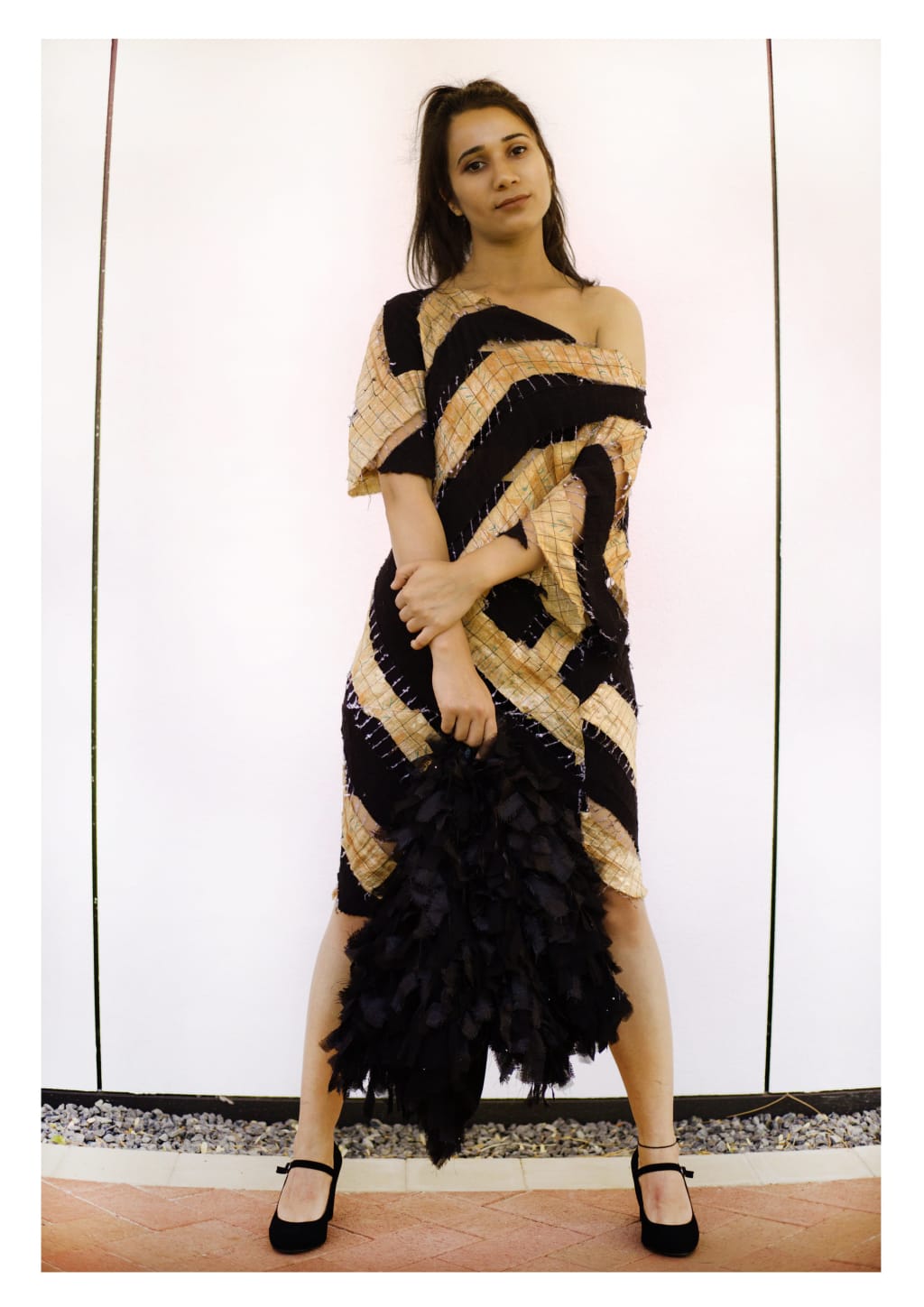
Abstract
The initial project focus intended to break down cultural barriers through the designing of fashion, inspired by both Indian and Western culture. However, whilst the concept of cultural fusion remained, the project began to shift as research led to an awareness and interest in the need for sustainable fashion. This project examines zero-waste pattern-making techniques along with the recycling and repurposing of used Indian saree cloth. Recycling practices are not a new trend in Indian culture, and zero-waste practices are embedded in the history of garment making. Such practices could be seen through the draping of the saree.
Different pattern-making techniques have been adopted by practitioners around the world and further developed. Additionally, the saree cloth is repurposed using different Indian textile techniques, in order to appeal to both, a Western and Indian contemporary fashion industry. This project aims to present a mini collection of clothing that proves that aesthetics in fashion are not compromised in the creation of sustainable fashion.
Previously, I have worked on projects breaking gender barriers through designing unisex collections. I am passionate about challenging the basic norms of fashion and fashion barriers based on class, culture, and gender. A similar notion inspired me to develop a project that breaks fashion barriers based on class and culture. However, after research, I discovered that it is very difficult to break class barriers and cultural mindsets in the time of this project. Hence, I decided to work on a project that engages with the opportunities presented by cultural fusion.
Aiming to work on bridging cultural barriers, the project revolves around intertwining traditional Indian ethnicity with western culture. The project focuses on sustainable contemporary western clothing inspired by Indian culture. To create garments for the international market with a contemporary twist while maintaining the ethnic essence. So, my research question is, how can traditional Indian practices of zero-waste garment making, along with recycling, influence a sustainable contemporary fashion industry?
Sustainable principles such as recycling, natural dyeing, mending, and zero-waste garment construction are not new concepts within Indian culture. Such practices are embedded in the history of garment making within many non-western cultures, such as the draping of the traditional Japanese kimono as well as Indian sarees.
In my project, influences from non-western cultures will be immersed within the techniques of garment-making and the creation of hand-made cloth. I will experiment with reusing and recycling Indian saree cloth, to create new hand-made textiles along with zero-waste pattern-making techniques to come up with uniquely contemporized silhouettes.
In this regard, I have researched the works of international designers working on sustainable fashion; Timo Rissanen, Julian Roberts, Holly McQuillan, and Shingo Sato.
Sustainable principles of fashion design—upcycling and recycling, zero-waste pattern development, re-evaluating the lifecycle of the garment in order to promote a circular fashion economy—are investigated and developed in this project.
According to FIB (2018), “It is not only Western designers that are experimenting with this (cultural) fusion. India has been influenced by Western Culture just as much, if not more than Western culture has been influenced by India.”
India is a multiplicity, with different ethnicity, language, cultures, religion, diets, and fashion. India cannot be considered a monolith. As seen in the figure, one can easily differentiate amongst people from a different region of India based on their attire, textile, and practices. For many years contemporary-minded Indian youth. However, in recent times, both Western and Indian designers are once again embracing traditional techniques and aesthetics. One example of this movement is rising designer to Bollywood stars, Swapnil Shinde (Haque 2018). Shinde presents collections that effortlessly combine new and old Indian identities.
Indian designers that were previously reluctant to design in this way are once again joining hands with Indian artisans to utilise traditional skills and techniques with utilising unique Indian handmade textiles. This method of designing promotes a sustainable approach to the retention of Indian cultural identity. It creates a bridge between the ‘the new’ and ‘the traditional’ in both, textile making and garment manufacture. The online journal Fashion United observes that the fashion and textile industry are “one of the largest contributors to India's export with approximately 13.5 percent of total export amounting 42.24 billion dollars”. This could be an account of India’s high population but also evidences the vastness of India’s textile industry and enriched clothing heritage.
Along with Indian fashion, the saree has succumbed to a western aesthetic. The saree is a piece of cloth owned by most Indian women. However, over time it has lost its cultural capital amongst the young people, and as it is no longer regarded as a modern fashionable item.
Therefore, more recently, emerging designers are making efforts to blend the saree with modern garments, in an attempt to reinvigorate the saree’s cultural and traditional heritage. Designers are redesigning the powerful drapery of sarees into ‘palazzo’ saree, ‘sarmi’ or sarong saree, and ‘gown’ saree.
My project aims to break the saree out of its traditional mold and infuse it with new energy. I aim to acquire the Indian saree to create a contemporary collection of garments for both Western and Indian fashion industries.
About the Creator
Keep reading
More stories from writers in Styled and other communities.
Eid Salwar Kameez Trends 2026: What Women Are Choosing This Year
Eid is one of those moments when fashion feels meaningful it’s not just about looking good, it’s about feeling good, comfortable, and confident as you celebrate with family and friends. As we head into Eid 2026, the fashion mood is clearly shifting. Women are choosing salwar kameez designs that are lighter, softer, and more versatile than ever, while still feeling special enough for the occasion.
By Amit Mandal8 days ago in Styled
Burmese Curly Wig vs. Kinky Curly Wig vs. Straight Wig
If you’ve ever stood in front of your mirror holding three gorgeous glueless wigs and thought, “Okay… but who am I today?”—trust me, you’re not alone. I’ve worn all three: a Burmese curly wig, a kinky curly wig, and a straight wig. Different seasons. Different moods. Different versions of me. And honestly? Each one hits differently.
By manman zhai6 days ago in Styled
Where's the Glory?
In breaking news, rehabilitated Republican Senator Johnnie Johnson (Pronouns: HE, HIM, HIS) called a press conference from the Men’s room of the New Orleans Louis Armstrong International Airport, Concourse B, across from the Ignatius Reilly’s Lucky Dog stand. The Senator had just returned from a sexual reorientation rehabilitation program in Memphis, TN after being publically disgraced at a Buckee’s Truckstop restroom soliciting sex from an undercover cop three months ago. He is a founding member of the Reformed Christians for Christ, a conservative, pro-family and ex-gay advocacy group. In the spirit of being reborn, Senator Johnson invited reporters to marvel at his plans for a major remodeling of airport bathrooms.
By Cathy Schieffelin5 days ago in Humor
Center Stage with Gina C.
*** I'm keen to republish the interviews I did for my series with Vocal creators. It's been a few years and I thought it might be nice to revisit these wonderful conversations. I'll be releasing them one at a time for a few weeks/months.
By Heather Hubler5 days ago in Interview


Comments
There are no comments for this story
Be the first to respond and start the conversation.