

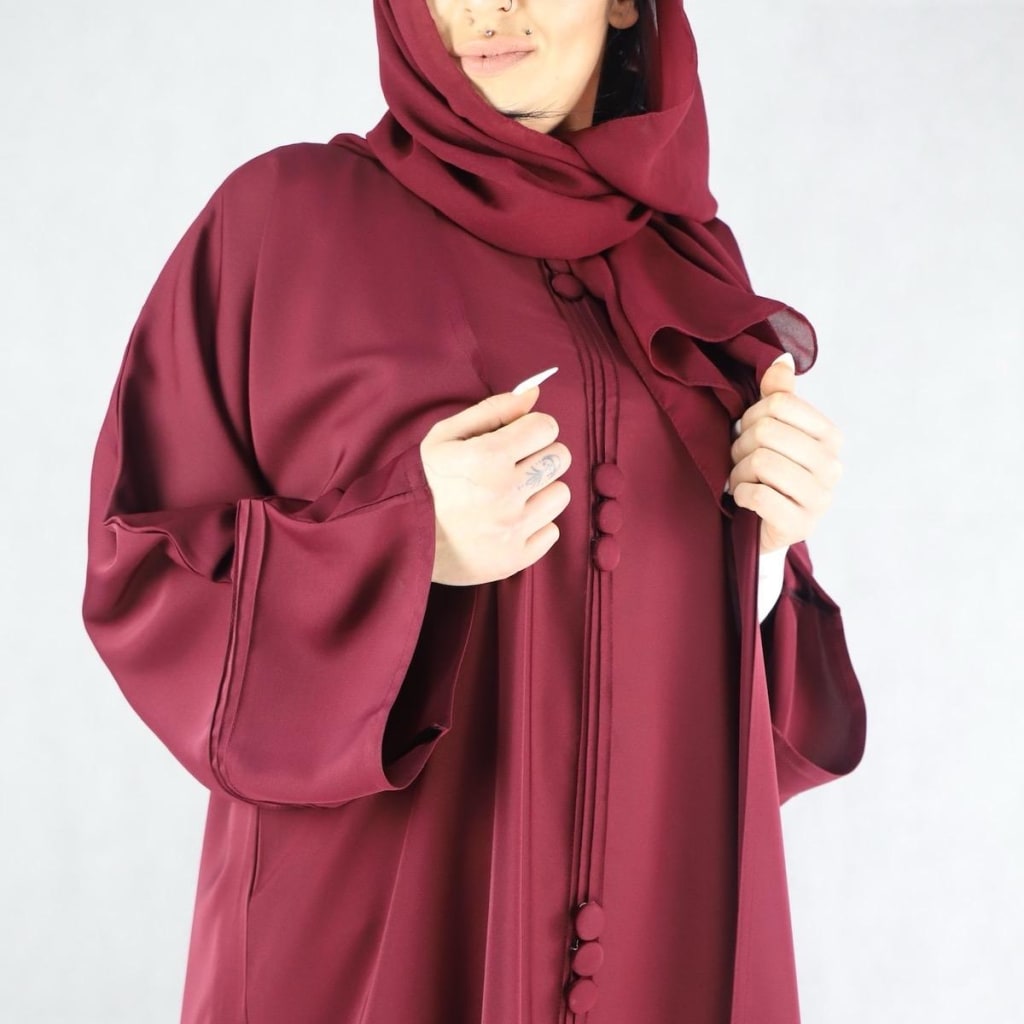
The **abaya** is a traditional, loose-fitting robe worn by women, particularly in parts of the Middle East, North Africa, and other Muslim-majority regions. The history of the abaya can be traced back to early Islamic times, with various cultural influences shaping its evolution. Here's a general overview of the abaya's history:
### **1. Origins in Early Islam (7th Century)**
The concept of modest clothing for women is deeply rooted in Islamic teachings, as outlined in the Quran and Hadith (sayings of the Prophet Muhammad). In the 7th century, Islamic women were encouraged to dress modestly, covering their bodies and avoiding clothing that might attract attention.
The Quran mentions modesty in various verses, such as Surah Al-Nur (24:31), which instructs women to cover their "adornment" and draw their veils over their chests. Although the exact garment described isn't specified as the abaya, the general principle of modest clothing is foundational to its later development.
### **2. Early Clothing Traditions in the Arabian Peninsula**
Before Islam, women in the Arabian Peninsula wore loose, flowing garments to maintain modesty and protect themselves from the harsh desert environment. These garments varied by region but generally included long robes or cloaks.
The introduction of Islam did not completely change the way women dressed but emphasized the need for more modesty and the practice of wearing a veil (niqab or hijab) alongside these garments.
### **3. Development of the Abaya**
As Islam spread throughout the Arabian Peninsula and beyond, the style of dress for Muslim women became more standardized in terms of modesty. The **abaya** evolved as a specific type of loose-fitting, full-length black robe with wide sleeves, traditionally worn over regular clothing. It became a symbol of modesty and piety.
The style was simple and practical, allowing women to move freely while maintaining privacy and modesty. The **black color** became the dominant choice, as it was considered more practical and dignified, though the abaya could also be seen in a variety of colors and designs in some regions.
### **4. The Abaya in the Ottoman Empire (16th to 19th Century)**
During the Ottoman Empire (which spanned from the 16th to the early 20th century), the abaya became more formalized as part of the broader dress code for women in the Islamic world. Ottoman influences extended to fashion in the Arab world, particularly in terms of embroidery and fabric choices. The abaya, along with other traditional garments like the **kaftan**, became part of the elite women’s wardrobe, often made from luxurious fabrics like silk and velvet.
### **5. 20th Century – The Rise of the Modern Abaya**
In the 20th century, particularly in the 1960s and 1970s, the abaya continued to evolve. As many Middle Eastern and North African countries gained independence and modernized, fashion began to reflect a mixture of tradition and Western influences.
During this time, more attention was given to the style and embellishment of the abaya. It was no longer just a simple black robe but began to feature more intricate embroidery, beadwork, and even prints. Designers started creating abayas in various colors and materials, sometimes adding decorative elements such as lace, sequins, or crystals.
The **1980s and 1990s** saw a renewed emphasis on the traditional abaya, as conservative movements in the region advocated for a return to Islamic values, including more modest clothing. In countries like Saudi Arabia, wearing the abaya in public became a legal requirement for women, reinforcing its association with modesty and Islamic identity.
### **6. Contemporary Abaya – Fashion Meets Tradition**
In recent years, the abaya has become a blend of tradition and contemporary fashion. Designers across the Middle East have reimagined the abaya to fit modern tastes, with styles ranging from simple, understated designs to more avant-garde creations. These modern abayas often feature new cuts, fabrics, and even fashion-forward elements, like kimono sleeves, asymmetrical shapes, and bold colors.
High-end designers like **Elie Saab** and **Abaya designers** in Dubai, Qatar, and other parts of the Gulf have helped to elevate the abaya to a global level, with luxurious materials like chiffon, satin, and velvet.
### **7. Global Influence and Variations**
While the abaya is closely associated with the Gulf region, it has become increasingly popular in other parts of the world, particularly among Muslim women who adopt it for cultural or religious reasons. Many women wear it for reasons of modesty, personal expression, or cultural pride.
In addition, the abaya is part of a broader trend in modest fashion, which has gained attention globally in the 21st century. As Muslim women around the world seek fashionable yet modest clothing, the abaya has become a key piece in the modest fashion industry, with online stores and fashion shows catering to this demand.
In non-Muslim majority countries, women from various cultural backgrounds also wear abayas, especially during religious events like Eid, weddings, or other celebrations.
### **Conclusion**
The abaya has evolved from a practical and modest garment rooted in Islamic teachings to a globally recognized symbol of modest fashion. From its origins in early Islamic culture to its current status as a modern fashion statement, the abaya continues to serve as an expression of both faith and identity for many women around the world. Its history reflects the broader social, cultural, and political changes in the Islamic world, while its contemporary versions demonstrate the dynamic intersection of tradition and modernity in fashion.
About the Creator
folik ahmed
Bringing the latest designer Abayas and scarves to you, Also will be bringing in some new fashion accessories
Keep reading
More stories from folik ahmed and writers in Styled and other communities.
Abaya
The *abaya* is a traditional garment worn by women, primarily in the Middle East and parts of North Africa. It is a loose-fitting, full-length cloak that covers the body from the shoulders to the ankles. The *abaya* is often black, although other colors are sometimes used, and is usually worn over other clothing to provide modesty. While the *abaya* is associated with Islamic culture, its origins and history are influenced by various cultural and regional factors.
By folik ahmedabout a year ago in Writers
Concealed Carry on the Move: Bags That Meet Legal and Practical Requirements
Key Takeaways Concealed carry bags are one of the many options for keeping a hidden weapon with you in a way that’s accessible. If you’re looking for concealed carry bags, explore options that follow safety guidelines, including a dedicated firearm compartment, internal holster, trigger guard protection, and a low-profile exterior. Bags that meet the practical requirements for concealed safety prioritize the functionality of carrying off-body, including safety, accessibility, and lockability.
By Tess DiNapolia day ago in Styled
Top 10 Tigre Rosa Heels Loved by Fashion Influencers in 2026
Dubai’s fashion landscape in 2026 is all about statement design, craftsmanship, and meaningful luxury, and no brand captures this spirit quite like Tigre Rosa. Blending Italian artisanal footwear with symbolic aesthetics, Tigre Rosa heels have become a must-wear among fashion influencers, style icons, and trendsetters not just in the UAE — but across the global fashion scene.
By tigrerosaofficial7 days ago in Styled




Comments
There are no comments for this story
Be the first to respond and start the conversation.