
A Brief History of Estate Jewelry
History of Estate Jewelry

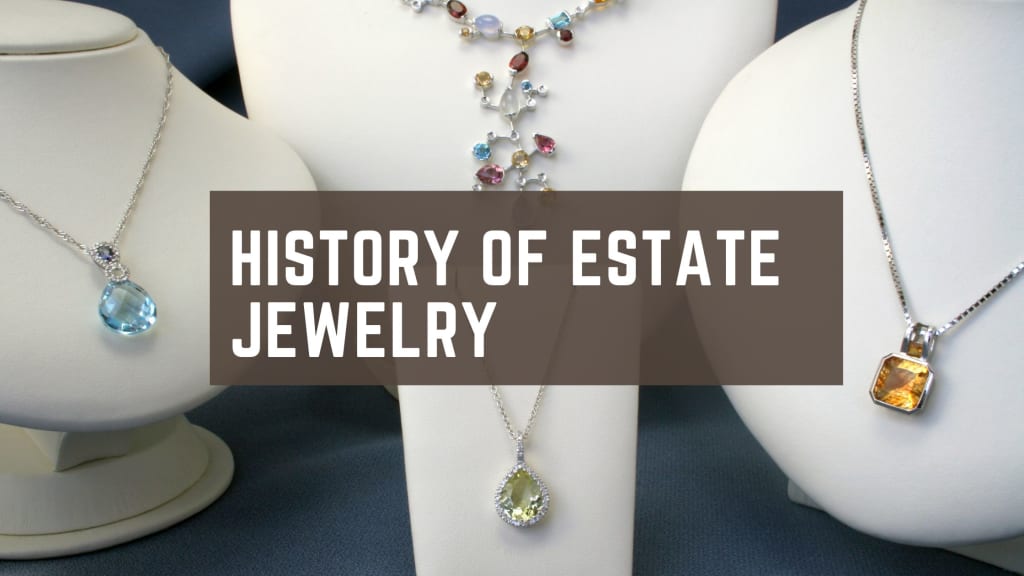
Estate jewelry is described as having formerly belonged to someone. It can be a genuine antique (one that is older than 50 years) or a more recent acquisition.
What draws people to Estate Jewelry?
Sentiment and nostalgia both have a significant role in jewelry choice. More and more people are looking for relics from earlier, more stable eras. Older jewelry serves as a constant reminder of earlier times, adding to the overarching sentiment of nostalgia.
Design - Each craftsman made their distinctive touch on the piece with a superb understanding of shape and form. There were only lone craftsmen working at their chosen craft of making exquisite estate jewelry one piece at a time; there were no machines stamping out items by the thousands.
1850–1890, the middle and end of the Victorian era
With the advent of Queen Victoria, France and Great Britain rose to prominence as important jewelry hubs. A middle class that was expanding as a result of the Industrial Revolution wore jewelry to show off its growing wealth. Mechanization also made it possible to extract precious metals and gemstones as well as create jewelry in large quantities.
Styles of the young queen's early and middle reign were influenced by the romantic image of her and her devoted consort, Prince Albert. Small colorful stones like garnets, amethysts, and topaz were in style, as well as strands of pearls, shell cameos, and seed pearls. When Albert passed away in 1861, jewelry underwent a significant transformation as Victoria began wearing hefty, melancholy pieces to show her mourning. Jet, black onyx, tortoise shell, and hair (often horse hair) were common materials used in heavy gold work.
The 1901–1914 Edwardian era
Edward VII, Victoria's son, succeeded her as monarch, ushering in a jubilant return to elegance. The laces, silks, and feathers worn by Edwardian women were complemented by jewelry. Diamonds were everywhere, either by themselves or combined with colorful stones. Also immensely popular were pearls.
Edwardian jewelry was an engineering marvel because to the metal strength of platinum, which replaced gold as the fashion metal of choice. Now, intricate filigree work could be created to mimic exquisite lace, and the components could move independently thanks to hinges.
1890–1915: Art Nouveau
By the late 19th century, a powerful counter-culture movement had infiltrated all the ornamental arts, challenging Victorian sobriety and dignity. With its romantic, jovial splendor, Art Nouveau erupted across Europe and America at the same time. It was a response to the imitational, frequently crude works produced by the Industrial Revolution and the opposite of its staid predecessor.
Slim, ethereal creatures also showed up in jewelry and artwork. The head of a girl with dreamy eyes and wavy hair is a hallmark of Art Nouveau. Other examples of the effects of nature were dragonflies, with their long, delicate wings, and peacocks, with their iridescent hues and stylized floral themes.
Rene Lalique, a French jeweler, expanded his avant-garde style to include ivory, horn, sculpted glass, and enamel, while more well-known jewelers continued to employ diamonds and pearls in the new, dainty forms. Moonstones and opals were two common gemstones utilised. Louis Comfort Tiffany was an American whose delicate designs and superb enameling had a significant impact on the Art Nouveau era.
1920–1935: the Art Deco era
Art Nouveau's delicate hues were replaced by a brasher, more opulent appearance. Flappers were popular, and Art Deco was too! Art Deco first appeared in France before exploding in America.
Streamlined enameled accessories, frequently in striking hues, complemented the angular-looking attire and style. Gemstone colour combinations were equally daring and vivid. Massive brooches usually featured rubies and emeralds next to coral and lapis lazuli or jade.
1935 to 1949 is the Retro Period
American jewelry flourished during this time while European jewelry manufacture was halted due to the need to finance World War II, which consumed all platinum and the majority of gold and silver. Pieces were colourful and had Hollywood stars as their influences. Large, enormous stones often mounted in rose, green, or yellow gold, depending on the composition of the alloy, began to appear. After the United States entered the war, jewelry production was still extravagant but less romantic. This pattern persisted until after the war, when fashions once more softerened.
But individual artistry was still very much alive. The usage of gold was one distinctive trend that appeared following World War II. Formerly employed as mountings to highlight the beauty of other components of a jewelry item, gold was now the only component of antique jewelry. The styles of the 1950s may be seen in many of the gold brooches that are currently on the market, including straightforward circular pins and more intricate animals or flowers.
About the Creator
Eric originals
We are specializing in antique and estate jewelry. Huge selection of original Antique engagement ring as well as signed jewelry from well know brands such as Cartier, Van Cleef and Arpels, Harry Winston, Tiffany & Co. etc.
Keep reading
More stories from Eric originals and writers in Styled and other communities.
Valentine's Day jewelry gifts they'll love
For the perfect gift for your special someone, think about giving a piece of jewelry. It's never too early to start thinking about Valentines Day. After all, you've always been romantic and thoughtful, and jewelry is the perfect way to express that. Diamonds, in particular, are the ultimate classic gift. They can be set in any precious metal, and are ideal for expressing your love and affection. You can choose a style that matches their personality and will make them feel extra special. You can get earrings in diamonds, for example, that look stunning in any environment.
By Eric originals4 years ago in Styled


Comments
There are no comments for this story
Be the first to respond and start the conversation.