
Who’s Firing Over Free Speech? Employers Reportedly Disciplining Workers After Charlie Kirk’s Death
From airlines to universities, here’s a running list of organizations accused of punishing staff for their online remarks.


On September 10, 2025, conservative activist Charlie Kirk was fatally shot while speaking at Utah Valley University. The killing triggered immediate shockwaves across U.S. politics and social media. But beyond the debates about ideology, violence, and political rhetoric, a quieter fallout has been unfolding in workplaces across the country.
In the days since, people from many different professions have reportedly been suspended, placed on leave, or outright fired for social media posts or public comments about Kirk’s death. Employers have said these actions were taken to uphold codes of conduct, social media policies, or reputational standards. Employees have countered that they are being punished for exercising free speech.
This article brings together two things:
- A list of employers reportedly disciplining staff in connection with Kirk’s killing (based on reputable news reporting and employee accounts).
- A deeper look at the law: what the First Amendment does — and doesn’t — protect, how public vs. private sector rules differ, and what courts have said in recent precedent.
Reported Firings and Disciplinary Actions
Below is a running list of employers that reputable outlets have reported took action against employees over comments about Charlie Kirk’s death. Each item is based on published reporting; terms such as reportedly and allegedly are used deliberately, as many of these cases are still under investigation.
- Nasdaq — Reportedly terminated a junior-level sustainability strategist over social-media posts about Kirk’s killing; Nasdaq said the posts violated its policies and that the company has a "zero-tolerance policy" toward commentary that condones or celebrates violence.
- Office Depot — An employee at an Office Depot in Portage, Michigan, was reportedly fired after a viral video showed staff refusing to print posters for a vigil for Charlie Kirk; the company said it was "deeply concerned" about the customer experience.
- Delta Air Lines — Multiple Delta employees were reportedly suspended pending investigation after social-media posts related to Kirk's killing that Delta said "went well beyond healthy, respectful debate."
- United Airlines — United reportedly took action against employees who publicly commented about Kirk's death, saying it will not tolerate staff celebrating political violence.
- American Airlines — At least one American Airlines pilot was allegedly removed from service (grounded) after mocking posts about Kirk’s death. Reports say the carrier identified multiple employees under investigation for social media activity.
- MSNBC — The network reportedly severed ties with political analyst Matthew Dowd after remarks about hateful rhetoric and violent acts; MSNBC called the remarks "inappropriate, insensitive and unacceptable."
- PHNX Sports — The Arizona-based outlet reportedly fired reporter Gerald Bourguet after a post that management said crossed a line. Bourguet argued that declining to mourn is not the same as celebrating violence.
- Carolina Panthers (NFL) — The Panthers reportedly fired communications staffer Charlie Rock following an allegedly insensitive social-media post about Kirk’s killing.
- Perkins Coie (law firm) — Reportedly dismissed an attorney after social-media comments criticizing Kirk; the firm said the views did not reflect its values.
- Middle Tennessee State University (MTSU) — Reportedly fired a university employee over "inappropriate and callous comments" online concerning Kirk’s murder.
- U.S. Secret Service — An agent was reportedly placed on leave after allegedly expressing negative views of Kirk on social media; the agency said it would not tolerate conduct violating its code.
- Various K–12 school districts and teachers — Reporting has identified teachers in multiple states (California, Florida, Iowa, Pennsylvania, Maryland, Massachusetts, Michigan, North Carolina, South Carolina, Oklahoma, Oregon, Texas) who have been suspended, placed on leave, or fired amid investigations into alleged comments about Kirk.
- Southern University Law Center — A law professor was reportedly suspended, with termination steps underway, after social-media comments about Kirk.
- Local government, military, and public-sector employees — Several government and military employees were reportedly relieved of duties or suspended after posts about Kirk’s death. Agencies have been asked to identify personnel involved.
What the First Amendment Actually Protects
The U.S. First Amendment protects citizens against government censorship, not against actions by private employers. This distinction is crucial to understanding why so many reported firings are legally permitted.
- Private employers: The First Amendment generally does not apply. Employees are usually “at-will” and can be terminated for nearly any lawful reason, including controversial speech. State laws vary: some (e.g., California, Colorado) have additional protections for political activity or lawful off-duty conduct.
- Public employers: Employees have some protections, but these are limited and depend on several legal tests.
The Legal Tests for Public Employees
Courts rely on precedents like Pickering v. Board of Education (1968) and Garcetti v. Ceballos (2006):
- Was the speech on a matter of public concern?
- Was the employee speaking as a private citizen, or in their official capacity?
- Did the speech cause disruption, undermine trust, or impair the agency’s ability to function?
Even speech deemed protected may lose out if the employer can prove disruption or reputational damage.
Recent cases highlight this balance. In Lane v. Franks (2014), the Supreme Court protected testimony by a public employee as citizen speech. In contrast, the case of Massachusetts teacher Kari MacRae, fired over pre-employment social media posts, shows courts are often deferential to schools’ claims of disruption.
Why So Many “Free Speech” Cases End With Terminations Upheld
- Private sector dominance — Most U.S. workers are employed privately, where the First Amendment does not bind employers.
- Broad at-will laws — Employers can act unless prohibited by contract or state law.
- Public disruption standard — For government workers, the “public concern vs. disruption” balancing test often favors the employer.
- Reputation & policy — Courts accept reputational harm as a legitimate reason for discipline, especially in politically sensitive contexts.
Opinion: The U.S. Free Speech Gap
The Charlie Kirk cases expose a deeper contradiction: while the U.S. champions free speech in principle, in practice many employees face severe consequences for political or controversial remarks.
This raises urgent questions: Should states expand employee protections for political expression? Should clearer boundaries exist for employer use of off-duty speech? Should reputational harm be sufficient grounds for termination, or is this an overly broad shield for selective punishment?
Without reform, the message remains uneven: you may have the right to speak, but not the right to keep your job afterward.
Disclaimer
Whilst every effort has been made to fact-check this information, we are not legal professionals, and this article does not constitute legal advice. Readers should seek qualified legal counsel for advice on their specific situation. All information here has been gathered through employee reports and media coverage and is allegedly correct to the best of our knowledge.
About the Creator
No One’s Daughter
Writer. Survivor. Chronic illness overachiever. I write soft things with sharp edges—trauma, tech, recovery, and resilience with a side of dark humour.
Keep reading
More stories from No One’s Daughter and writers in Serve and other communities.
Trump & Epstein: How Close Were They Really? A Verified Timeline of Their Relationship
Introduction Donald Trump has long downplayed his ties to Jeffrey Epstein. Yet the public record — magazine profiles, photographs, court filings, and even congressional disclosures — tells a more complicated story. Trump and Epstein moved in the same elite circles for years, appearing together at parties, sharing social networks, and even praising one another publicly.
By No One’s Daughter6 months ago in FYI
War Between Pakistan And Afghanistan
Tension Escalates Sharply at the Pakistan-Afghanistan Border What’s happening now? Tensions between Pakistan and Afghanistan have suddenly escalated into heavy fighting along their shared border, known as the Durand Line. Both sides are accusing each other of attacks, and military clashes have intensified in recent days. 
By shaoor afridia day ago in Serve
Non Stop War Between Pakistan And Afghanistan
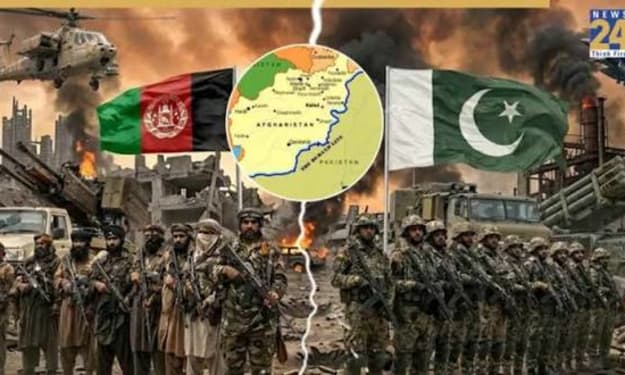
The situation between Pakistan and Afghanistan has suddenly gotten much worse. In late February 2026, Pakistan said it is now in what it calls an “open war” with Afghanistan. Pakistan’s military carried out airstrikes on several major Afghan cities, including the capital Kabul and places like Kandahar and Paktia. This has caused fighting to grow significantly between the two neighbors. �
By shaoor afridiabout 10 hours ago in Serve


Comments
There are no comments for this story
Be the first to respond and start the conversation.