

The package arrived on a Tuesday.
Knowing that I preferred watching the real world over daytime television, one of the nurse’s aides had been kind enough to push my wheelchair as close as he could to the broad front window. I read his name tag carefully — Jackson, it read — and thanked him, but we both knew that by dinner I would forget it. It was a dance we did every day, my failing mind and I.
The mail truck arrived just after the rain started coming down in heavy silver sheets. The driver, visibly annoyed that he had to leave the comfort of the truck to bring a package to the door, turned his collar up against the cold.
“Miss Rose,” Abby called from the front desk, and I looked up in surprise at the sound of my name. “Miss Rose, were you expecting a package?”
“No,” I said, wondering what it could possibly be — and who might have sent it.
“Oh, wow,” Abby said excitedly as she stepped out from behind the desk and practically sprinted across the room to me. “The postmark says it’s from Germany. Do you know someone who lives there?”
“A lifetime ago.” It couldn’t be. It couldn’t — but could it?
With trembling hands, I took the package and turned it over in my hands as if just holding it might provide insight into what lay inside. My crippled fingers, twisted by arthritis over the years, struggled to remove the plain brown paper.
Underneath lay a plain wooden cigar box, but someone had stripped off the paper label and carved an ornate rose into the lid. At the bottom right corner of the lid, the initials “S.B.” were also carved.
“Stefan,” I breathed, still hardly believing it was real. I opened the box, and a folded piece of white paper fell to the floor. Abby picked it up and held it out to me, but I shook my head and asked her if she’d mind reading it aloud. My eyes, along with my memory, were slowly but surely failing me.
Drawing up a chair beside me, Abby unfolding the paper and began to read.
To Miss Rose Cohen,
My father, Stefan Becker, passed away some weeks ago. I am writing to you because, as I collected his belongings, I found several items that I believe are rightly yours. I apologize for the delay in sending them, but all I had to go on was your name and your home state of New Jersey.
You should know that he spoke of you often in his final days and thought of you all his life. I know this because he named me Rose as well — and after reading a few of the entries in the enclosed journal, I believe he did so in your memory.
Best wishes,
Rose Becker Muller
“Well?” Abby turned to me as she finished reading, her eyes glittering with excitement. “What’s in the box? And who is this Stefan?”
“Stefan is — was a German soldier I treated during the war,” I said, and the memories flooded back in full color like a film reel, burning the images into my brain. “It didn’t matter which side they were on if they were hurt, and he came to us with a terrible infection. He nearly lost his left arm because of it.”
Stefan had been so young when he was captured that I wondered at the time whether he, like so many of our boys, had lied about his age in order to take up arms for his country. I could still see him when I closed my eyes: his baby face and the thick shock of straw-blond hair that constantly fell down over steely grey eyes that were equal parts piercing and kind.
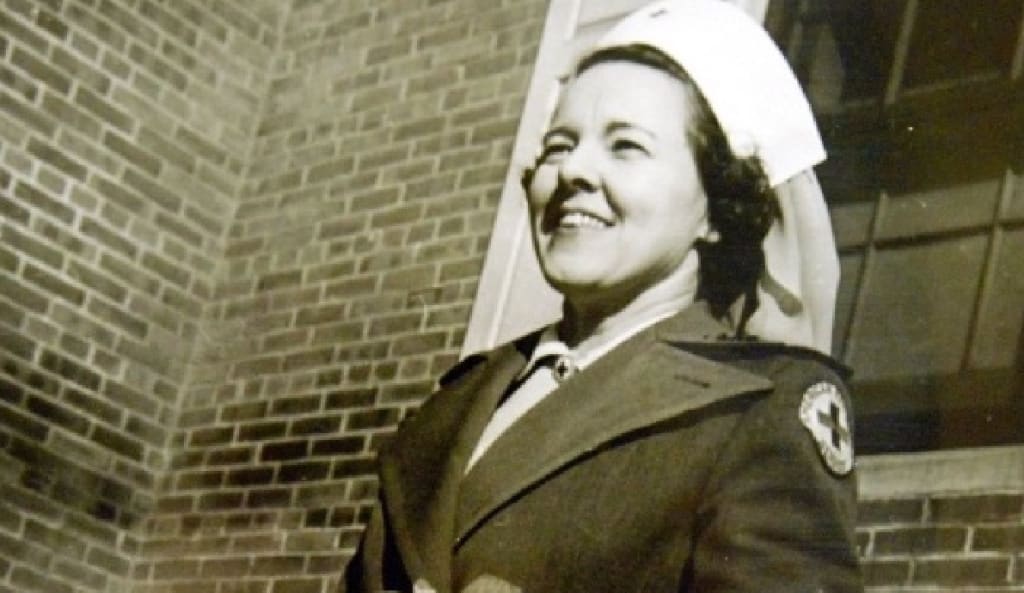
“Is this you?” Abby asked, carefully lifting a worn photograph from the box, and suddenly I saw myself as I had been so many years ago.
My waist-length chestnut-brown hair — once the envy of all the girls in my grammar school class — was twisted into a bun at the nape of my neck, and I wore the standard white cap with a red cross on the front. Under a white apron, I wore a standard khaki green American Army uniform with a Women’s Army Corps (WAC) pin on the collar.
I looked in the box then and saw a little black leather-bound book, clearly the journal mentioned in the letter. Carefully lifting it from the box, I held it out to Abby.
“Read it, please?” I asked.
“April 3, 1945,” Abby read from the first page, and she settled into her chair and opened the black book.
Just twelve short hours ago, I believed my life was over. My arm was quite swollen after being grazed by a bullet, and a fever had begun to take hold. I was left behind to fend for myself, and I was taken prisoner within a matter of hours.
But the Americans did not kill me. They questioned me for several hours, but once they were satisfied that I had no useful information, they sent me to see a doctor. I must have blacked out from the pain, but I awoke soon after to find an angel caring for me. Her voice was like warm honey and her touch was like nothing I had ever felt.
She told me of her home in America, and she asked about mine. I told her I would take her to see it someday, and she just smiled and told me we’d best get the war overwith first. She’s right, of course, but laying here and waiting for the fever to break or kill me, I can’t even remember what we’re fighting about.
“I remember when Stefan told me about his home,” I said, my eyes closed as I pictured it the way he described. “’Rolling hills and miles and miles of vineyards, dotted by the occasional castle,’ he told me. When he offered to take me there, I thought he was delirious, his fever was so high.”
“Maybe not,” Abby said with a smile. “Shall I continue?”
“Please,” I said.
“April 20, 1945,” Abby read. “The angel’s name is Rose.”
We’ve heard rumblings that the war is nearly over, and by the number of my own comrades who have passed through the infirmary here, I must assume that news does not bode well for those of us in German uniforms. Aside from a few rude remarks — most made when the speaker believed me to be asleep or unconscious — my American captors have not mistreated me.
Rose is still the bright spot in every day. I find myself laying awake to watch her when she is on duty and waiting until she is nearby to ask for anything I might need. She doesn’t appear bothered by the distraction, and always has a kind word for me. I will miss the sight of her when I am sent home.
“Were you bothered, Miss Rose?” Abby looked at me expectantly.
“Was I what?”
“Bothered,” Abby repeated. “Stefan wrote that you didn’t seem ‘bothered’ by his attention.”
“Oh, no,” I smiled. “He was a lovely boy, and he had such a wonderful laugh. It made you laugh right along with him.”
“You liked him!” Abby said with a giggle.
“Your laugh is like his, you know,” I told her. “And I did like him. I might have loved him. But then the war ended, and his family came for him. I came home. And I never heard from him again.”
“I think I might know why,” Abby said, thumbing through the black book to a later entry. “He wrote several times about trying to track you down. He even went to the U.S. Embassy in Frankfurt, but all he had was this photo and your name and they were unable to help him.”
She skipped forward through more pages, and then began reading again: “December 5, 1948. I met the woman I am going to marry.”
I met Marta at tonight’s Advent service when I stopped to light a candle for Rose. She asked my name and for whom I lit a candle, and I told her. I half expected her to walk away, thinking that I was spoken for. But instead, she said that if I truly wanted to remember Rose, I should name a daughter after her — and then she asked if I would sit by her during the service.
I felt a tear slide down my cheek, and Abby reached over with a handkerchief to pat it dry. She tucked the handkerchief into my hand and let her hand rest over mine.
“We can stop, if you like,” she said, and I nodded. “We can read some more tomorrow.”
She pressed the book back into my hands, glancing at the box to see whether we had missed anything.
“Miss Rose …” her voice trailed off. She lifted a thick envelope from the box and dumped the contents into my lap. “There’s got to be twenty thousand dollars here!”
“You keep it,” I told Abby as I hugged the black book to my chest. “I have everything I need.”
About the Creator
Virginia Kruta
Daughter of the Revolution. Third generation Army veteran. Scot, according to genetics — American by the grace of God.
Keep reading
More stories from Virginia Kruta and writers in Serve and other communities.
The Rise and Impact of World War II
World War II, which lasted from 1939 to 1945, was the deadliest and most widespread conflict in human history. It involved over 100 million people from more than 30 countries, reshaping the global political landscape and leaving a legacy that continues to influence the world today.
By shaoor afridi6 days ago in Serve
The Impact of World War I: Global Changes and Costs
World War I, often called the Great War, was a conflict that reshaped the political, social, and economic landscape of the 20th century. Beginning in 1914 with the assassination of Archduke Franz Ferdinand of Austria-Hungary, the war quickly escalated due to complex alliances, rising nationalism, and militarism in Europe. Nations including Germany, Austria-Hungary, Britain, France, Russia, and eventually the United States were drawn into a conflict that would last four brutal years and leave an indelible mark on the world.
By shaoor afridi6 days ago in Serve



Comments
There are no comments for this story
Be the first to respond and start the conversation.