
The Wrath Unleashed:
Unraveling the Power and Destruction of Tornadoes

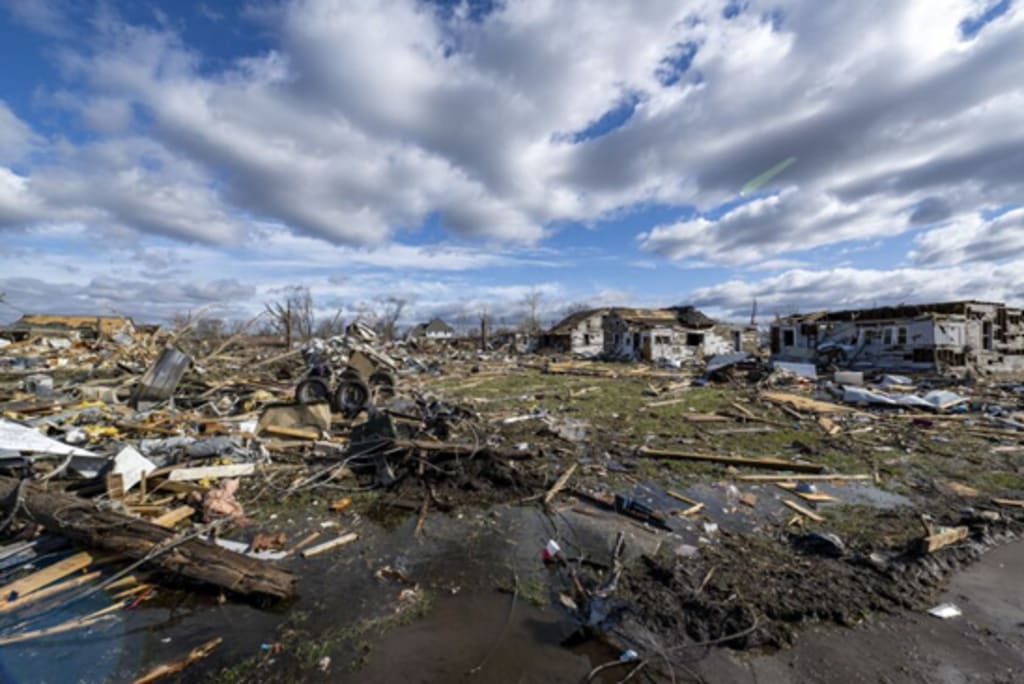
They begin life as ghosts, gently coursing through a solitary existence, but slowly, their gentility turns to rage. They grow larger and larger, hurling and twisting, and desperately reaching down from the sky, and what began as an invisible shade is turned into a monster. Tornadoes, these powerful spinning columns of air, unleash immense destruction wherever they strike. Let us delve into the origins, formation, classification, and impact of these awe-inspiring natural phenomena.
Tornadoes, characterized by their swirling winds stretching from the ground to the clouds, can be found on six of the seven continents. While most tornadoes are relatively weak, it is the few that develop into large-scale events that exhibit extreme violence and wreak havoc upon communities. Among nations, the United Kingdom holds the highest number of tornadoes per land area, averaging around 33 reported occurrences each year. However, in terms of overall frequency and intensity, the United States takes the lead, with over 1,000 tornadoes reported annually.
Tornadoes manifest in two main forms: supercell tornadoes and non-supercell tornadoes. Supercell tornadoes originate within supercell thunderstorms, the most powerful class of thunderstorms. On the other hand, non-supercell tornadoes are smaller and weaker, emerging from non-supercell storms. The formation of tornadoes involves various theories, but a common factor is the coexistence of high and low-pressure air in a confined space.
Non-supercell tornadoes, such as waterspouts and landspouts, emerge when cool, high-pressure air and warm, low-pressure air converge, particularly near the ground. Horizontal movement of air particles from the high-pressure area to the low-pressure area initiates the development of wind. As winds blow at different speeds and directions across various altitudes, a cyclic rotation begins. In the case of non-supercell tornadoes, this rotation evolves into an upright spinning vortex.
To create supercell tornadoes, the circumstances differ slightly. Violent supercell storms draw warm, low-pressure air upward to higher altitudes, leaving behind cool, high-pressure air near the ground. This stark pressure difference initiates vertical wind flow. As the wind gains intensity, it starts to blow in a cyclical fashion, creating a rolling pipe of wind along the ground. In both cases, the vital ingredient for tornado formation is an upward current of wind known as an updraft.
In non-supercell tornadoes, the updraft stretches the vertical vortex until it reaches the clouds. In supercell tornadoes, the updraft lifts the rolling pipe of wind upward until it stands upright. As condensation from the skies is pulled into the spinning vortex, the vortices, whether supercell or non-supercell, officially become tornadoes when they connect the ground to the clouds.
All tornadoes are rated using the Enhanced Fujita (EF) Scale, which classifies them based on factors such as the extent of damage caused and Doppler radar estimates of wind speeds. The scale ranges from EF0, the weakest tornadoes with wind speeds between 65 to 85 miles per hour, to EF5, the strongest tornadoes with wind speeds exceeding 200 miles per hour.
Among the most devastating tornadoes on record is the EF5 tornado that struck Oklahoma City in 1999. Born from a supercell thunderstorm, it unleashed wind speeds of over 300 miles per hour. The tornado resulted in 36 fatalities, injured nearly 600 individuals, and caused approximately $1 billion in damages, leaving a lasting impact on the affected community.
About the Creator
Francis Arhin
A Ghanaian immigrant who ventured from the shores of the Gold Coast to the vast opportunities that awaited him in the United States. I embarked on a transformative path, seeking to carve out a better future for myself
Keep reading
More stories from writers in Serve and other communities.
Stolen Bike, Not Valor
Koa was riding his new electric bike through the city park not too far from the US Embassy where he served in an Asian country. The ride was a part of his daily evening workout. He didn't really like the idea of an electric bike because he thought it was lazy. Besides, Koa had another good mountain bike he'd bought here used and it gave him a much better workout. But this one was his girlfriend's gift for his 29th birthday that she had taken the trouble to ship to him across the ocean. Koa felt obliged to ride it out at least occasionally, but promised himself not to use the battery. He even took it off the bike, to avoid the temptation.
By Lana V Lynx26 days ago in Serve



Comments
There are no comments for this story
Be the first to respond and start the conversation.