
My father, Robert Edmundo Perez, of Mexicali, Baja California, Mexico, son of Edmundo Perez, of Ciudad Juarez, Mexico, has come a long way. He wasn’t born under a full moon or surrounded by a large group in celebration of his arrival, but he was brought into this life with genuine love. Love. It seems like a very simple concept that exists in life. Love encompasses many things. A will. A goal. A choice. A desire. Ganas.
I recall my father telling me that anyone with the last name Perez or the fact that you were from Mexicali would never be capable of achieving such an accomplishment as being a Captain in the United States Army National Guard. Mexicali, like most Baja California or even Mexico, was poor. Anything or anyone coming from such a place would not be able to overcome such disparity. He did it. This was his choice. This was his will. This was his desire. Not once in his lifetime did he think that his service to the United States military would be such a significant part of his life or be a model for the American dream, or the impossible dream as he once told me. The impossible dream. He started singing the song “The Impossible Dream” from Man of La Manche in his soft tenor voice. I always loved the way it came out of his mouth rather than my squeaky teenage voice.
To dream the impossible dream
To fight the unbeatable foe
To bear with unbearable sorrow
To run where the brave dare not go
There goes my father giving me another life lesson of achieving the impossible. At least he didn’t bring out his guitar. The one that grandma left him after she had passed. The one that was signed by a real famous Spanish guitarist. It was in this song that translated to me his desire, his mission, and I listened without judgement until he paused for a brief moment. In that moment, for that split second, I looked at him as he took a deep breath through his nostrils. His breath had the sound of the ocean. There were waves in there and as he let out the air from his mouth, the waves of those ocean waters crushed. How refreshing that sound was and how locked in my mind was that special moment with my father. I looked upwards into his eyes and saw a very low margin build up of a single watery teardrop, but the tear was not going to live as a stream of flowing rivers under his right eye. He wasn’t the emotional type, at least not at this hour. He relied on the Army leadership values for his toughness. Poise and refined. Discipline accompanied with military protocol. My father looked down upon his soft beer belly. He rubbed it, and turned his face from me unnoticeable, then returned to look at me eye to eye.
“Dad, I’m curious, with all the experience and grit that has come with you over the years as a non-commissioned officer, what was your most memorable experience in the Army National Guard?” Now was my time to get the real story from him, if only he should remember fully.
Asking him this question made me think that I haven’t asked him about his experience in the Army at all. I’ve always been the listener rather than the asking, or the seeker, and now that I had matured, it was time to inquire on a more personal level with him. My father always shared freely about his Army experience and it was always interesting to hear these tales, but today, I wanted to know.
His Army experience had a tremendous effect on me as much as it did for him. In a way, I wanted to emulate him. He cast himself as a firm leader who had a great plan and his mannerisms, even though he had Army training, convinced me that I was going to be a man like him one day. He wasn’t hard-nosed or a strict disciplinarian, but kind and gentlemanly instead. With seven sisters to take care of growing up, I was confident that he was capable of handling anything.
What made him join the Army, especially during the Vietnam war, was not for the guts and glory, or fighting enemies for total defeat. No, not at all. Leadership opportunities. Yes, coming from my own father, the attraction to military service was to become a man beyond himself. A symbol, an example for his community and for his family. When my father didn’t show off his rifle or flash ammunition or grenades, I knew, and my brothers knew, that there was more to being an “army man” than guns and battles. It was about leading your platoon in the correct formations and procedures in battle rather than being a trigger happy soldier. Battlefield smarts, battle readiness, and strategies were key to winning a battle and that was key in training his battalion as well.
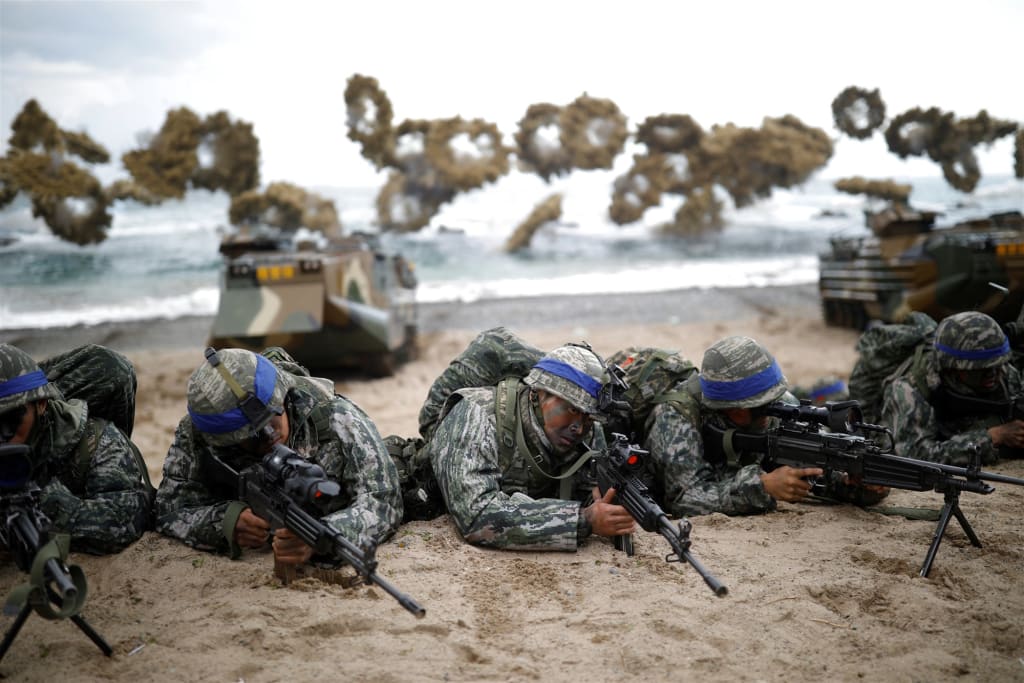
He recalled a particular event in his Army guard career in Seoul, Korea from March 1989, that was a one in a lifetime opportunity for him.
“Being an Umpire, or military referee, during the Team Spirit Mock Battle, between the blue team and the orange team was something very special.
All around us the landscapes reminded me of Tijuana, Mexico. Very old. Dry from all distances. TJ is a poor, broken down country and so was Korea, at least in this village infested region where we took up our mock battle. It wasn't the U.S. It was a third world country and those were some of things you had to consider when proceeding with this kind of exercise. I will never forget the dry hillsides with the low brisk wind and how it swept across the dry grass resembling ocean waves and I stood there with my radio in my hand watching troops march past me. A-10s Thunderbolt aircraft and AH-64 Apache helicopters flying above were just exciting. There were some nearby villagers witnessing chaos of the heavy artillery and troops on foot. Alone the way, there was even graffiti on concrete outhouses that spell out in English “Yanks go home (hell)!” That was a kind welcome for us.
There I was in Korea managing and evaluating this battle exercise. What was I going to do? How was I going to proceed with this evaluation? I was a Captain at the time. Although there were other officers such as Captains and Majors, and Lieutenant Colonials to be evaluators as well. I got lucky when they called me to go to the two week battle-training school.
I had special training and spent two week for evaluating and battle assessment to tabulate damage and losses. I was the neutral one and I gave them an assessment of the engagement and took into consideration how well they were covered and when they clashed with each other.
The soldiers were lined up in single files spread out above the landscape of about a fifty mile radius. Then you could hear all the dispatch from the radios of various commanders, and battalion leaders each ordering their troops to man their post and take their positions. You could see a massive gathering of ninety to one hundred troops with their weapons ready and standing at attention. I lifted my field radio to my ear and radioed out to the Orange and Blue commanders commanding, “Battalions --- commence battle!”
K1 88-Tanks that had been rolling into position were loudly cutting into the low level dry terrain. It was early in the morning too. As the tanks came through the cobblestones on the sidewalks and the asphalt along the street was being ripped apart. There were even government adjusters from Korea that went behind the troops and he would run up to the front and with his little team and assess the damage created by the tanks and troops and he would charge the U.S. government for the damages. The U.S. would get a bill for thousands of dollars, but that doesn’t mean that it was damaged due to explosions. We didn’t blow anything up. We simply rolled heavy equipment into the infrastructure and the infrastructure didn’t support the equipment.
Around 7:15 am to be exact. I watched from my jeep on the top of hill outside of Gap Yeong with Sergeant Joe Vindiola, from Calexico, California. He became a close and reliable assistant for me during this training and battle exercise. And then there was Specialist First Class Gary Cruz from Los Angeles. This young fellow, on 23, was wet behind the ears still. He was rigid and a hard-nosed soldier. What a heck of a team I was blessed with! These guys were good and very well-trained.
As I looked into my binoculars, I was able to identify the teams. The Orange army had orange elastic bands around their helmets and the blue army had blue elastic bands around their helmets. Since I was the evaluator, I had a white elastic band around my helmet to distinguish me and a patch on my shoulder that said “Evaluator/Umpire.”
We used mostly tank and mechanized troops on carriers and then dismounting troops on the field of battle shooting it out with blanks and then they called in air support. The soldiers were firing blanks and they had MILES (Multiple Integrated Laser Engagement System) equipment, a laser testing system, that had buzzers go off when they fired their weapons at you.
What you do is you end up using all the toys and bringing all the military toys to bear on the battlefield. It was very exciting because I only practiced with infantry and tanks before when we did our exercises at Fort Irwin. It was very exciting to witness and be a part of. It only lasted a couple of hours.
At the end of the battle, I had to assess the battle and tell each side how many KIAs (killed in action), how many wounded and what equipment was destroyed based on the confrontation. I had to make an assessment as to whether you were exposed and your equipment was damaged, dead, neutralized. For example, I would say to the orange army, “Attention Orange team, based on the assessment of the mock battle, you guys lose seven tanks and two companies of infantry.” The commander officer of the Orange team reviewed the assessment sheet from me, looked over them and conferred with their lieutenants, calling their troops to attention.
“Attention, Company B!”
On the other end of the field, “Attention, Company A!”
It was marvelous to see large troop formations. Their camouflage uniforms were full of dirt and mud, and their faces lined with black markings under their eyes and across their foreheads. They had battled hard in this training exercise. I never saw such battle efficiency and direct battle awareness among Army troops.
We would do these assessments out in the open field because both armies wanted quick results. I would bring out this tabulation pad and give out the tabulation and all these various army personnel would report to their headquarters and reply with a response such as “we executed our engagement and we lost so much equipment.” We then took the equipment that was neutralized out of the war game.
That was the exciting part.
Then on my assigned umpire worksheet, where I made my BDA (Battle Damage Assessment) , with a plastic protective sheet and a grease marker that could be resilient in the field and take a beating from all the dirt and sweat of the battle. I made my markings and did my very observant battle evaluation. On the front side of the worksheet, the first column listed the “combat system.” On the back of the worksheet, there listed the possible factors for standard damage that was typical of a basic battle assessment using the direct fire method. It is interesting to note and consider that troops who were caught in the open during a battle held a higher KIA (Killed In Action), wounded and wounded injured ratio to troops who were under cover or in vehicles. Soldiers who were on the ground, for instance, who were moving rather than being stationed in a hole or trench would be more of an open target and their kill ratio would be higher. Dirt cover was a better defense than being out in the open and bullets would go through brushes and nail you and all your fleshy. There were no forward flanking attacks. Attacks were advancing into another unit.
These combat systems were the weapons used in the combat simulations such as standard Army Tanks with M163 Vulcan air defense system attached to them, TOW (Tube-launched, Optically tracked, Wire guided), M47 Dragon (Tube-launched, Optically tracked, Wire guided), 60/81 mm mortars, 4.2” inch mortar and the infantry squad itself.
The Vulcan is a self-propelled anti-aircraft gun attached to a tank in defending ground units while under heavy air assault. TOW were wire guided missiles that hardly ever missed their target. Dragons were smaller missiles, which is a short distance missile about only a thousand meter range in comparison to a Vulcan missile that goes over three thousand meters out. Infantry soldiers would carry on their shoulders this portable anti-tank guided missile system that deployed the Dragon missiles. The 60/81 mm mortars were used in support to clear the field for ground troop assaults. I used to be an 81 mm mortar platoon leader. The 4.2 inch mortars were the size of a softball in diameter. Their kill ability is close to the kill ability of a tank, based on their combat value, but not quite as much. The infantry squad was light, but they mostly consisted of eleven men with M16 machine guns and their combat value is only 1.6. This value was a specific number that I can not recall. If only my memory of the combat value would have struck inside me longer than the memory of the excitement of battle.
Next to each combat system is a slot for “combat value” and the bigger the number on the combat value rankings, the more damage was produced in the field of battle. With all the combat systems listed under the umpire worksheet, depending on how many times the system was used in combat, each system is given a combat value. This value was determined by the effectiveness that it was used in executing its specific task. In addition to, first, computing the BDA for ARTY (Artillery), CAS (Combat Air Support), and ATK-HELO (Attack Helicopters) and secondly, “attacker/defender” power, a third component in determining BDA assessment , under METT-T (Mission, Enemy, Terrain and weather, Troop support available, Time available, Civil considerations). For example, it was important to shift the ratio of defenders who were “dug-in” because a soldier was stronger, more prepared and tough, so he could survive a longer period of time in the field of battle because of the cover that he has. Another consideration, listed on the umpire worksheet was “Defender has effective obstacles.” This meant that field minds were an obstacle to those defending a specific territory and it made a soldier or team of soldiers more survivable in these situations. Any flanks or rear attacks due to reduced visibility were evaluated, especially those squads that attacked from the left flanks, it provided a better advantage to the attacker. The Umpire/Player Handbook, if I still had it, would have explained more about the BDA totals. There were a lot of military acronyms that you needed to put on the report.
This was the gist of it. There was no right or wrong assessment. Just provide the best judgement on what you are observing and follow commands. If you didn’t see it and even if they did a good job, they didn’t do a good job even if you say it. These soldiers, sometimes you could trust them and sometimes you had to be the one coordinating their strategies.
There were lots of people taking photos and I was in the middle of it all so I never got a copy of the picture or anything because I was out there with my tablet and my driver and my platoon sergeant doing our little thing.
The battle itself was two hours. Just a quick boom, boom, boom. We got taken out and it was really fast . A few explosives from mortars and missiles launching from distance to distance. Soldiers taking cover in trenches and beyond anything and everything that would deflect bullets and fire. I had to make a call and anybody who was exposed was declared dead, wounded, missing in action, KIA and the equipment that was exposed and not well hidden and behind hills was declared destroyed. It was strictly an evaluation.
Nowadays, modern battles don’t last that long.
This was only one battle I evaluated during my six month tour of Seoul, Korea.
My wife Marion and my boys were far from home. Roughly 5,992 miles away. The boys were without their father. The male figure who nurtured and provided for them. I made certain to write to them and call despite the time difference. The letters from Marion always gave me comfort and relief. I knew what I needed to do in Korea. I was following my written orders as an officer. This training exercise was important. My leadership abilities as Captain needed to be exhibited and times with the South Korean government were peaceful. This was a great opportunity to deplore, oversee, and manage a mock battle. I was feeling a sense of victory and success that was meaningful in my military career.
I never thought I would be an Umpire in a battle-training exercise.”
About the Creator
Paul Perez
Jazz, House music, Star Wars, Biking, and Dubble Bubble are the most simple and free contentments, but Jesus leads me. I'm just a blessed soul with a humorous and spiritual side and everyone needs a gentleman like that around.
Keep reading
More stories from Paul Perez and writers in Serve and other communities.
House Plug
Alex House. I met this young man in grade school. I am not sure if it was fourth or fifth grade but Alex was like me. He was quiet, not much of a talker, but he managed to get by and be noticed among the rest of us of kids. Alex was a tall, slender white boy with long blonde hair. I don’t know why I became friends with him, but he just was. By the way, I was a short slender Mexican looking boy myself. I wasn’t too dark skinned. I was more light skinned on average for a Mexican kid. Alex and I used to play together at recess and we’d do a lot of mischievous things while playing too. One of those things was sneaking to the back restrooms during recess. The back restrooms were not the closet restrooms to the playground area. The back restrooms were on the other side of the school. There was no significant purpose to sneak out to the back restrooms, but it was just something to do. Alex and I thought we were so slick in sneaking to the back restrooms. We even monitored and observed the campus supervisor and waited for the right moment to mill our way across this small elementary school to the other side of the school just for fun. Alex and I would go in short intervals, peering through the different buildings undetected until we both reached the back restrooms. None of us got caught on the way to the back restrooms. We acted as if we were on a covet James Bond type mission. For what? I have no idea.
By Paul Perez5 years ago in Beat
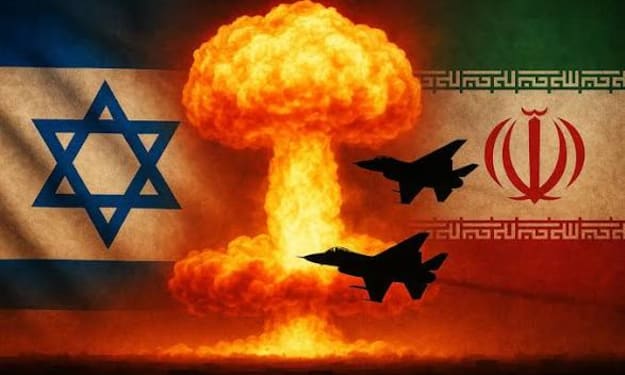
Escalation of the Iran-Israel Conflict: Regional and Global Implications
The conflict between Iran and Israel has entered a dangerous new phase, raising fears of a wider war across the Middle East. Military strikes, retaliatory attacks, and the involvement of international actors have turned the situation into one of the most serious geopolitical crises in recent years. Beyond the battlefield, the conflict is affecting global security, energy markets, and international diplomacy.
By shaoor afridi3 days ago in Serve
Behind the Kosher Seal: Understanding Kosher Requirements and the Koshering Process
Walk through any modern supermarket and you’ll notice a small symbol on many food packages indicating kosher certification. For some consumers, it represents adherence to Jewish dietary laws. For others, it signals high standards of quality, transparency, and trust. But what actually lies behind that small seal?
By klbdkosher3 days ago in Serve


Comments
There are no comments for this story
Be the first to respond and start the conversation.