
The Special Forces Decision Framework: How to Make Tough Choices Like a SEAL
Why Your Brain Fails Under Pressure (And How to Rewire It)


You’re staring at a high-stakes decision:
- Quit your stable job to start a business?
- End a long-term relationship?
- Move across the country for an opportunity?
Your heart races. Your mind overthinks. You freeze or make a reckless choice.
Navy SEALs face harder decisions daily:
- Ambushes with seconds to react
- Hostage rescues where mistakes cost lives
- Mission-critical calls with incomplete intel
After studying 100+ special forces operators and testing their methods myself, I discovered a battle-tested decision framework that works whether you’re in combat or choosing a career path.
Here’s how it works.
Part 1: The 3 Decision Traps That Cripple Most People
Trap 1: Analysis Paralysis
- SEAL Scenario: Over-mapping an assault plan while the enemy adapts
- Your Life: Researching endlessly but never committing
Trap 2: Emotion Hijacking
- SEAL Scenario: Charging into firefight to save a buddy against orders
- Your Life: Staying in toxic relationships/jobs out of guilt
Trap 3: Default Mode
- SEAL Scenario: Repeating tactics that no longer work
- Your Life: Staying on autopilot while life passes you by
"Indecision is a decision. Inaction is an action." — Jocko Willink, Navy SEAL
Part 2: The S.T.O.P. Decision Framework
SEALs use this 4-step filter for all critical choices:
S - Situation Assessment (10 Seconds Max)
Ask:
- What’s actually happening? (Strip away emotions/assumptions)
- What’s the worst possible outcome? (Most fears never materialize)
SEAL Trick: Squeeze your left thumb—this physical cue blocks emotional hijacking.
T - Tactical Options (Generate 3 Max)
Rule: Never brainstorm more than 3 choices (or you’ll overwhelm your brain).
Example for career change:
- Stay but renegotiate role
- Quit and freelance
- Lateral move to different department
O - Outcome Forecasting
For each option, ask:
- Best case (What’s possible?)
- Likely case (What’s probable?)
- Worst case (Can I survive this?)
SEAL Secret: If you can handle the worst case, the decision gets easier.
P - Prioritize & Execute
Choose the option that:
- Aligns with your core values
- Leaves multiple paths open
- Can be reversed if wrong
Part 3: The 40-70 Rule (When to Pull the Trigger)
Colin Powell’s combat-tested principle:
- Never decide with <40% information (reckless)
- Never wait for >70% information (you’ll be too late)
How to apply it:
- List what you know (solid facts)
- List what you don’t know (gaps)
- Ask: Do I have enough to make a 70% confident choice?
Part 4: The After-Action Review (How SEALs Learn From Every Decision)
After any major choice, SEALs conduct a brutally honest debrief:
- What worked? (Do more of this)
- What failed? (Eliminate this)
- What did I miss? (Blind spot awareness)
Pro Tip: Schedule these reviews weekly—not just for big decisions.
How to Train Your Decision Muscle
Daily Drills:
- The 2-Minute Rule: Force yourself to decide small things instantly (what to eat, what to wear)
- Red Team/Blue Team: Argue both sides of a decision like SEALs do
- Decision Journal: Track 1 key choice daily and its outcomes
When You’re Stuck:
Ask SEALs’ favorite question:
"What would I advise my best friend to do?"
(Creates instant clarity)
Final Mission Brief
Indecision costs more than wrong decisions. SEALs don’t make perfect choices—they make timely, adaptable ones.
Your call to action:
- Use S.T.O.P. on one decision today
- Comment below what you discovered
- Share this with someone stuck in analysis paralysis
Because in life as in combat: He who hesitates, loses.
. . . . . . . . . . . . .
About the Creator
Keep reading
More stories from Liam Osuos and writers in Serve and other communities.
Why High Performers Practice 'Strategic Quitting' (And You Should Too)
You’ve been told your whole life: ✔ "Winners never quit!" ✔ "Push through the pain!" ✔ "Hustle harder!" But here’s what no one admits—the most successful people in the world quit constantly.
By Liam Osuos11 months ago in Motivation
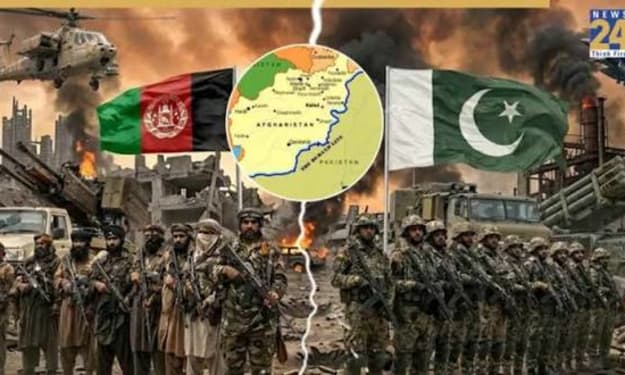
Non Stop War Between Pakistan And Afghanistan
The situation between Pakistan and Afghanistan has suddenly gotten much worse. In late February 2026, Pakistan said it is now in what it calls an “open war” with Afghanistan. Pakistan’s military carried out airstrikes on several major Afghan cities, including the capital Kabul and places like Kandahar and Paktia. This has caused fighting to grow significantly between the two neighbors. �
By shaoor afridiabout 14 hours ago in Serve
War Between Pakistan And Afghanistan
Tension Escalates Sharply at the Pakistan-Afghanistan Border What’s happening now? Tensions between Pakistan and Afghanistan have suddenly escalated into heavy fighting along their shared border, known as the Durand Line. Both sides are accusing each other of attacks, and military clashes have intensified in recent days. 
By shaoor afridia day ago in Serve


Comments
There are no comments for this story
Be the first to respond and start the conversation.