
Sun Black Spot 4 Times Bigger than Earth
Sun Black Spot


A sunspot is a region on the Sun's surface that is cooler and darker than the surrounding areas. They are caused by intense magnetic activity, which suppresses convection and inhibits the transport of heat to the surface. Sunspots can be as small as a few kilometers or as large as 50,000 kilometers in diameter.
The term "giant black spot" is not a scientific term, but it is often used informally to describe large and particularly dark sunspots. These sunspots can be seen from Earth with the naked eye or through a telescope, and they are often accompanied by solar flares and coronal mass ejections (CMEs).
Sunspots have been observed for thousands of years, with the first recorded observations dating back to ancient China and Greece. In the 17th century, Galileo Galilei was the first to observe sunspots through a telescope, and he used them to study the rotation of the Sun.
Sunspots are caused by intense magnetic activity, which suppresses convection and inhibits the transport of heat to the surface. The Sun's magnetic field is generated by the convection of hot plasma in the solar interior, and it is strongest in sunspots. The magnetic field lines in sunspots are so strong that they inhibit the rising of hot plasma, resulting in cooler and darker regions on the surface.
Sunspots are usually found in pairs or groups, and they are aligned along a curved line called a "filament." The leading sunspot in a group is usually the darkest and the most magnetically active, while the trailing sunspot is usually smaller and less active. Sunspots are also associated with other solar phenomena such as solar flares and coronal mass ejections (CMEs).
Sunspot activity follows an 11-year cycle, with the number of sunspots increasing and decreasing over time. This cycle is called the "solar cycle" or the "sunspot cycle." During the maximum phase of the solar cycle, sunspot activity is at its highest, and there are more sunspots, solar flares, and CMEs. During the minimum phase of the solar cycle, sunspot activity is at its lowest, and there are fewer sunspots, solar flares, and CMEs.
The study of sunspots and their effects on the Earth's climate and weather is an active area of research. Sunspots are known to affect the Earth's climate by altering the amount of solar radiation that reaches the Earth's surface. During periods of high sunspot activity, the Earth's climate is slightly warmer, and during periods of low sunspot activity, the Earth's climate is slightly cooler.
In conclusion, sunspots are regions on the sun's surface that are cooler and darker than the surrounding areas. They are caused by intense magnetic activity, and they can be seen from Earth with the naked eye or through a telescope. Sunspots are usually found in pairs or groups, and they are aligned along a curved line called a "filament." The study of sunspots and their effects on the Earth's climate and weather is an active area of research. And "giant black spot" is not a scientific term, but it is often used informally to describe large and particularly dark sunspots.
Sunspots are a common phenomenon on the sun and are regularly observed by scientists. However, a "giant black spot" is not a scientifically recognized term, and it's important to be cautious about alarmist language without accurate scientific information to back it up.
It's also important to note that sunspots, even large ones, do not pose a direct threat to the Earth. However, they can be associated with solar flares and coronal mass ejections (CMEs), which can potentially disrupt communication systems and power grids on Earth. Scientists and space weather forecast centers are constantly monitoring the sun's activity, and any potential risks will be communicated to the public and relevant authorities
About the Creator
Gajendira Kumar
I am Not a Legend I am the Lengends Maker by GAJAJI
Content Creator
Future Technology
Keep reading
More stories from Gajendira Kumar and writers in Serve and other communities.
Power of Vote (Elections)
Elections are a powerful tool for democratic societies around the world. They provide a mechanism for citizens to hold their leaders accountable and to peacefully transition power between different political parties and ideologies. The act of voting gives citizens a voice in the governance of their country and allows them to shape the direction of their society.
By Gajendira Kumar3 years ago in Journal
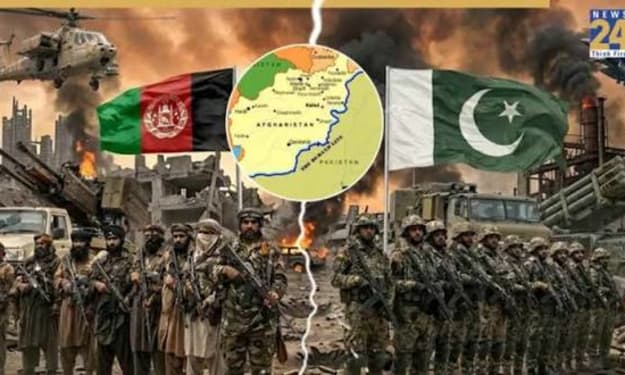
Non Stop War Between Pakistan And Afghanistan
The situation between Pakistan and Afghanistan has suddenly gotten much worse. In late February 2026, Pakistan said it is now in what it calls an “open war” with Afghanistan. Pakistan’s military carried out airstrikes on several major Afghan cities, including the capital Kabul and places like Kandahar and Paktia. This has caused fighting to grow significantly between the two neighbors. �
By shaoor afridia day ago in Serve
Ayatollah Ali Khamenei Is Dead Or Live?
Israeli and U.S. Officials’ Claims Israeli Prime Minister Benjamin Netanyahu has publicly stated there are “many signs” that Iran’s Supreme Leader Ayatollah Ali Khamenei is dead after a joint U.S.–Israel military offensive targeted Iranian leadership compounds, including sites linked to him in Tehran. �
By shaoor afridiabout an hour ago in Serve


Comments
There are no comments for this story
Be the first to respond and start the conversation.