
New Missiles Cause a Frenzy
How Lockheed's New Mako Missile Boosts F-22 and F-35 Capabilities

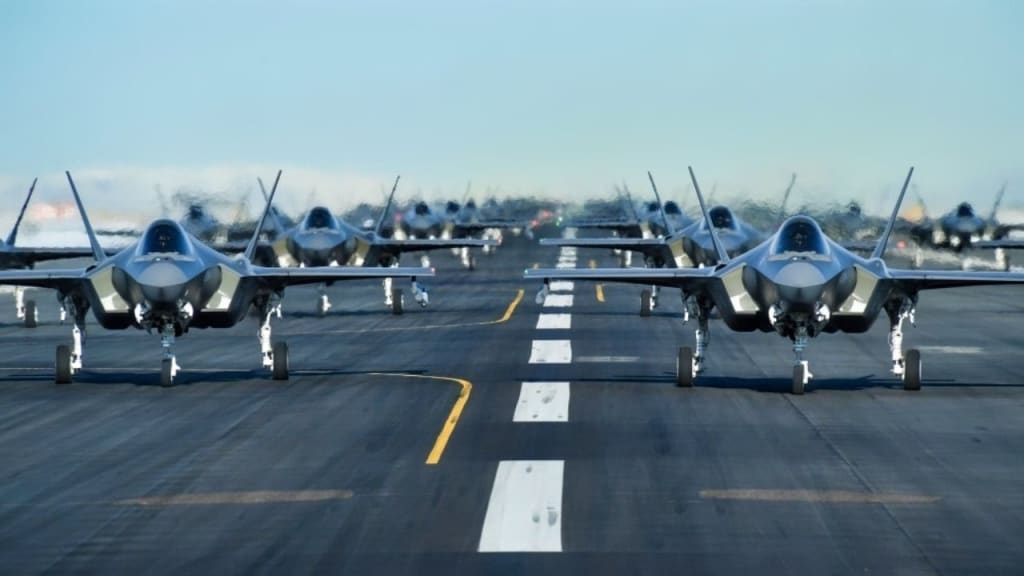
Lockheed Martin has unveiled the Mako missile, a cutting-edge air-launched hypersonic weapon designed specifically for the F-22 Raptor and F-35 Lightning II, the two most advanced stealth fighters in the U.S. military. The missile, developed over seven years, represents a significant leap in hypersonic technology and could reshape the future of air combat.
A Hypersonic Breakthrough
The Mako missile is designed to achieve speeds greater than Mach 5, making it a formidable challenge for even the most advanced air defence systems. What sets it apart, however, is not just its speed but its ability to maneuver at such high velocities. Traditional hypersonic weapons typically follow a ballistic trajectory, making them somewhat predictable for defence systems to track. Mako, on the other hand, can change course mid-flight, making it much harder to intercept.
According to Lockheed Martin officials, the Mako missile is a versatile, multi-mission weapon capable of maritime strikes, counter-air defence, and a wide range of surface-attack operations. It has been specifically designed to be launched from the internal weapons bays of both the F-22 and F-35, a breakthrough in hypersonic missile technology that offers unprecedented flexibility in combat scenarios.
Date of Manufacture and Marketing
The exact date of manufacture and marketing for Lockheed Martin’s Mako missile is not publicly available, as it remains in the development and testing phase as of the latest updates. The Mako missile has been under development for approximately seven years, beginning around 2016-2017, under the Air Force's Stand-In Attack Weapon (SiAW) program.
Lockheed Martin has unveiled details of the Mako missile's capabilities and potential uses, indicating that it is still being tested and refined. There has been no official announcement regarding the date of entry into service or large-scale marketing for the missile as it depends on further testing and military adoption, likely within the next few years.
Enhancing Stealth Fighter Operations
One of the biggest advantages of the Mako missile is its ability to be launched from stealth aircraft without compromising their low radar signature. Typically, hypersonic missiles are too large to fit inside the weapons bays of fighter jets, meaning they would have to be carried externally, making the aircraft more visible to radar. With Mako’s compact design, the F-22 and F-35 can now carry and deploy hypersonic weapons while maintaining their stealth capabilities.
This development has far-reaching implications for U.S. military strategy. Stealth fighters equipped with Mako missiles could engage targets from longer distances while remaining undetected, giving the U.S. a decisive advantage in any air-to-air or air-to-ground combat scenario.
Versatility and Affordability
Lockheed Martin designed the Mako missile with modularity and affordability in mind. The missile can be adapted to various mission requirements, such as anti-ship, air-defense suppression, and even land-based strikes. This adaptability makes it a cost-effective solution for a wide range of combat situations.
Moreover, Mako is not just limited to 5th-generation fighters like the F-22 and F-35. The missile can also be fitted onto 4th-generation aircraft like the F-16, F-15, and even the Navy's F/A-18 Super Hornet, offering a significant boost in firepower for older platforms. Additionally, it can be deployed from naval ships, further extending its operational range and versatility.
The Future of Hypersonic Warfare
The development of the Mako missile marks a pivotal moment in the evolution of hypersonic weapons. Its combination of speed, maneuverability, and modularity makes it one of the most advanced missiles in the U.S. arsenal. As the Pentagon continues to prioritize hypersonic technologies, the Mako missile could become a cornerstone of U.S. military strategy, ensuring that the F-22 and F-35 remain at the forefront of air combat capabilities.
In the future, the Mako missile could be integrated into a broader network of hypersonic systems, further enhancing the United States' ability to project power across the globe. With its compact size, versatile mission set, and cutting-edge technology, Mako offers a glimpse into the future of air warfare.
About the Creator
Horace Was
Essay Writer, Aviation and Technology Expert
Keep reading
More stories from Horace Was and writers in Serve and other communities.
Military Big Birds
Military transport aircraft are essential for moving troops, equipment, and supplies, playing a pivotal role in logistics and operations around the world. This blog post explores the top 10 largest military transport aircraft currently in service, highlighting their impressive specifications and unique capabilities.
By Horace Wasabout a year ago in Serve
The Impact of World War I: Global Changes and Costs
World War I, often called the Great War, was a conflict that reshaped the political, social, and economic landscape of the 20th century. Beginning in 1914 with the assassination of Archduke Franz Ferdinand of Austria-Hungary, the war quickly escalated due to complex alliances, rising nationalism, and militarism in Europe. Nations including Germany, Austria-Hungary, Britain, France, Russia, and eventually the United States were drawn into a conflict that would last four brutal years and leave an indelible mark on the world.
By shaoor afridi3 days ago in Serve
Rising Tensions: The Current State of Iran-U.S. Relations and Global Implications
Relations between Iran and the United States have been tense for decades, shaped by political rivalry, military confrontations, and deep ideological differences. In 2026, these tensions have escalated again, drawing global attention and raising concerns about regional stability and international security. The situation involves military actions, economic sanctions, and disputes over nuclear development, all of which could have major consequences for the world.
By shaoor afridia day ago in Serve
The Politics of Playing Dress-Up
Well, to start off I'd like to say a happy world book day to all who celebrate. I know I haven't really posted anything on my socials about it but I'm not a jubilant kind of person. I lay low most of the time. Let's start off with a popular anecdote from the vaults...
By Annie Kapur4 days ago in Geeks



Comments
There are no comments for this story
Be the first to respond and start the conversation.