

I spent most of the 1990’s as a member of the U.S. Coast Guard, I was stationed in the Central Florida area the entire 8 years. This story comes from my time aboard the first ship I was stationed on out of boot camp. I was stationed on that ship for just over 3 years, it was a working class ship affectionately called a “black hull” due to the fact that the ship was painted black instead of the normal white that most of you are used to seeing on the news. This class of ship maintains the aids to navigation markers and buoys that mark the channels, shallow water, dangers to shipping, etc. We “black hull sailors” were a hard-working type that went relatively unknown to most.
We were returning from a patrol to the northern most point of our working zone up in the panhandle of Florida, when the captain said that we were going to work the continental shelf markers on our way south. The continental shelf markers were permanent structures that marked the edge of the shelf in the “big bend” of Florida (the curve of Florida from the panhandle to the peninsula). These structures stood 230 feet above the water; the 4 corners were anchored directly into the sea floor. Each of the corner posts were big enough to put 4 telephone polls inside, they are connected at about 10 feet above the water by cross beams that are slightly smaller in diameter but still big enough to get a man inside. At about 30 feet up there was another set of cross beams about the size of telephone poles that had a tri-ladder in the middle that went up the remaining 200 feet. At the top was a 20 foot by 20 foot expanded metal grating platform with a flashing red light, 4 batteries, and 3 solar panels.
Our job was to go up and check on the light, batteries, and solar panels, replace any burned out light bulbs in the light (there was a set of 6 that rotated into place if the active one burned out), check the batteries for capacity to hold charge, and the solar panels for any broken or cut wires, and clean them.
My partner and I were referred to as “buoy jumpers”, we quite literally jumped off the ship and onto the apparatus we were working on. Sometimes this meant jumping on a floating buoy, but today that meant jumping onto the towers, making our way to the top, and doing the maintenance necessary. The towers were set exactly 10 miles apart along the edge of the shelf, the ship would drop us off, go to the next one drop off another set of jumpers, and return for us. This gave us about 2 hours on the tower. We never needed more than about 20 minutes to do the job, so we took a snack and a cribbage board to pass the time.
We gathered our gear, strapped it to our safety harness belts, went to the edge of the deck, and timed our jump with the slight rocking of the ship. One quick leap and we were on the cross beam about 30 feet above the water. We sat still and waited for the ship to pull off a bit, because we were not strapped on if we fell off the ship being so close could pose a significant a risk. We stood, balanced, and made our way to the tri-ladder in the middle. After securing our safety harnesses to the ladder, we made our way up to the platform on top.
It was a beautiful, clear, warm autumn day. From the top we could see about 25 miles out to the horizon, so our ship was never out of view for us. We knew that our captain would have someone up on the flying bridge with a pair of binoculars keeping an eye on us as well. We went about doing our job and taking care of the devices without saying a word. He and I had worked together for a couple of years now and done many these types of things together. We knew what each other was going to do without having to discuss anything.
As we figured we completed all the necessary work in about 20 minutes, so now we just had to wait till the ship returned for us. We removed our life vests to sit on, the metal grating was really uncomfortable, and broke out the cribbage board. After about an hour we started getting a bit hungry, so we got the snacks that the cooks had prepared for us and sat there looking out to the horizon and admiring the view. The ship was in the process of dropping off the jumpers on the next tower, it looked so small from our viewpoint. We were joking about how it looked like a bathtub toy that you could just pick up and play with, when we heard a splash.
We looked down to see what was jumping in the water, but it was not something jumping but rather a very large tail and dorsal fin moving along below the tower. The towers corner posts were 20 feet apart on the inside measurement and the posts were about 3 feet across, so a total of about 26 feet from the outside to the outside of each post. Though the water depth at that point was nearly 100 feet deep you could easily see the bottom in the crystal-clear water. We each knew ocean animals quite well, the Coast Guard made sure of that, so this monstrous shark was easily identifiable as a great white shark. As it swam directly underneath, through the middle of the tower corners, we could see that as its nose cleared the outer edge on one side the tail had not passed the corner on the other side. This monster was longer than the tower base was wide. It was the most beautifully terrifying creature we had ever seen. We watched it for several minutes as it made its way back out beyond the end of the continental shelf and dove into the deep. As it disappeared into the darkness of the ocean we knew no one was ever going to believe us but we knew what we had seen that day.
About the Creator
Keep reading
More stories from Clay Wilkinson and writers in Serve and other communities.
Take the risk
As with every afternoon at 2pm, I made my way down to the Central Ave Java House from my 5th story office overlooking Central Ave. It was my daily ritual for my afternoon break to go get a cup of coffee and a slice of chocolate cake at the Java House. I needed a break from looking at the bland, sparsely decorated, white walls of the publishing house I worked at. It was a mundane existence, same thing day in and day out, filing papers, and keeping track of records for the editor, but I was continent with my position. By mid-afternoon I was looking forward to getting out of the office for a few min and so I was a daily regular at the coffee shop across the street. They all knew me and knew what I wanted so I never had to actually order, I just said my hellos to everyone, paid and picked my spot to sit and enjoy my afternoon treat.
By Clay Wilkinson5 years ago in Humans
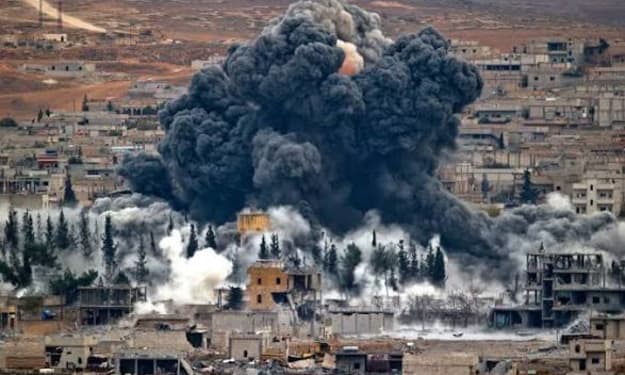
Rising Tensions: U.S.-Iran Conflict Escalates After Leader's Death"
In a dramatic escalation of tensions in the Middle East, Iran’s Supreme Leader Ayatollah Ali Khamenei has been confirmed dead following a large-scale military operation conducted by the United States and Israel. This development marks one of the most serious confrontations between the U.S. and Iran in decades, with region-wide impacts and uncertain global consequences.�
By shaoor afridi4 days ago in Serve



Comments
There are no comments for this story
Be the first to respond and start the conversation.