
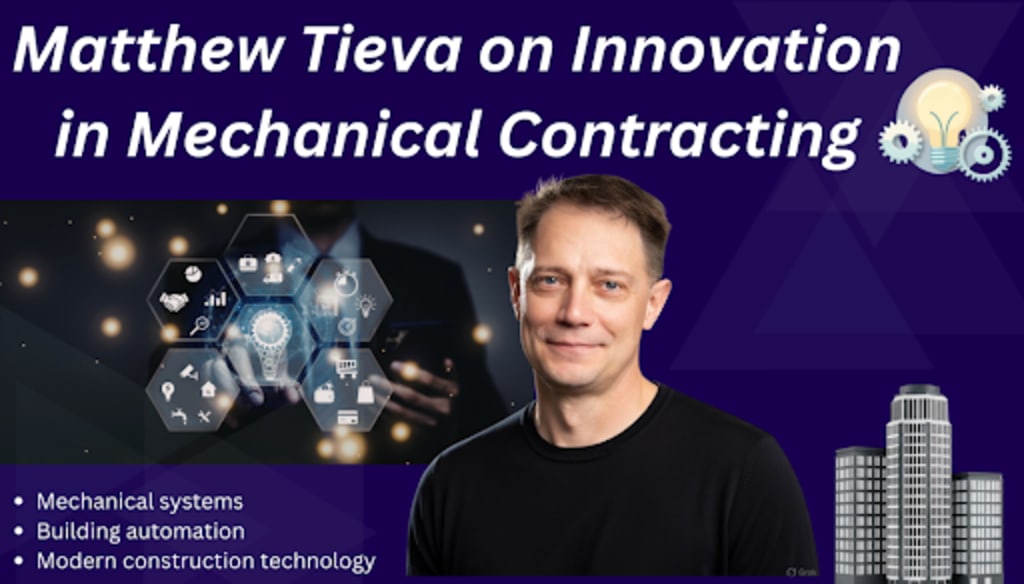
Matthew Tieva on Innovation in Mechanical Contracting
Matthew Tieva shares his insights on innovation in mechanical contracting, highlighting modern technologies, efficiency strategies, and forward-thinking approaches shaping the future of the industry.

Mechanical contracting isn’t what it was ten years ago. Between building automation, tighter energy regulations, and increasingly complex projects, contractors today are operating in a completely different environment.
As construction becomes more complex and innovative, efficient project management has become essential. Professionals who understand both technical systems and business operations play an important role in this shift.
Matthew Tieva, a mechanical contracting executive with more than 25 years of experience, has worked across design build projects, operations and team leadership, focusing on practical ways to improve efficiency and support steady growth within the industry.
Mechanical Contracting Is Becoming More Complex:
Modern buildings rely heavily on mechanical systems to manage comfort, efficiency, and safety. Heating, cooling, ventilation, automation, and energy monitoring systems now work together in ways that would have been difficult to imagine in the past.
This growing complexity means contractors must think differently about how projects are delivered. It's no longer enough to simply install equipment according to a set of plans. Mechanical contractors are often expected to contribute practical expertise early in the process and help shape the systems that will ultimately run the building.
As Matthew Tieva sees it, contractors who adapt to this shift have a major advantage. Those who don't often struggle to keep up with the pace of change.
Why Early Collaboration Matters?
One approach that continues to gain momentum across the industry is the Design/Build project delivery model. Instead of separating design and construction into completely different phases, Design/Build encourages collaboration between engineers, contractors, and owners from the beginning of the project.
For mechanical contractors, that early involvement can make a significant difference.
When contractors are part of the design conversation, they can:
- Identify potential system conflicts before construction begins
- Recommend equipment or layouts that improve efficiency
- Provide cost insight that keeps projects within budget
- Help prevent costly changes during construction
In many cases, these early conversations save both time and money while producing systems that perform better once the building is operational.
The Growing Role of Building Automation:
Another area transforming mechanical contracting is building automation. Smart buildings are no longer a niche concept. Many modern facilities rely on centralized control systems that allow operators to monitor and manage mechanical performance in real time.
Matthew Tieva helped expand into this area earlier in his career when he supported the development of a Building Automation Division at Northland Mechanical Contractors through a partnership with Siemens.
Automation systems allow building owners to manage complex mechanical operations through integrated platforms. These systems can monitor temperature, airflow, and equipment performance across an entire building while automatically adjusting settings to improve efficiency.
The advantages are clear:
- Reduced energy consumption
- Better comfort for occupants
- Earlier detection of mechanical issues
- Lower long-term maintenance costs
For contractors, the growth of building automation has opened the door to a much broader role, one that extends beyond installation into long-term system performance and optimization.
Technology Behind the Scenes:
Innovation in mechanical contracting isn’t limited to what happens inside the building. It also affects how contractors manage their businesses and projects.
Digital tools now play a major role in how companies estimate jobs, track costs, and coordinate teams across multiple projects. Systems like Enterprise Resource Planning (ERP) platforms help contractors keep a close eye on finances and operations, while everyday tools such as Microsoft Office still play an important role in reporting, scheduling, and communication.
Matthew Tieva has long supported the use of structured systems and digital tools to help contractors stay organized and maintain financial visibility. In an industry where margins can be tight and projects move quickly, having reliable operational data can make a real difference.
Leadership Still Matters Most:
Technology may be transforming the industry, but mechanical contracting remains a people-driven business. Every successful project still depends on the coordination between project managers, estimators, field technicians, engineers, and administrative teams.
Strong leadership plays a major role in keeping those groups aligned.
Over the years, Tieva’s work has focused on building teams that communicate well, follow consistent processes, and stay focused on both safety and profitability. Mechanical construction often involves many moving parts, and maintaining that balance between technical performance and financial accountability is critical.
At the end of the day, even the most advanced systems still rely on skilled people to design, install, and maintain them.
Looking Ahead:
The future of mechanical contracting will likely be shaped by continued advances in building technology and data-driven operations. Smart building integration, energy efficiency standards, and digital project management tools are already pushing the industry toward new ways of working.
Contractors who embrace these changes will be better positioned to deliver the kind of performance modern buildings demand.
For professionals like Matthew Tieva, the goal remains straightforward: build systems that work reliably, manage projects efficiently, and create long-term value for building owners. Innovation simply becomes the tool that helps make that possible.
Final Thoughts:
Mechanical contracting has always been a technical field, but the expectations surrounding it continue to grow. Today’s contractors must combine engineering knowledge, project management skills, and technological awareness to stay competitive.
Matthew Tieva’s experience reflects how the industry itself has evolved, moving toward smarter systems, stronger collaboration, and more efficient operations. As buildings continue to advance, contractors who focus on practical innovation and strong leadership will help shape what the next generation of mechanical projects looks like.
About the Creator
Mega players
Entrepreneurs are the visionaries of the modern era—risk-takers, innovators, and disruptors who turn bold ideas into reality.
Keep reading
More stories from Mega players and writers in Serve and other communities.
Complete Guide to Kratom Goat: Uses, Benefits, Risks, and Safety Information
Kratom is a natural plant that has gained significant attention worldwide for its traditional uses and potential wellness applications. Known scientifically as Mitragyna speciosa, kratom is a tropical tree native to Southeast Asia, particularly countries like Thailand, Indonesia, Malaysia, and Papua New Guinea. Its leaves have been used for centuries in traditional practices and are now widely discussed in modern health and wellness communities.
By Mega players23 days ago in Longevity
Is Benjamin Netanyahu Dead?
Introduction In the modern digital age, rumors and misinformation can spread quickly across social media and online platforms. One such rumor that occasionally appears online concerns the supposed death of Benjamin Netanyahu, the long-time political leader of Israel. Many people search the internet asking whether the Israeli prime minister has died. However, it is important to examine reliable information and understand the truth behind such claims.
By shaoor afridi3 days ago in Serve
Escalation of the Iran-Israel Conflict: Regional and Global Implications
The conflict between Iran and Israel has entered a dangerous new phase, raising fears of a wider war across the Middle East. Military strikes, retaliatory attacks, and the involvement of international actors have turned the situation into one of the most serious geopolitical crises in recent years. Beyond the battlefield, the conflict is affecting global security, energy markets, and international diplomacy.
By shaoor afridi4 days ago in Serve



Comments
There are no comments for this story
Be the first to respond and start the conversation.