
Escalating to War between Israel, Hezbollah, and Iran
WWⅡ BEGIN


The Issue
There is a serious risk of all-out war between Israel, Hezbollah, and Iran. According to new CSIS analysis, both the scale and geographic scope of violence have dramatically increased. The number of violent incidents related to the Israel-Hezbollah conflict increased 4.5 times in the last week of September from the weekly average between October 7, 2023, and August 31, 2024. In addition, the attacks are targeting a much larger geographic area. Israeli and Hezbollah attacks struck an average of 27–28 km from the Blue Line in the last week of September, up from an average of about 3–4 km between October 7, 2023, and August 31, 2024. The number of strikes and the geography of the conflict are likely to grow and include a larger swath of Lebanon and Israel as well as potentially Iran, Syria, Iraq, and Yemen.
Introduction
Israel and Lebanese Hezbollah continue to escalate in what Israel has called Operation Northern Arrows.1 In mid-September 2024, Israeli intelligence sabotaged thousands of Hezbollah beepers and walkie-talkies, detonating them in an operation that killed dozens of group members and wounded thousands more. On September 27, 2024, Israel killed Hezbollah’s leader Hassan Nasrallah in an airstrike on the group’s Beirut headquarters—the culmination of a campaign against Hezbollah’s leaders that led to the killing of numerous senior group leaders in September 2024. Two days before the Nasrallah assassination, Lieutenant General Herzi Halevi, chief of the general staff of the Israel Defense Forces (IDF), told Israeli troops from the Seventh Brigade deployed along the northern border, “We are preparing the process of a manoeuvre, which means your military boots . . . will enter enemy territory.”2 The IDF also called up two reserve brigades for what it referred to as “operational missions in the northern arena.” Israeli commandoes have conducted cross-border operations to gather intelligence and otherwise prepare for a ground invasion, and Israel has done limited operations so far in southern Lebanon. Iran responded by launching waves of ballistic missiles and other stand-off weapons at Israel.
To better understand the prospect of further escalation, this brief asks four questions: What are Israel’s and Hezbollah’s objectives? How has violence evolved over the past several months? What are plausible scenarios for further escalation? What options do the United States and other countries have to mitigate or prevent escalation? To answer these questions, this analysis draws on a mixture of quantitative and qualitative information. It compiles data on Israeli and Hezbollah strikes along the Israel-Lebanon-Syria border and geolocates Hezbollah attacks against Israel in the demilitarized zone between the Blue Line and Litani River.
The data show the increased scope and scale of Israeli and Hezbollah operations in recent months. Although most strikes by both sides have been within a relatively narrow area along the Israel-Lebanon border, the nature of the limited war between Hezbollah, Iran, and Israel is rapidly changing. Israel has escalated the number of strikes and the depth of its targeting. Hezbollah too has increased strikes, though in a far more limited way than Israel. And Iran has become directly involved in the conflict by firing ballistic missiles at Israel.
Despite the growing risk, an all-out war is not inevitable. Israeli attacks might successfully coerce Hezbollah to accept a ceasefire and move forces away from the border, or they might significantly weaken Hezbollah’s capabilities to strike Israel. But if negotiations fail to establish a buffer zone along the Israel-Lebanon border, there is a heightened possibility of all-out war. Escalation could lead to significant casualties for both Hezbollah and the Israeli military, put Israeli civilians throughout the country at risk, lead to hundreds and perhaps thousands of Lebanese civilian casualties, and spread to Iran, Syria, Iraq, Yemen, and other countries.
To explore the implications of escalation, the rest of this brief is divided into four sections. The first examines likely Israeli and Hezbollah objectives. The second assesses the evolution of violence. The third explores plausible scenarios of further escalation, and the fourth explores U.S. policy options.
Strategic Objectives
Shortly after the 1979 Iranian revolution, Iran’s Islamic Revolutionary Guard Corps (IRGC) helped establish Lebanese Hezbollah and provided money, equipment, training, and strategic guidance to the fledgling Shia organization. In addition, Iran sent as many as 1,500 IRGC advisers to the Bekaa Valley in Lebanon to build and run training camps that prepared Hezbollah fighters for war with Israel. Hezbollah played a major role in Israel’s 1985 decision to withdraw to a buffer zone on the Lebanese border and its 2000 decision to withdraw from Lebanon completely. Hezbollah, since its establishment, has defined itself in opposition to Israel. Its main objectives have been to drive Israel out of Lebanon and, ultimately, to destroy the state of Israel. In the 1980s and 1990s, Israel and Hezbollah regularly attacked each other despite the presence of the United Nations Interim Force in Lebanon (UNIFIL) along the Israel-Lebanon border, which is typically known as the Blue Line.
After Israel withdrew in 2000, Hezbollah continued occasional attacks on Israel and conducted a series of attacks against Israeli interests and citizens across the globe. This limited conflict flared into an all-out war in 2006 after a Hezbollah cross-border kidnapping operation. The war left over 100 Israelis and around 500 Hezbollah fighters dead and devastated Lebanon. The 2006 war ended with United Nations Security Council Resolution (UNSCR) 1701. Among other measures, UNSCR 1701 created a demilitarized zone between the Blue Line and Litani River along the borders of Israel, Lebanon, and Syria (Figure 1). Weapons and fighters that did not belong to the Lebanese government or the United Nations (i.e., those of Hezbollah) could not pass south of the Litani River.

After 2006, an uneasy status quo prevailed. Israel occasionally attacked Hezbollah fighters, and Iranian arms shipments headed to Hezbollah and other groups in Syria. There were intermittent rockets and drones and other standoff attacks across the border. For the most part, however, the border was the calmest it had been in decades. Another area of dispute was the village of Ghajar, just west of Shebaa Farms and bisected by the Israel-Lebanon border. Its residents have both Lebanese and Israeli citizenship. For years, a fence divided Ghajar, but in 2006 Israeli forces reoccupied the entire village and today retain control.
Over the past year, however, several factors have changed the dynamics between Israel, Hezbollah, and Iran. First, the October 7, 2023, Hamas attacks in Israel dramatically increased Israeli insecurity and took a psychological toll on Israelis.Israel’s risk tolerance significantly changed. If Hamas could kill over 1,100 Israelis in a surprise cross-border operation, what could a much better organized, armed, and trained Hezbollah do? Hezbollah’s close relationship with Iran and ties to Hamas reinforced this fear. Second, the repercussions of the October 7 attack and clashes between Hezbollah and Israel displaced more than 150,000 people on both sides of the Israel-Lebanon border after October 2023, including over 62,000 civilians from northern Israel and more than 92,000 from southern Lebanon. The continuing displacement has put pressure on Israeli leaders to contain the Hezbollah threat to northern Israel so that residents can return. Third, Hezbollah has dramatically improved its military and stockpiled more than 150,000 standoff weapons in Lebanon and Syria.With Iranian partner and proxy forces active in Lebanon, Syria, Iraq, and other countries across the region, the threat from the north could get worse over time, not better.
Based on these changes, Israeli leaders likely have several main objectives. The first is to curb the Hezbollah threat to Israel by seriously degrading Hezbollah’s military capacity and deterring further actions against Israel. As Israeli defense minister Yoav Gallant remarked, a key Israeli goal is “destroying Hezbollah’s capabilities that have been built up over 20 years,” including “disarming entire units of the Radwan force and leaving Nasrallah alone at the top of Hezbollah.” As the Nasrallah killing, beeper operation, large-scale air attacks, and ground operations showed, Israel is increasingly shifting from a traditional deterrent approach of threatening punishment to one of weakening Hezbollah’s capabilities to the point that the group cannot effectively respond.
Hezbollah has repeatedly fired anti-tank guided munitions (ATGMs), rockets, drones, missiles, and other standoff weapons at Israeli military and civilian targets from south of the Litani River and other locations in Lebanon. Figure 2 displays possible launch areas for Hezbollah ATGM attacks based on geolocated footage of ATGM impacts shown in Hezbollah propaganda videos.These attacks are a clear violation of UNSCR 1701. Hezbollah’s elite Radwan forces have also been deployed along the border. Thanks to Iranian assistance, Hezbollah possesses as many as 200,000 standoff weapons, including short- and long-range unguided rockets, short- and intermediate-range unguided ballistic missiles, and short- and medium-range guided ballistic missiles such as the Fateh-110/M-600 and Qadr-1.

A second Israeli objective is to resettle Israel’s internally displaced population back to their homes and villages in northern Israel. Doing this requires establishing and sustaining a security environment that currently does not exist. Prime Minister Benjamin Netanyahu stated it would be impossible to return Israeli civilians to their homes without a “fundamental change in the security situation in the north,” an attitude that appears to be driving Israel’s recent escalation.Defense Minister Gallant added, “We will continue with additional blows that are already prepared until we achieve our goal—the return of the residents of the north to their homes, to achieve the goal we are willing to take any action.”
Escalating Violence
The escalation of violence in late September far surpasses any other phase of the Israel-Hezbollah conflict. After conducting an average of about 160 attacks each week for the 11 months following October 7, Israel struck Lebanon more than 300 times in the week of September 15 and more than 700 times in the week of September 22 (Figure 3).
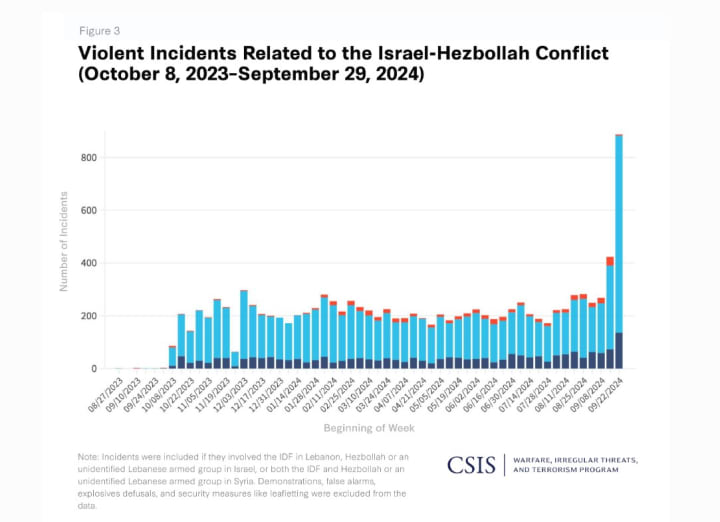
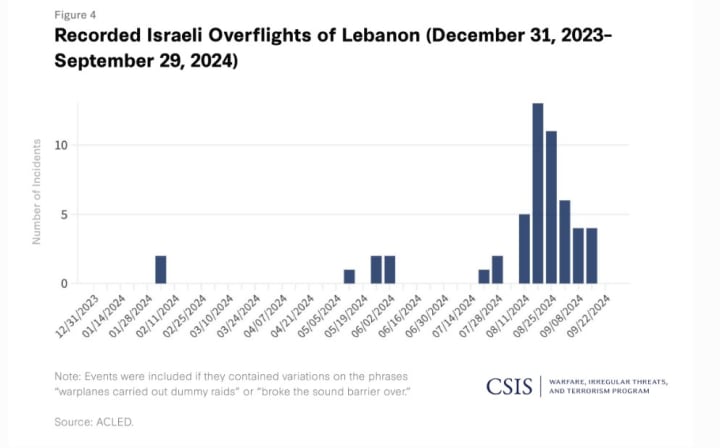
But even before Israel commenced Operation Northern Arrows in September, there were indications the conflict was entering a new phase. The number of violent incidents related to the Israel-Hezbollah conflict fluctuated between 150 and 250 incidents each week between October 7, 2023, and August 18, 2024. But late August saw the number of incidents rise past 280 per week, with Israeli attacks driving most of the increase. Another sign was an increase in Israeli warplanes conducting threatening overflights over Lebanon (Figure 4). Before summer 2024, these incidents were extremely rare, but Israel sent warplanes over Lebanese cities with increasing frequency throughout the summer, frequently breaking the sound barrier in what now seems to be an implicit threat.
During the summer, most of the violence took place in the vicinity of the Blue Line (Figure 5). Hezbollah and Israel have traded artillery, ATGM, and air and drone strikes across the border almost daily since October. Before the beginning of Operation Northern Arrows, the fighting displaced roughly 60,000 Israelis and 110,000 Lebanese.19 The fighting has resulted in a major increase in displacement and death since the beginning of Operation Northern Arrows, with Lebanese authorities reporting that more than 90,000 people were displaced and 600 were killed between September 24 and September 26.

The violence has not remained limited to southern Lebanon or northern Israel; it has expanded deeper into both countries. Israel has conducted long-range strikes into Lebanon since early 2024, and both the frequency and depth of these strikes have increased over time (Figure 6). Between October 7, 2023, and August 31, 2024, the average Israeli strike occurred about 4 km into Lebanon. In the first three weeks of September, the average depth of an Israeli strike was approximately 6 km. During the week of September 22, the average depth of an Israeli strike was 27 km.
The highest-profile deep strikes have been the assassinations of Hezbollah leaders in Beirut, but the IDF has also repeatedly attacked Hezbollah’s logistics and air defense infrastructures. The IDF does not appear to be limiting its deep strikes to symbolically or politically important targets but seems to have been engaged in a campaign to degrade Hezbollah’s ability to supply and protect its forces throughout Lebanon.Options for Mitigating a War
The United States has engaged in near-constant diplomacy to bring about a ceasefire between Israel and Hezbollah since the crisis began. Although U.S. efforts have clearly failed, the United States did help convince Israel not to launch a preemptive strike on Hezbollah in the days after the October attack. Moreover, the United States has probably helped deter Iran from increasing its direct role and may be a factor in Hezbollah’s decision, so far, not to escalate to all-out war.
Amos Hochstein is the face of U.S. diplomacy in the Lebanon crisis, often working with French, and at times German, officials. He has put forward a plan to relocate Hezbollah forces north of the Blue Line and end Israeli overflights of Lebanon, which violate UNSCR 1701. Hochstein has advocated for additional observers (potentially from Germany) to the 13,000 UNIFIL troops deployed in southern Lebanon to better monitor potential Hezbollah activity there. Hezbollah, however, claims it will not end its attacks as long as Hamas is fighting, a stance it reiterated after the Nasrallah killing. Israeli officials claim diplomacy alone will not bring a ceasefire, and they call for Hezbollah to abide by UNSCR 1701, which prohibits the group from placing fighters near the Israeli border.
Even as the United States has pushed for a diplomatic settlement, however, it has supported Israel militarily with equipment, ammunition, air defense, and intelligence, and it could continue to do so as a way to increase pressure on Hezbollah. Given the risk of all-out war, however, U.S. officials should redouble efforts to bring about a ceasefire in Lebanon, even if they cannot achieve one in Gaza. Hezbollah, given its recent losses, may be open to a ceasefire if it can occur in a face-saving way, which in practice may mean after Hezbollah successfully conducts a significant attack on Israel.
As an alternative, experts like Middle East analyst Robert Satloff contend the United States might push for an informal deal where both sides suspend or significantly curb cross-border fire and civilians return to their homes. Under this proposal, Hezbollah would remove its major military systems from the area near the Israeli border. An Israeli concession would allow Hezbollah’s forces to return to the border but not in uniform or as part of large formations.
Despite these diplomatic initiatives, a lasting ceasefire will be difficult to achieve. The October 7 Hamas attack was a landmark moment for Israel’s government and population, exacerbating the country’s insecurity. The best that negotiators may be able to achieve is managing the escalation of violence and preventing an all-out war that devastates much of Lebanon and expands into Syria, Iraq, Yemen, and other countries.
About the Creator
China Stand with Iran Against Israel
Recent military strikes by the United States and Israel against Iran have triggered not only intense regional violence but also a flurry of global diplomatic reactions. Among the world’s major powers, China’s response has been cautious yet clearly articulated, emphasizing respect for sovereignty, calls for ceasefire, and appeals to diplomacy. While some observers describe this as tacit support for Iran in the face of Western military action, Beijing’s stance is rooted in a mix of principled diplomacy, strategic interests, and geopolitical calculations that reflect both China’s broader foreign policy orientation and its national priorities. �
By shaoor afridi3 days ago in Serve
Who Has Suffered More Casualties in the Current Conflict: America, Israel, or Iran?"
The Middle East is once again the center of a major military conflict involving the United States, Israel, and Iran. What began with strikes on Iranian leadership and military infrastructure has rapidly escalated into full-scale hostilities, raising global alarm about regional stability and human cost.
By shaoor afridia day ago in Serve
Who is your "Person"?
It's important to recognize that you cannot go through life as easily on your own. My name is Elizabeth and I'm a survivor of child abuse and horrific trauma. Healing from trauma is not a quick fix and recognizing that it will take time, is part of the struggle.
By Elizabeth Woods3 days ago in Psyche


Comments
There are no comments for this story
Be the first to respond and start the conversation.