
Ching Chong Conundrum
Why Were Chinese Military Planes’ Demand at the Egypt Air Show in Question?


The Egypt International Air Show, held at El Alamein International Airport, was a notable event in 2024, drawing global attention with the first-ever demonstration of Chinese J-10 fighter jets and Y-20 transport aircraft in Africa. As China continues to expand its military and technological influence across the Middle East and North Africa (MENA), its presence at the airshow signals a growing interest in Chinese military hardware. But what is driving demand for Chinese planes, and how does this affect the broader geopolitical landscape?
What is the Egypt International Air Show?

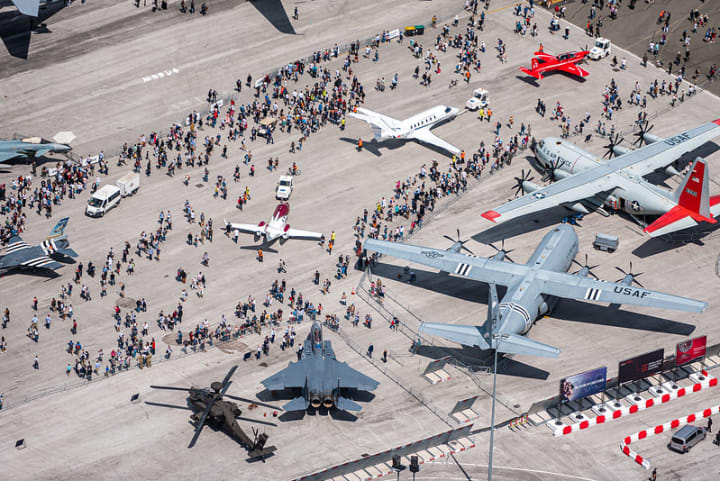
The Egypt International Air Show is an aviation exhibition that was held for the first time in 2024 at El Alamein International Airport, Egypt. The event brought together major global players from the aviation and defense industries, showcasing military and civilian aircraft, as well as cutting-edge aviation technologies.
The show featured approximately 50 aircraft and attracted representatives from around 100 countries and 300 companies, including major industry players like Boeing and Lockheed Martin. Highlights included aerial demonstrations by fighter jets, transport aircraft, and other advanced aviation technology, providing a platform for countries and manufacturers to display their capabilities.
A key aspect of the event was its geopolitical significance. The participation of countries like China underscored efforts to increase military influence and collaboration in the Middle East and North Africa (MENA) region. China's high-profile presence, featuring the debut of its J-10 fighter jets and Y-20 transport aircraft in Africa, highlighted its growing military ambitions and expanding influence in the region.
Overall, the Egypt International Air Show serves as a hub for industry experts, government officials, and defense companies to explore partnerships, showcase innovations, and discuss future developments in aviation and defense.
China's Growing Influence in the Middle East and North Africa
China’s presence at the Egypt International Air Show was not just about displaying military power; it was about signaling its broader ambitions in the region. The J-10 fighter jets and Y-20 transport aircraft represent China’s advanced military capabilities and its aim to compete with Western powers, particularly the U.S., in the Middle East market.
China's strategic interest in the MENA region stems from its deepening economic ties. The Middle East ranks as China’s region with the highest bilateral trade growth, largely fueled by oil imports. Countries like Saudi Arabia and the UAE are increasingly turning to China not just for commercial trade but also for military equipment such as drones, missiles, and anti-drone systems. Egypt, too, has expressed interest in diversifying its military suppliers, and China is eager to fill that role.
The J-10 Fighter Jet - A Game Changer?

The J-10 fighter jet, also known as "Vigorous Dragon," is one of China’s most significant military exports. Primarily designed for air-to-air combat, it is armed with advanced surface attack weapons, making it a versatile choice for nations looking to bolster their air defenses. Comparisons have been drawn between the J-10 and the U.S. F-16 Fighting Falcon, though the Chinese jet is seen as a cheaper, more accessible option for many countries in the region.
Egypt's growing interest in the J-10 stems from a desire to diversify its military suppliers. Currently, Egypt relies heavily on U.S. and Russian aircraft, but the addition of the J-10 could help enhance its military capabilities. In July, Egypt’s air force commander visited Beijing for talks, a move that highlights the country’s keenness to strengthen military cooperation with China.
However, despite the technological advancements of the J-10, the question remains whether it can fully replace or compete with Western aircraft in the long run. Many countries in the region, particularly Saudi Arabia, still prefer Western military suppliers due to the superior quality and reliability of their equipment.
The Y-20 Transport Aircraft - Expanding China's Military Reach
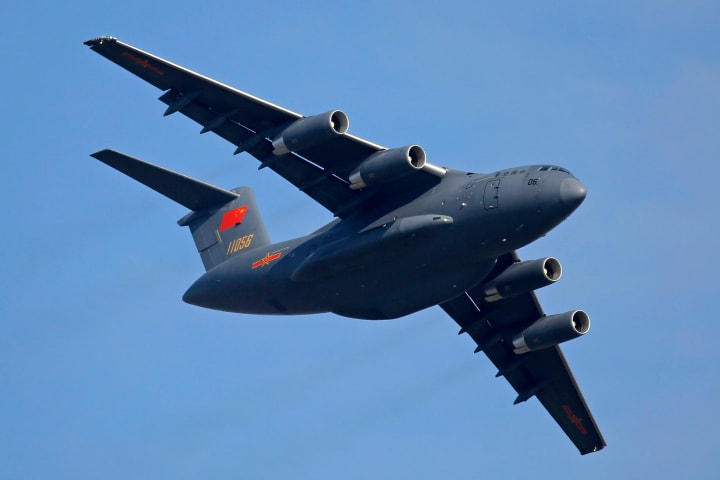
China’s Y-20 transport aircraft also took center stage at the Egypt air show, performing aerial maneuvers outside China for the first time. The Y-20, nicknamed “Chubby Girl” due to its wide fuselage, can carry up to 66 tons over a distance of 7,800 kilometers. This makes it a critical component of China’s plans to project its military power far beyond its borders.
The Y-20’s appearance at the airshow was significant because it represents China’s attempt to rival U.S. heavy-lift aircraft, such as the C-5 Galaxy and C-17 Globemaster. While China’s transporter is less powerful than its American counterparts, it offers a cheaper alternative for nations looking to strengthen their airlift capabilities without the high price tag of U.S. equipment.
Despite its appeal, however, the Y-20 may face challenges in finding buyers. Many countries in the region lack the infrastructure, technical expertise, and financial resources to operate and maintain such sophisticated equipment. Without extensive training and support, the Y-20 could be more of a burden than a benefit for prospective buyers in Africa and the Middle East.
Why China Is Targeting the Middle East Market
China’s focus on expanding its military presence in the Middle East is part of its larger expansionist goals. As the world’s second-largest economy, China is not just interested in economic dominance but also military influence. The region is of strategic importance to China due to its energy resources, and strengthening ties with Middle Eastern countries through military cooperation could further solidify China’s role as a major player in global geopolitics.
Moreover, China sees opportunities for long-term business relationships through military sales. When a country purchases military equipment, it often commits to years of training, maintenance, and spare parts deals. These ongoing agreements help build trust and deepen diplomatic relations, opening doors for China to extend its influence even further.
Challenges Facing Chinese Military Sales
Despite China’s ambitions, there are several challenges that could hinder the success of its military sales in the region. One major issue is the technical complexity of Chinese aircraft. The Y-20, for instance, requires significant training and technical support, which many Middle Eastern and African countries may struggle to provide. Additionally, while Chinese equipment may be cheaper than Western alternatives, it is often seen as less reliable and more vulnerable to threats like missile attacks.
Another challenge is competition from U.S. suppliers. Middle Eastern countries like Saudi Arabia and the UAE have long-standing relationships with U.S. defense companies, which offer more advanced and battle-tested equipment. While some countries may be interested in Chinese aircraft to diversify their arsenals, it is unlikely that they will sever ties with Western suppliers in the near future.
Final Thoughts
China’s display of military planes at the Egypt International Air Show was more than a demonstration of technological prowess—it was a signal of China’s growing ambitions in the Middle East and Africa. As countries in the region look to diversify their military suppliers, Chinese aircraft like the J-10 and Y-20 offer attractive options for nations seeking to bolster their defenses without breaking the bank. However, significant challenges remain, particularly in terms of technical support and competition from U.S. suppliers.
Whether Chinese planes will become a common sight in Middle Eastern and African skies remains to be seen, but one thing is clear: China is determined to expand its military footprint in the region, and the Egypt International Air Show was a key step in that direction.
About the Creator
Horace Was
Essay Writer, Aviation and Technology Expert
Keep reading
More stories from Horace Was and writers in Serve and other communities.
From Concept to Combat
The Predator drone, one of the most transformative technologies in modern warfare, started from humble beginnings. What began as an idea to balance the scales in a conflict-ridden Central America eventually turned into a cornerstone of global surveillance and military strategy. In this post, we will explore how General Atomics entered the Predator business and the significant advancements that shaped the future of unmanned aerial vehicles (UAVs). It all began with the conflict in Nicaragua, where the Sandinistas were butchering indigenous Miskito Indians with Russian-made helicopters. General Atomics' founders, driven by a desire to stop this violence, conceived the idea of a "poor man's cruise missile." The concept involved using new GPS technology—which was unknown at the time—on small, unmanned aircraft that could be loaded with explosives and flown into fuel storage tanks. This innovative idea was the spark that later led to the development of the Predator drone.
By Horace Wasabout a year ago in Serve
War Between Pakistan And Afghanistan
Tension Escalates Sharply at the Pakistan-Afghanistan Border What’s happening now? Tensions between Pakistan and Afghanistan have suddenly escalated into heavy fighting along their shared border, known as the Durand Line. Both sides are accusing each other of attacks, and military clashes have intensified in recent days. 
By shaoor afridi2 days ago in Serve
Israel Attacking On Iran
Israel has carried out major air and missile strikes on Iranian targets. Explosions were reported in Tehran and other areas. Israeli leaders say they attacked to stop Iran’s military and missile capabilities before Iran could launch its own large attack.
By shaoor afridiabout 7 hours ago in Serve



Comments
There are no comments for this story
Be the first to respond and start the conversation.