
What lives in the Spaces
The Architecture of Knowing
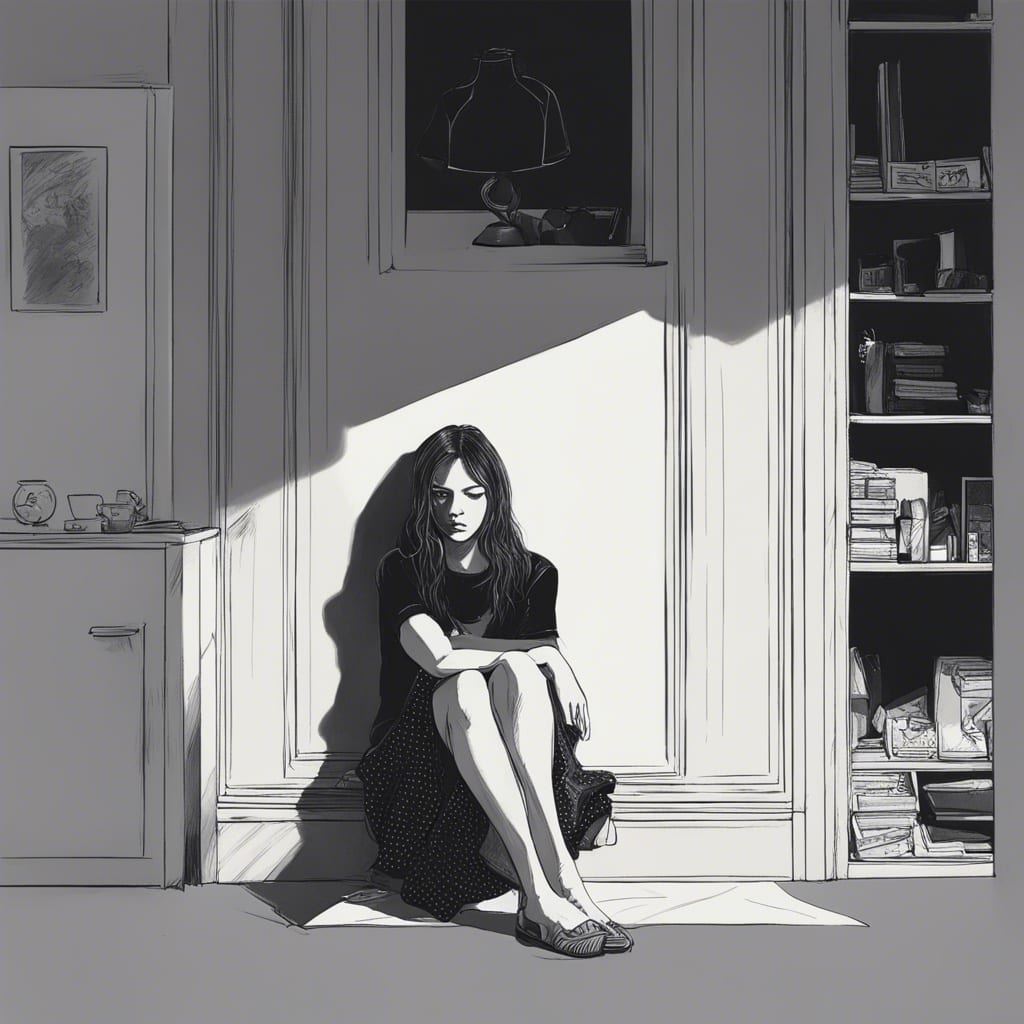
Sylvie understood she was in her childhood kitchen without seeing a single tile or cabinet. The knowledge sat heavy in her chest—the weight of recognition without image. She could feel the warmth radiating from where the afternoon sun should be hitting the breakfast table, though no golden light painted her dream-vision. Then, like a camera suddenly focusing, fragments began to appear—a flash of yellow curtains swaying in peripheral vision, the gleam of chrome on the old refrigerator handle catching light that shouldn't exist.
Her grandmother was there. Not visible, but present in the way that only dreams allow—a certainty that felt like gravity. The old woman's hands moved through space Maya couldn't see, kneading dough that existed only as the rhythmic whisper of palm against counter, the faint dust of flour hanging in awareness rather than air.
"Listen," her grandmother said, though her voice came from everywhere and nowhere, like sound traveling through water. "This is how we remember what matters."
Sylvie tried to look, tried to force her sleeping mind to paint the scene in familiar colors and shapes. But the dream resisted, offering instead something richer—the *essence* of the moment. She knew the blue ceramic bowl held rising bread, knew her grandmother's apron was dusted white, knew the afternoon light slanted golden across worn linoleum. She knew these things the way she knew her own heartbeat, without question or sight. Yet occasionally, like lightning illuminating a landscape for a split second, she'd glimpse the actual blue of that bowl, vivid and startling against the darkness of not-seeing, before it faded back to pure understanding.
The dream shifted, as dreams do. Now she stood in a vast library, though she'd never seen its walls. Books surrounded her—thousands of them—their presence pressing against her consciousness like a crowd of whispered conversations. She understood their contents without reading, absorbed their knowledge through some deeper sense than sight. But then the dream flickered, and for a breathless moment she saw them: endless shelves stretching impossibly high, leather spines in deep burgundy and forest green, golden letters that seemed to pulse with their own light. The vision lasted only seconds before dissolving back into the warm certainty of their presence.
A figure approached through the stacks. Again, no face, no form—just the approaching weight of another soul, the shift in the dream's gravity as someone drew near. Their footsteps were silent but somehow audible, creating ripples in the fabric of the dream space.
"You're looking for something," the figure said. It might have been her father, or a teacher, or some version of herself. In dreams like these, identity flowed like water, less important than intent. For just an instant, Sylvie glimpsed a profile—sharp cheekbones, kind eyes behind wire-rimmed glasses—before it melted back into formless presence.
"I am," Sylvie replied, though she hadn't known she was looking until she spoke. "But I can't see where to find it."
"Then maybe," the figure suggested, "you're not meant to see it. Maybe you're meant to know it."
The library around them began to shift and breathe like a living thing. Sylvie felt the shelves rearranging themselves, books sliding and whispering secrets to each other in languages she'd never learned but somehow understood. A brief visual flash showed her the books moving like birds, their pages fluttering as wings, before the image dissolved back into sensation and sound.
Sylvie's dreaming mind reached out—not with hands, but with something deeper. She touched the spine of a book that existed only as concept, felt the leather binding that was only an idea, and suddenly understood: the story she sought was already written in the spaces between thoughts, in the architecture of knowing that needed no blueprint, no visual plan.
The dream shifted once more, and now she found herself in a garden that existed primarily as fragrance and the feeling of earth beneath her feet. Roses bloomed in dimensions she couldn't see but could sense—their petals soft as velvet thoughts, their thorns sharp as sudden realizations. Then, like a curtain being pulled aside, she saw them: cascades of deep red and pristine white, climbing an old stone wall that appeared and vanished like a mirage.
A child was playing somewhere in this garden-that-wasn't-quite-there. Sylvie heard laughter carried on a breeze she couldn't feel, footsteps on grass she couldn't see. The child might have been herself at seven, might have been her sister, might have been no one at all. But then the dream offered her a gift: a flash of small hands reaching for dandelions, a glimpse of scuffed white shoes against green grass, a momentary vision of sunlight caught in curly hair before it all faded back to the deeper knowing of childhood joy.
When she woke, she remembered not what the dream looked like—because most of it had no appearance—but how it felt to understand without seeing, to navigate through pure knowing punctuated by those startling moments of sight. The brief flashes of yellow curtains, her grandmother's weathered hands, the deep blue ceramic bowl, the towering library with its golden letters, roses cascading down stone walls, and a child's hands reaching for dandelions—these images sat alongside the larger experience of knowing without seeing, like photographs scattered on a table of darkness.
The memory lived in her chest like a warm stone, the visual moments and the non-visual understanding woven together into something richer than either could be alone. She understood now that her dreams spoke in multiple languages: sometimes in the ancient tongue of pure knowing, sometimes in the newer vocabulary of sight, but always in the deeper grammar of meaning that connected them both.
She reached for her sketchpad, ready to draw both what couldn't be seen and what flickered briefly into view—the whole strange, beautiful conversation between darkness and light that her sleeping mind had offered her.
About the Creator
Parsley Rose
Just a small town girl, living in a dystopian wasteland, trying to survive the next big Feral Ghoul attack. I'm from a vault that ran questionable operations on sick and injured prewar to postnuclear apocalypse vault dwellers. I like stars.
Keep reading
More stories from Parsley Rose and writers in Psyche and other communities.
The Truth About Social Media Addiction: Why We Can’t Stop Scrolling
The Reality of Social Media Overuse One morning in 2026, fingers swipe screens before feet touch the floor. Instead of coffee, attention flows into glowing rectangles filled with faces, clips, noise. Beneath each endless feed lies invisible wiring - patterns forming without consent.
By Abdul Lateef4 days ago in Psyche

Comments
There are no comments for this story
Be the first to respond and start the conversation.