
Understanding Inceptions's Complex World
Inception: The Architecture of the Mind

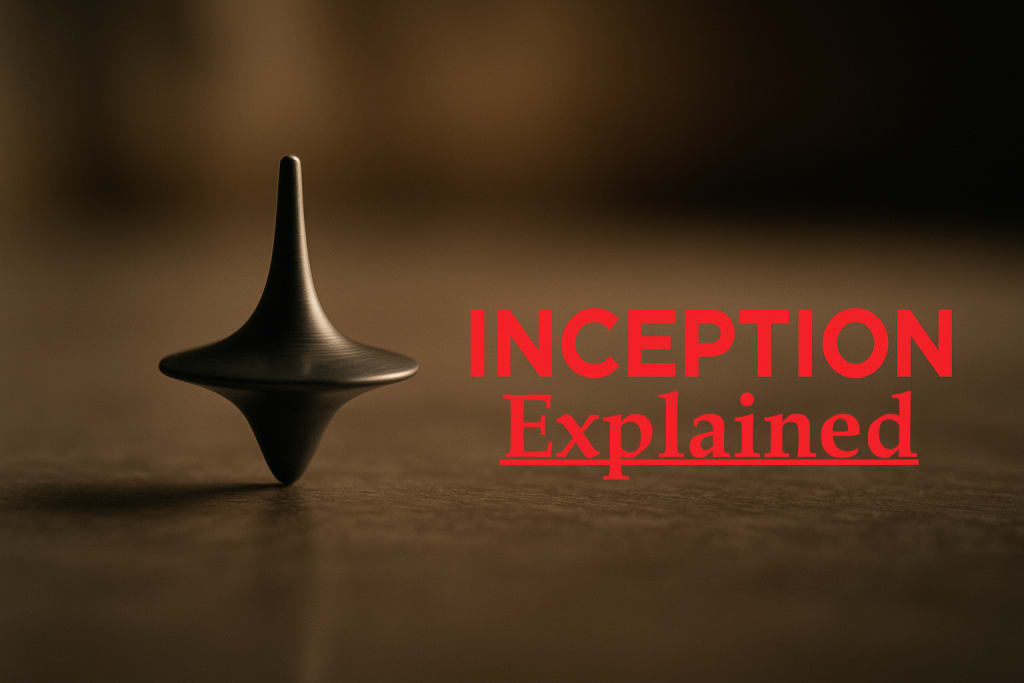
Every time I watch Inception, I come away with a different question. The first time, I wondered if the top fell. The second, I wondered if Fischer really believed his father loved him. Now, I wonder how much of my own reality has been shaped by memory, emotion, or ideas someone else planted long ago.
That’s the trick of Inception. It looks like a sci-fi thriller, but it’s really a film about how the mind defends, distorts, and deceives itself and how belief, even false belief, can feel real enough to change who we are. Cobb isn’t just running from authorities; he’s stuck in a loop of guilt that rewrites his subconscious like clockwork. The dream levels? They’re just psychological metaphors. And limbo? That’s what unprocessed pain looks like when it’s been left to rot unchecked.
The brilliance of Inception isn’t in how clever it is, it’s in how familiar it feels, once you stop treating it like a puzzle. Because we’ve all spun our own tops. We’ve all hidden parts of ourselves in mental safes. And whether we admit it or not, we’re all living in stories we’ve partly made up just to stay functional.
Guilt as the Architect of Limbo
Cobb’s guilt isn’t just emotional residue, it’s the central architect of the entire dream-world scaffolding in Inception. His subconscious uses Mal not as a memory, but as a recursive symbol of unresolved trauma. Each appearance she makes in his dreams is an involuntary reenactment of failure, a cognitive loop his mind refuses to break. Rather than haunting him randomly, Mal shows up at key moments to sabotage progress, signaling that guilt is not passive but invasive, capable of hijacking purpose and perception alike.
The concept of limbo becomes more than a dream layer, it functions as the mind’s purgatory, built by Cobb’s refusal to let go. His projection of Mal is distorted by time and shame, no longer resembling the real woman, but the version his guilt constructed. Philosophically, Cobb’s journey is about unlearning a self-imposed narrative: not just “I caused her death,” but the deeper, quieter lie that he is forever bound to that act.
Guilt isn’t just something we carry, it’s something we build with. In Inception, Nolan shows us how our psyche can construct entire emotional prisons from a single unresolved act, and how confronting that story is the only way out.
Time as a Psychological Hallucination
In Inception, time is not simply bent, it’s redefined. Nolan doesn’t treat time as an external measure but as a psychological variable. Each layer of the dreamscape slows time exponentially, creating a visual metaphor for how the human mind processes emotional intensity. The deeper you go into the subconscious, the more elastic time becomes. Cobb and Mal’s “50 years in limbo” represents this perfectly: a lifetime of experience compressed into hours of real-world time.
This structure isn’t arbitrary. It mirrors real psychological states, how trauma can stretch a moment into years of memory, or how joy can make hours vanish. The film’s concept of synchronized “kicks” to awaken from different dream levels is symbolic of psychological integration. It takes a unified jolt across fragmented layers of self-awareness to return to equilibrium.
Time, in this context, is subjective, personal, and often distorted. Nolan takes a philosophical stance: we don’t live in time, we live in our perception of it. That’s why characters who dwell too long in dreams lose touch with reality; they’ve detached from the collective clock and entered private chronologies ruled by emotion.
Time isn’t what the clock says. It’s what your mind feels. And Inception makes that tension visible.
Reality as a Collective Hallucination
We all have our version of the spinning top, that one test we keep going back to, hoping it’ll prove our life is real. In Inception, that test loses meaning. Cobb spins the top and walks away. Why? Because he finally realizes something that most of us resist: you don’t need certainty to feel grounded, you just need meaning.
The whole movie builds up this tension: are we dreaming? Is this real? But that’s not really the question. The question is: Does this matter to me? Cobb’s choice to walk away from the totem and toward his children isn’t proof he’s awake, it’s proof he’s done needing proof. He believes in what he feels.
Even Mal’s tragic downfall shows what happens when you over-question reality. She becomes trapped in the search for what’s real and misses the life in front of her. It’s like Descartes’ doubt taken too far, when you can’t trust anything, nothing matters.
Inception challenges us to accept that reality is not binary. It’s not about “real” or “fake,” but about what we choose to believe, and what those beliefs make us become.
The Parasitology of Ideas: Inception as Mental Symbiosis
In Inception, ideas are portrayed as parasitic, not in the sense of being harmful by default, but in how they operate once implanted. Cobb famously calls an idea “the most resilient parasite,” because once it takes root, it grows independently, reshaping perception and behavior. This metaphor turns abstract cognition into biological warfare: ideas replicate, mutate, and colonize.
The act of inception isn’t just suggestion. It’s psychological engineering. The idea must not feel foreign; it must emerge organically from the subject’s own subconscious. That’s why Fischer’s inception succeeds, the belief that his father wanted him to “be his own man” is crafted to align with his emotional need for approval. The idea doesn’t feel imposed; it feels discovered.
Mal’s tragedy, on the other hand, is the dark mirror. The seed Cobb planted, that her world wasn’t real, metastasized until it consumed her. It wasn’t the content of the idea, but its uncontrollable growth that made it lethal.
In Nolan’s world, an idea is never just a thought. It’s a living parasite, a symbiotic truth, and sometimes, a lie that feels like home.
Dream Architecture: The Mind as a Self-Deceiving Artist
If you’ve ever been stuck in a mental loop, replaying a conversation, reliving a mistake, you’ve walked the psychological architecture Nolan makes literal in Inception. Dreams in this world aren’t random. They’re designed. Not just by the Architect, but by the dreamer’s emotional state.
Look at Cobb’s elevator of memories. Each floor is a locked room, a moment with Mal. He’s literally built his grief into architecture. Ariadne explores it the way a therapist might, floor by floor, learning how Cobb has sectioned off his pain. That’s not just a plot device. That’s how the mind works. We compartmentalize. We decorate trauma. We visit it on bad nights like old rooms we can’t sell.
The brilliance of Nolan’s world is that it doesn’t ask if dreams make sense. It asks what they mean. Cities fold, staircases loop, safes guard beliefs. Every object is psychological shorthand.
In Inception, the subconscious isn’t chaos. It’s structured, by memory, defense, and desire. And sometimes, it takes an Architect to show us the floor plan.
The Ethics of Dream-Sharing, Intimacy as Invasion
Inception presents dream-sharing as a technological marvel, but beneath the spectacle lies an unsettling ethical landscape. Entering another person’s subconscious grants total access to their interior world, memories, fears, and emotional vulnerabilities. What begins as intimacy quickly veers into manipulation.
Fischer’s inception is framed as a kind of emotional therapy, orchestrated to free him from his father’s legacy. But it’s still an act of psychological trespassing. The team studies Fischer’s relationships, exploits his wounds, and engineers catharsis. It works, but was it ever really his choice?
Even Cobb’s own relationship with Mal exists in ethically murky waters. His inception on her was meant to save them but it rewired her perception of reality and led to her death. The violation was subtle, but irreversible.
What Inception forces us to confront is this: when we influence someone’s inner world without consent, even for good, we blur the line between help and harm. Dream-sharing isn’t just invasive. It’s godlike.
The subconscious is sacred space. In Inception, even good intentions can weaponize intimacy and leave permanent imprints on the soul.
The Spinning Top a Metaphor for Epistemic Humility
The spinning top in Inception has often been reduced to a cinematic cliffhanger. But its real function is not to answer whether Cobb is dreaming, it’s to question our obsession with answers. By walking away from the top, Cobb performs a radical act: he rejects the demand for certainty. His peace isn’t based on evidence; it’s rooted in emotional resolution.
The top becomes a symbol for epistemic humility, the understanding that some truths are not knowable, and some don’t need to be. Nolan doesn’t ask viewers to solve a riddle. He invites them to confront their discomfort with ambiguity. Cobb has lived through guilt, memory loops, and self-deception. What matters now is that he feels home.
In philosophical terms, this shifts us from Cartesian skepticism, “prove what’s real” to existentialist freedom: “choose what matters.” Nolan reframes reality not as something verified, but something lived.
The top’s final spin isn’t a trick, it’s a statement: the need for certainty is often the final illusion we must let go of to heal.
Limbo, the Underworld of Uncreation
In Inception, limbo is portrayed as a realm of raw subconscious unstructured, timeless, and profoundly dangerous. It is the mind without ego, without grounding, and without exit. But more than a sci-fi construct, limbo symbolizes psychological collapse. It’s what happens when identity dissolves under the weight of unprocessed emotion.
Cobb and Mal’s decades in limbo represent their attempt to construct a perfect world out of denial. They build cities, live a full life, but it’s all an illusion sustained by willful forgetting. When Mal clings to the belief that the dream is reality, she becomes psychologically untethered. Her jump is not escape, it’s a desperate act of disorientation.
Cobb eventually escapes limbo physically, but not emotionally. Until he confronts the projection of Mal and accepts her death, part of him remains trapped. The crumbling architecture reflects this unraveling, the mind revolting against its own illusion.
Limbo is not just a location. It’s a mental state: a place we go when we refuse to feel pain, deny truth, or lose the narrative that keeps us whole.
The Catharsis of Collapse, Why the Ending Matters
People obsess over that last spin. Did the top fall? Was it real? But honestly, that’s not what makes the ending powerful. What makes it work, what makes it matter, is that Cobb finally stops caring.
He’s spent the whole film trapped in his head, haunted by guilt, chasing reality, checking his totem like it’s going to save him. But in the end, he walks away from it. He sees his kids’ faces, and that’s the breakthrough. That’s when we know he’s actually made it, not necessarily home, but out of limbo, out of grief, out of obsession.
Nolan doesn’t give us closure because that’s not what Cobb needed. What Cobb needed was release. He let the world collapse. He let the top spin. And for once, he just lived.
The catharsis isn’t that we get an answer. It’s that Cobb no longer needs one. And maybe neither do we.
My Personal Openion: Inception as a Mirror for the Mind
What if Inception was never about dreams at all? What if it was always about us?
Think about it, every major theme in the film maps back to something personal. Guilt that won’t let go. Time that stretches when you’re stuck. The feeling that reality is slippery, especially when grief or love or memory clouds it. Cobb’s journey might be extreme, but it’s familiar. We’ve all lived in loops. We’ve all carried someone like Mal in our minds longer than we should’ve. We’ve all wanted to rewrite a moment.
By the end of the film, Nolan doesn’t hand us clarity. He hands us a question: Are you awake? Not in the literal sense but emotionally, psychologically. Are you building your life with intention, or letting old ideas run the show?
That’s the real inception. Not planting a thought in someone else’s head but realizing we have the power to change the ones we’ve buried in our own.
About the Creator
Beyond The Surface
Master’s in Psychology & Philosophy from Freie Uni Berlin. I love sharing knowledge, helping people grow, think deeper and live better.
A passionate storyteller and professional trader, I write to inspire, reflect and connect.
Keep reading
More stories from Beyond The Surface and writers in Psyche and other communities.
The Quiet That Screamed
They say there is a silence so loud, it tears the skin of your thoughts. It doesn't arrive like a thunderclap or a scream or the slam of a door at midnight. No. It comes like dust. Slow. Gentle. Undefinable. Until one day you look around and realize the world has stopped responding. You speak, and nothing echoes back, not even your own voice. You reach for something solid—work, love, prayer, even pain—and your hand passes right through it like it’s smoke. And suddenly, the life you thought was yours feels like a film projected on fog. You can see it. Almost touch it. But not enter. That’s what happened to me. And I don’t remember when it started. That’s the worst part. There was no explosion, no death, no dramatic betrayal. Just the slow, quiet erosion of meaning.
By Beyond The Surface11 months ago in Psyche
Learn to Be Alone...
We often find that people are told to stop making 'X, Y and Z' their personality. Well, this only arose in the social media age as especially women's interests: reading, dramas, art etc. was heavily criticised as being 'useless'. It is historically well-documented that though many men require the work of women, whether it be through unpaid labour or entertainment, they also refuse to acknowledge it is important. This is why since it has been something of recognition, they have been complaining of a 'loneliness epidemic' now that women are withholding access.
By Annie Kapur27 days ago in Psyche
Born Between Shame and Grace: My True Story of Adoption
Some lives begin with celebration. Mine began with silence. It was a late afternoon when an eighteen-year-old girl walked through the wind with her head lowered, carrying a secret that felt heavier than her own body. In a small town governed more by judgment than mercy, there was an unspoken rule: No father, no child. No scandal. No shame.
By Magma Star2 days ago in Psyche
I wanted to title this something different, but worried that my chosen title might cause problems entering the United States in the future so this is the new title. It's the greatest title. No one has ever written a title better than this. (All titles unrelated to content).
Let me be honest. I am finding this difficult. Now, I like a challenge, a stretch, a bit of an obstacle course. “Write about the decline of the British Empire in the form of a narrative poem in which your protagonist is an artichoke” I read, and flex my fingers. “Write a haiku to evoke the sensation of sibilance using only the first half of the alphabet.” “Well”, I think to myself, “this should be fun.” But “write about a system that isn’t working”? A system that isn’t working? Now? In 2026? ONE system? My favourite system that isn’t working? The sexiest system that isn’t working? The one giving me the most angst day to day? The one giving me the most existential dread? I am, as I say, finding this difficult. I will own that I have contemplated writing a thousand words on why the steady “all on” setting on my fairy lights is the EIGHTH of seven options which must be sequentially activated to get there, because that is a system that some fool came up with and it definitely doesn’t work, and now who is paying the price, eh? But how can I write about my fairy lights when…. When…. When….
By Hannah Moore4 days ago in Humans




Comments
There are no comments for this story
Be the first to respond and start the conversation.