
The Weight of Ink
Some words are too heavy to ever leave the page.
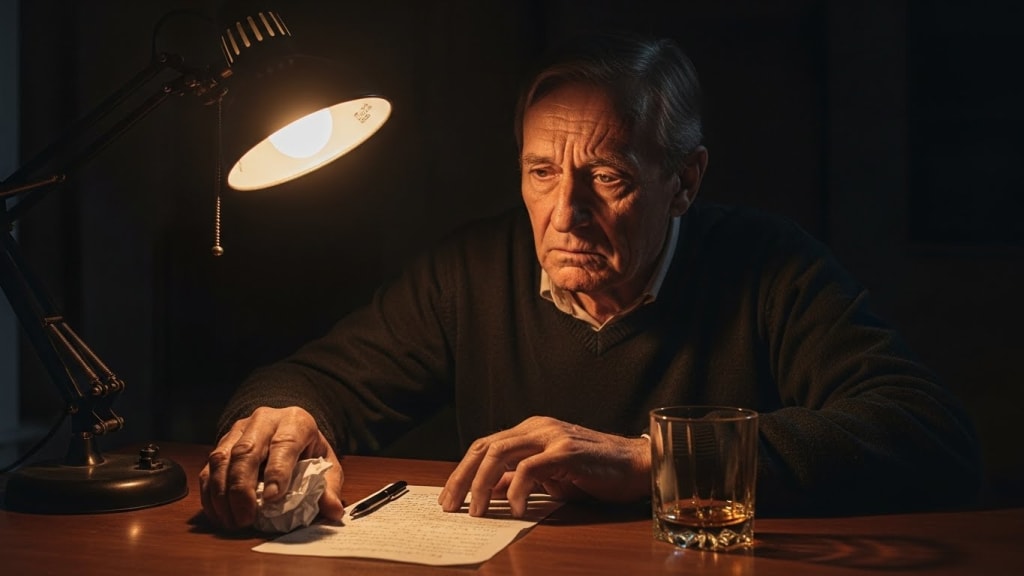
Arthur’s desk lamp threw a sickly yellow circle onto the stack of paper, illuminating the same half-finished letter he’d been staring at for the better part of a decade. His hand, gnarled and spotted with age, trembled slightly as he picked up the pen, the cheap plastic cool against his skin. Whiskey sat beside it, amber liquid shimmering in a heavy glass, untouched. Not yet. He always waited until the words, or the lack of them, had thoroughly beaten him down.
“Dearest Clara,” it began, the cursive shaky, an old man’s attempt at remembering a younger man’s hand. He’d crossed out ‘My sweet Clara’ a hundred times, ‘Clara, my daughter’ felt too formal, too distant. ‘Dearest’ was a compromise, a white flag waved across a chasm he wasn’t sure could ever be bridged. He read the next line, the same old stumbling block: “I wanted to explain…” Explain what? The hours spent at the office instead of at her recitals? The way he’d snapped at her the day her mother left, a harsh word flung like a stone, catching her squarely in the chest when she’d just needed a goddamn hug? Too many explanations, not enough apologies.
He closed his eyes, picturing her face, a blur of sun-streaked hair and eyes that used to hold so much life, so much uncomplicated love. That was before. Before the arguments with Sarah became daily rituals, before the silence in the house grew louder than any shout. He remembered the last time he’d seen her up close, truly seen her. She was seventeen, standing in the doorway of her room, her suitcase heavy at her feet. He’d said something stupid, something about responsibility, about pulling herself together. She’d just looked at him, not with anger, but with a cold, clear disappointment that had burned worse than any rage. Then she was gone, the door clicking shut, the sound a finality he hadn't grasped until years later, alone in this quiet house.
The pen scraped against the paper, a faint whisper in the silent room. He wrote: “…I wanted to explain that I was a coward. That I let my own hurt blind me, twisted my tongue until it bit the very people I swore to protect.” He paused, the words stark, ugly. Too honest? Maybe not honest enough. He remembered the night he’d called her, a year after she’d left, the phone ringing and ringing until her machine picked up. He’d mumbled something incoherent, something about missing her, and then hung up before the beep, his throat tight, his stomach churning with shame.
He picked up the whiskey, swirled it, the ice clinking against the glass. He knew what she’d say. Or, more likely, what she *wouldn’t* say. The silence would be deafening. The letter would sit in her mailbox for days, maybe weeks, before she opened it, if she opened it at all. He imagined her reading it, her brow furrowed, a faint sigh escaping her lips. Would she forgive him? Would she even care? The fear of that indifference, that polite dismissal, was a colder thing than any anger she could muster. It was the fear of being truly forgotten, of having ceased to matter.
Another page crumpled, thrown onto the growing pile beside the wastebasket. He picked up a fresh sheet. “Clara,” he started again, simpler this time. “There are days I can barely breathe without thinking of you. I see a young woman laughing in the park, and I wonder if that’s you, if you found that joy I couldn’t give you.” He dipped his head, a dull ache throbbing behind his eyes. He tried to think of what a father *should* say, what a father *should* feel. All he felt was this raw, exposed mess inside him, a knot of guilt and longing.
He thought about the internet, about finding her social media, sending a message. He’d even created an account, scrolled through pictures of people he didn't know, trying to catch a glimpse of her. But what would he say in a message? It felt too casual, too easy for something that had been tearing him apart for so long. This letter, this physical, tangible thing, felt like the only real offering he could make, even if it was just to himself.
Hours passed. The streetlights outside cast long, pale shadows through the window. The whiskey glass was empty now, the ice long melted. He had written another paragraph, a clumsy recount of a specific memory, a trip to the zoo when she was six, her face lit up by the antics of a mischievous monkey. It felt weak, insufficient. He stared at the last sentence, his own words mocking him: “…and I wish I could go back to that day, just for a moment.” He could almost feel her small hand in his, warm and trusting.
He read the entire unfinished draft, his eyes scanning his own fragile hopes laid bare on the page. He imagined sealing the envelope, addressing it, walking to the mailbox in the cold morning light. The definitive thump as it dropped inside. And then what? Waiting by the phone? Every ring a fresh stab of anxiety? He couldn't do it. Not tonight. Not yet. The courage, or the desperation, just wasn't there.
With a heavy sigh, he folded the letter carefully, slid it into an old, unmarked manila folder already thick with identical, unsent drafts. He placed the folder in the bottom drawer of his desk, pushing it beneath a stack of old bills and yellowed photographs. The drawer clicked shut, a soft, final sound in the quiet house. He pushed himself up, his old bones protesting, and walked to the window, staring out at the dark, indifferent street.
About the Creator
HAADI
Dark Side Of Our Society
Who is your "Person"?
It's important to recognize that you cannot go through life as easily on your own. My name is Elizabeth and I'm a survivor of child abuse and horrific trauma. Healing from trauma is not a quick fix and recognizing that it will take time, is part of the struggle.
By Elizabeth Woods2 days ago in Psyche



Comments
There are no comments for this story
Be the first to respond and start the conversation.