
The Responsibility of Your Employer for better Mental Health
Did you know that if you are a 40-year-old full-time office worker, chances are — you have already spent 3,375 days on work? That amounts to around 27 000 hours of your life time that you will never get back. Work takes more of your life time than any other activity, besides sleeping.


The average worker will spend a total of 100,000 hours of their lives at work. Even though work may be the source of self-fulfillment or just a way to stay afloat and support the family financially, it has serious mental health ramifications. So, we are left asking the following:
- How much does the workplace contribute to your mental state?
- How do you know if your employer is doing enough to support your mental health?
- What should you be demanding from your employer when it comes to resources and benefits offered that support better mental health?
How much does the workplace contribute to mental health?
According to the WHO, research shows that workplace stressors such as long hours, economic insecurity, work–family conflict, and high job demands coupled with low job control are as harmful to health as secondhand smoke. Regardless of industry or seniority level, employees’ mental health problems are affecting them at work. 59% reported in 2021, up from 48% in 2020. This isn’t surprising, considering the host of research studies showing that people with mental health conditions like depression and anxiety are more likely to face job-related difficulties.
While the pandemic cannot be blamed entirely on employers, the barrage of mental health issues that have stemmed from it can be linked back to employers and the type of work environment fostered. While employers are trying to remain competitive and meet aggressive losses and impossible bottom lines, employees still had to contend with stress-inducing circumstances that weakened their mental health. Whether dealing with health anxiety, grief over losing loved ones, canceled plans, stress, and burnout due to staffing or supply shortages at work or attempting impossible work-caregiving juggles, the pandemic has deeply affected employees’ mental and emotional well-being.

Our expectation as employees is that our workplace would step up to meet this challenge by providing more flexibility in work schedules, taking time to recharge, and a positive work environment that supports people’s diverse needs when it comes to work/life balance. But unfortunately, this did not happen. Instead, people started to recognize their power and began to leave their jobs in enormous numbers due to misaligned company values and organizations remaining focused on revenue, at the cost of employee well-being. It is clear that work is a massive contributor to the state of our well-being and one has to ask: If I am doing everything my employer asks, what is my employer doing for me?
The Workplace: How much do they do for you and is it enough to maintain good mental health?
If you work at a small / medium business (SMB) or a large enterprise, you likely will have seen global policies being rolled out to support employee mental health. Benefits such as Global Mental Wellness Days or mindfulness online courses, might look attractive on paper, but in the long term, they do little to nothing toward actually improving employee mental health. But the employer can check the box that they have done something. Task completed, right?
Employees have wised up and this tactic is no longer fooling them. However, there are organizations taking concrete steps toward better mental health in the workplace. Here are just a few of the initiatives or policies to look for in case you think your workplace is not doing enough:
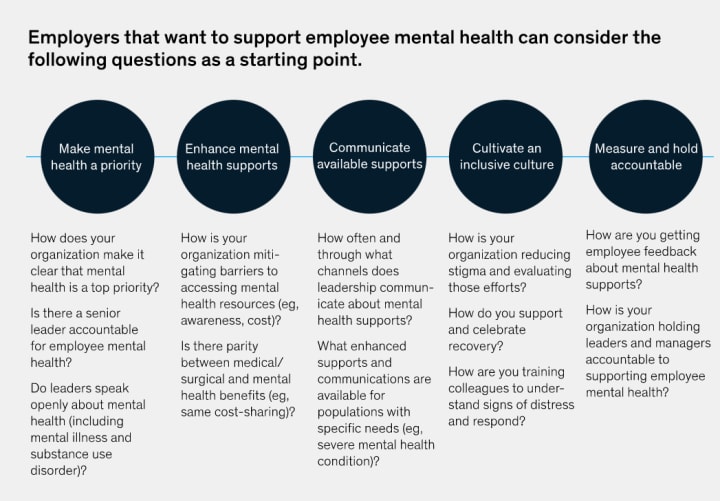
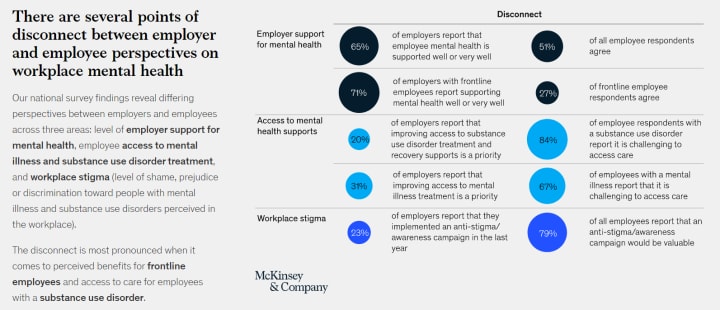
So, if this is the goal, then the current state needs to also be examined in order to fully understand how to reach this employer utopia. The main barrier for employers to reach this point is because most employers are under the impression that they do enough for their employees, which is why employees stay. But as is clear by the Great Resignation, there is a fundamental misunderstanding between what employees expect and what employers are prepared to invest. According to a study by McKinsey:
- An overwhelming amount of employees believe that employers offer little to no access to mental health care.
- Workplace stigma still exists and it is worse than the upper management would have you believe.
What to Demand from your Employer, in terms of mental health resources and benefits
Resources for mental health are not limited to professional support or therapists. Starting points can be as simple as offering training that acknowledge mental health as a contributor to productivity, while also recognizing the individual needs for mental health, to investing in telemedicine and additional professional resources for moral and professional support. It is clear that employers following the status quo simply does not work in this post pandemic age, where people are putting an emphasis on working on their own terms, rather than slaving in front of a computer for X hours for the sake of a paycheck.
In addition, we believe that investments in breaking the epidemic of silence within organizations is the bare minimum employers can do to make the day-to-day of the employee just a little bit easier. Much of a company’s performance can be attributed to how prepared the leadership team is to deal with crisis. There is value in connecting with employees at all levels. Understanding how a coworker feels “is a critical social skill that grows communication, connection, and loyalty, enhancing individual productivity, team cohesion, and employee alignment to organizational goals.
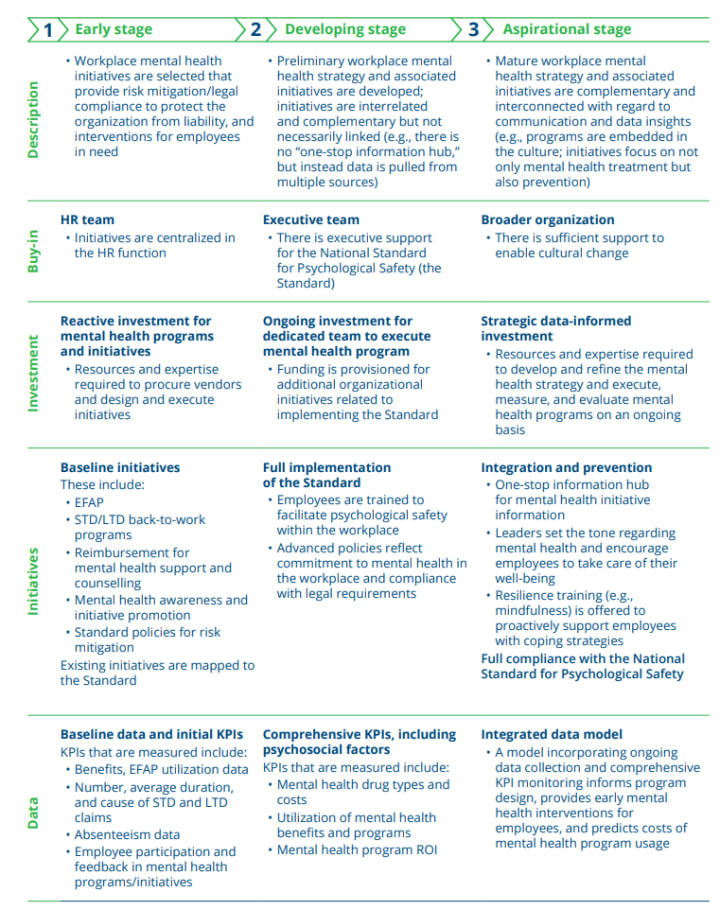
One of the most common mistakes organizations make is not examining the nuanced strategy needed to tackle the stigma around mental health in the workplace. Simply throwing money at the problem will result in wasted funds and low ROI. However, an iterative strategy that objectively examines the different phases of maturity and assess where they would like to be will be a far more successful strategy.
The Benefits to Employers in Investing in Mental Health
The costs to employers of poor mental health in the workplace are substantial. Using conservative assumptions, it is estimated a total annual cost to businesses up to £45bn, comprising £7bn in absence costs, £28bn in presenteeism costs and £9bn in costs of staff turnover. There are also other indirect costs to employers of poor mental health, such as the adverse impact on creativity, innovation, and colleagues.
Return On Investment (ROI) also takes time, but if assessed accurately, ROI for investments into mental health can be long-lasting and far outweigh the sunk costs of doing nothing. Companies can “save” money in the short-term by not offering or expanding mental health benefits, but the long-term costs of that decision will prove far more expensive. Benefits leaders are well aware of this reality. However, measuring the financial impact of mental health programs has long been a vexing calculus.
The bottom line: Proactivity Matters.
According to an in-depth study by Deloitte on the investments that matter in mental health, it has been revealed that the return on investment of workplace mental health interventions is largely positive. Based on a systematic review of the available literature, ROIs ranged from £0.40 per £1 invested (0.4:1) to £9 per £1 invested (9:1), with an average ROI of 4.2:1. So, for every £1, an average of £5 is returned in the long-term. Additional fun facts include:
For employers without the capabilities or financial resources to invest in training or screening and diagnostic tools, it should be noted that awareness raising and culture change provide almost as high a return on investment and is a relatively accessible and cost‑effective way for employers to effect real change in their organizations.
Breaking an institutionalized culture of silence can be the most difficult to attain and it is unrealistic to expect this change overnight, however, employers that do nothing, or do not even acknowledge the culture of silence that still pervades many organizations will suffer the consequences, when it comes to employee satisfaction, productivity, and retention. All we as employees ask, is for employers to take the first step, demonstrating that the mental health of employees is a top priority and investing accordingly, not just by throwing money at the problem, but actually analyzing the structures that stigmatize mental health within organizations and begin to break them down, one process at a time.
We believe in a commitment from employers to help employees get proactive about Mental Health. @ConfidConvos are optimistic that peer led support groups, tailored multimedia and mentoring will help employers offer a fully immersive and meaningful experience to employees suffering from painful mental health issues. We are building a library of PC and video games tailored to specific mental health issues to complement the anonymous peer led support group service currently offered within our app. Our digital media library will be released in the next iteration of the Confidential Conversations App on iOS and GooglePlay.
About the Creator
Confidential Conversations
Anonymous peer led online support groups all in one app designed to promote better mental health by empowering users to share their stories, find community, help each other and get better.
www.confidconvos.com
@confidconvos
Keep reading
More stories from Confidential Conversations and writers in Psyche and other communities.
How can Video / PC Games help address misdiagnosed Mental Health Issues?
How Common are Misdiagnosis in Mental Health? When visiting medical professionals for treatment, we trust that they will make the right diagnosis. Getting the right diagnosis is always the first step towards recovery. Therefore, when the opposite happens and an individual suffers a misdiagnosed mental illness, or the medical professional fails to identify the disorder, it inevitably leads to severe complications for mental health sufferers and unfortunately occurs more frequently than anyone should be comfortable with in the medical field.
By Confidential Conversations3 years ago in Longevity
When Faith and Feelings Collide: Christian Counselling, Doubt, Anxiety, and Inner Conflict
For many people of faith, emotional struggle does not arrive neatly packaged or easy to explain. Anxiety may surface during prayer. Doubt may appear alongside deep belief. Inner conflict may sit quietly beneath outward strength. These experiences are common, yet they are rarely spoken about openly, particularly within Christian spaces where resilience and trust are often emphasized. Christian Counselling sits in the space between belief and emotional reality, offering room for both faith and feeling to exist side by side without judgement.
By Rochelle Martinez7 days ago in Psyche
Smart phones, Humans and Aliens.
WARNING. I will be tapping into one of your favorite creative tensions: The absurdity of humans worshipping their glowing rectangles as if they were tiny oracles. There’s something deliciously poetic about that contradiction, and it lends itself beautifully to an instructive proviso.
By Novel Allen5 days ago in Poets


Comments
There are no comments for this story
Be the first to respond and start the conversation.