
The Paraphrasing of Personal Development
How the Self-Help Resurgence Does More Harm than Good...


Self-help books are usually defined as a genre of literature that provides advice, strategies, and techniques to help individuals improve aspects of their personal lives. These books typically focus on topics like mental health, personal growth, productivity, relationships, career development, and overall well-being. According to trends in literature, personal development books (a subset of the self-help genre) have seen a resurgence, making up a large portion of books being bought in the 2010s onwards (Nielsen Book, 2023).
The books within this genre typically promote the idea that with the right mindset and tools, individuals can change or improve aspects of their lives. Whether this is true or not is up for extreme levels of debate and has been in recent years where we have seen: a publishing trend of self-help literature and podcasts, but a decline in living standards and mental health almost at the same time. In the article Why Are Self-Help Books Not So Helpful At All?, the author argues that the 'one size fits all' approach that is offered in self-help books ad nauseam can be frustrating to readers who do not see themselves as fitting into the mould (Psychology Today, 2020). Therefore, when failure strikes, this could actually be harmful when it comes to their mental wellbeing.
The question of who self-help books are aimed at has been a long debate as well with many more recent studies shown that they have been aimed at men. In her article, Suzanne Moore discusses how these books have hyper-focused themselves on improving the emotional wellbeing of men in our modern and more detached world whilst also perhaps oversimplifying the issues within (Moore, 2019). However, according to Goodreads, while three-quarters of overall readers are women, 62.5% of self-help books readers are also women. This not only makes for a weird overlaps in the market, but shows us too that there is large amount of people reading self-help books.
Which obviously brings us on to whether they actually work. The question of whether they work has divided the stratosphere for mental health, looking at the 'problem focused' and 'growth focused' subsets differently and acknowledging that the latter perhaps does not have the same positive impact as the first. (Bergsma, 2008). 'Problem focused' books are the ones that rely on one sole issue, usually concerning mental health whilst 'growth focused' books are those about personal development and the idea of perpetually 'growing as a person'. The latter metaphorically the literary equivalent of the 'before and after' photos of people on diets.
But there is an even bigger question about the self-help industry as a whole which is perhaps the focus of this entire article and it concerns how the self-help industry, including its literature has shaped the way we as people understand growth, development, mental health and success. In his book Oracle at the Supermarket, Steven Sarker argues that this is the actual route taken and not the other way around. We have not sought out the self-help literature instead, it has sought us out and shaped our perception of what it means to be better than ourselves. This is reflective, Sarker argues, of our deeper cultural fear of personal failure. (Sarker, 2004). This is where we get a commodification of personal growth stepping into the argument and how, an over-simplification of complex life problems has possibly led us down the rabbit hole to the issue of self-diagnosis of mental health issues which we see today.
In this article I will address the following issues:
- the complex problems usually dealt with by self-help books
- the way in which self-help preys on cultural fears of personal failure
- how self-help has perhaps helped lead our society down a mental health self-diagnosis rabbit hole
Pop-Problems: How the Self-Help Industry is Part of a Self-Fulfilling Cycle
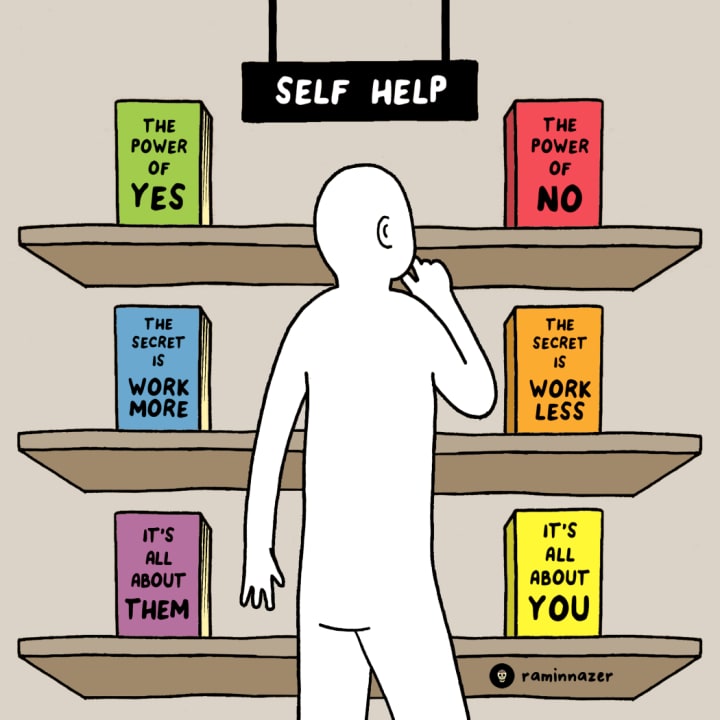
From the years 2013 to 2019, it was seen that in the USA, the self-help genre tripled in its output and sales of books and as of 2020 - the genre became worth almost $11 billion (Anderson, 2020). And, in the same statistics, it is thought that the most common themes of the best-selling self-help books happen to be those dealing with anxiety and depression through the lens of recovery and confidence.
In her article Is Self-Care Just a Trend? Shainna Ali argues that there is a clear line between what once was constituted as self-care before 2018 and what is now constituted as self-care. In this she states that there is much more of a focus and a want to read books related to mental health than physical fitness or dieting, which were perhaps the older methods of personal development and improvement. Whilst she recognises the surge in people being "hungry for knowledge" she also acknowledges that it could be a topic that is, in fact, more complex than the pop-sociology book tends to offer.
So the question here is simply: what happened?
Well, if we are to believe a theory called the 'prevalence inflation hypothesis' (Andrews and Foulkes, 2023) we can clearly see that self-help books have contributed to the awareness we have today about mental health problems such as depression, anxiety and OCD - the three that seem to have been on the increase for the past twenty years or so as they go hand-in-hand with the rise in these topics appearing in self-help literature and culture. Even though this has great advantages to those suffering from complex mental health problems, the theory suggests that it could also be contributing to the problem itself. Whilst the article by Andrews and Foulkes suggests that the awareness in mental health has come to mean that the diagnosis of symptoms has become more refined and accurate, they also state this:
"awareness efforts are leading some individuals to interpret and report milder forms of distress as mental health problems..."
(Andrews and Foulkes, 2023)
With part of the 'awareness efforts' being linked to the rise in self-help literature concerning the improvement of mental health, it is no wonder as to why they are making so much money from the perhaps more mildly suffering public. By pushing the lexicon relating to common mental health problems into the atmosphere, these books have caused a more mental health focused public to use the language of more extreme versions of these problems to report their own symptoms. Thus, making it inadvertently 'trendy' to have these perhaps more complex mental health problems.
This, coupled with the fact that those who write self-help books do not in fact, have to be mental health professionals (mentalhealth.com, 2024) means that often advice becomes distorted or suiting to a point of view that is perhaps, either more serious or more specific than the reader's whilst also convincing them that they can solve this problem that may or may not be their own. Thus, this proves the prevalence inflation hypothesis and also shows how the self-help industry could actually be doing more harm than good in the department of more subtle, less rigid mental health problems.
The Problem as Commodity: The Toxic Cycle of Self-Help

I would like to direct you back to the two different types of self-help book as we are about to cover the problems with the latter: the 'growth focused' books. "Growth focused" self-help books are perhaps the ones with more buzzwords in their lexicon such as: 'mindset' and 'empowerment', not to mention 'resilience', 'manifestation' and 'inner child'. In his article Self Help Books Can Just F- Off, Ian Whitworth describes the self-help industry as producing "sad, predictable ideas" (Whitworth, 2019) only strengthening the cookie-cutter ideas alongside the repetitive lexicon that places them firmly in the genre.
But, as we have already established this is the case, we need to be questioning how this could be more harmful than helpful to the readers who are continuously looking for the answers to life within them. For example, an article in Forbes (Travers, 2022) referenced a study about cortisol levels in the readers of self-help books, showing that they were much higher than those who did not engage in the same genre of books (Raymond, 2016). It again refers to the 'one size fits all approach' which in turn, creates a feeling of failure in those who cannot abide by the author's own rules and methods for success. On the other hand, we have those who in abiding by the rules and methods, still do not feel the state of success they were hoping for - or advertised.
Another article by the British Psychology Society has analysed that the focus on failure and causes of negative moods can often enhance them (Jarrett, 2010) and therefore, the books that tell these stories of failure and cognitive inability are often not best for solving the core of the problem - possibly doing more harm than good and thus, sending the person reading them into a cycle of "addiction" (Travers, 2022) and "rumination" (Jarrett, 2010).
This shows something present in many articles and studies regarding how self-help books actually work. In order to sell, they need not really fix anything but instead, create an awareness and fixation in the reader that something needs to be fixed. The commodification of this therefore becomes selling them the 'cure' whilst also creating new problems and, as Emily Goddard says in her Guardian article "(makes) happiness conditional" (Goddard, 2024). A condition it seems, reliant mostly on the next fix of self-help book.
This also refers to the cultural shift in which the 'growth' self-help book has perpetuated in the repetition of positive affirmations to oneself. Many psychological studies of the modern day have not only referred to this as not a helpful practice but they have stated it is actively harmful. (Nursing Times, 2009) The commodification of this quick-fix could only be for one reason: ease. Get people to do something that is easy to do and do not let them know it is actively harmful and then, sell them the cure to this newly created problem they have no idea is linked to the last thing they were told to do.
The way in which self-help books commodify this problem they themselves have created is probably best presented by an article entitled Why You Should Stop Reading Self-Help Books (2017) as they fall into:
The kind of (books) that tell(s) you you’ve got a problem and the only way to solve this problem is by buying this very book.
(Baze, 2017)
The Modern Mental Health Rabbit Hole: Born Out of the Darkness of the Self-Help Industry

Steve Salerno (2005) called the self-help industry:
‘(An) enterprise wherein people holding the thinnest of credentials diagnose in basically normal people symptoms of inflated or invented maladies, so that they may then implement remedies that have never been shown to work..."
This obviously has some ties into what we looked at before in terms of the toxic cycles produced by reading self-help for any reason. But what does all of this mean for the modern perspective of mental health and what happens to these people who get trapped in the mental health 'rabbit hole' of quick fixes? One of the key concerns I'm going to look at is self-administration - known in our modern times more commonly as 'self-diagnosis'.
Self diagnosis is the act of asserting that there is a mental health condition without the assistance of a mental health professional. It has been shown that anecdotal experiences are perhaps the most perviasive way in which these self-diagnoses are shared and manipulated when it comes to social media (Jaramillo, 2023). But if we scale back a bit, self-help books do the exact same thing. Where social media began with a glamorisation of mental health problems, self-help began with a justification as is: 'you are the way you are because you have (insert mental health problem here)'. And thus, through a number of carefully worded anecdotes that may or may not be true, the writer slowly convinces the reader of how alike they are, a small-scale form of 'mass hysteria'.
Therefore, the self-administration of these other self-help books to treat the same problem coincides with the same issue we are facing today where millions of social media users are consuming and creating content that fuels a support for self-diagnosed mental health problems where nuance is ignored and anecdotes (whether true or not) are focused on how alike they are. This is a larger form of mass hysteria which really put emphasis on the word 'mass'.
Therefore, we can see clear links between what has formed out of the social media hysteria of mental health problems and those born out of the self-help industry in that they focus on the requirement for people being alike, ignoring the nuance of the difficulty being spoken about and often, offering quick and sometimes harmful 'fixes' that perhaps do not even work. Again, if we are to look back in this article, we can tell that these are (like on social media) coming from the mouths of those with the least credentials most of the time.
Conclusion

In conclusion, self-help books, while promising solutions to complex personal issues, often oversimplify challenges, preying on cultural fears of failure. These books may inadvertently contribute to a rise in mental health self-diagnosis, encouraging individuals to label ordinary distress as psychological disorders. Its impact on mental health awareness and self-diagnosis underscores the need for more individualised, professional approach to personal well-being. It has in fact, started a ball rolling on a problem that is now out of our control through its commodification of mental health and personal growth which focuses more on buzzwords than it does on solutions.
Works Cited:
- Ali, S. (2019) ‘Is self-care just a trend?’, Psychology Today
- Anderson, P. (2020) ‘NPD: ‘A Decade of Personal Exploration’ Ahead in US Self-Help Books’, Publishing Perspectives.
- Baze, T. (2017) ‘Why you should stop reading self-help books’, Thought Catalog
- Bergsma, A. (2008). Do Self-Help Books Help? The Journal of Happiness Studies. Volume 9, pp. 341–360.
- Foulkes, L. and Andrews, J.L. (2023) ‘Are mental health awareness efforts contributing to the rise in reported mental health problems? A call to test the prevalence inflation hypothesis’, New Ideas in Psychology.
- Goddard, E. (2024) ‘Self-help: the toxic world of books, courses, and apps’, The Guardian
- Jaramillo, J.A. (2023) 'Down the rabbit hole of self-diagnosis in mental health', University of Colorado Denver
- Jarrett, C. (2010) ‘CBT-based self-help books can do more harm than good’, BPS Research Digest
- MentalHealth.com (2024) 'Are Self-Help Books Helpful?'
- Moore, S. (2019). Self-help books for men: the new solution to anxiety and depression? The Guardian.
- Nielsen Book, (2023). ‘New year, new me’: the consumers driving the self-help boom.
- Nursing Times (2009) ‘Can self-help books be bad for you?’
- Psychology Today, (2020). Why are self-help books not so helpful after all? Psychology Today.
- Raymond, C. (et al) 2016. Salivary cortisol levels and depressive symptomatology in consumers and non-consumers of self-help books: A pilot study. Neural Plasticity, 2016
- Salerno, S. (2005) The Self-Help Myth: How the Self-Improvement Industry Is Making Us Worse, 1st ed. New York: St. Martin's Press
- Starker, S. (2004). Oracle at the Supermarket: The American Preoccupation with Self-Help. 1st ed. New York: Viking Press.
- Travers, M. (2022) ‘A psychologist tells you why you need to escape the toxic world of self-help’, Forbes
- Whitworth, I. (2019) ‘Self-help books that can just f*** off’ ianwhitworth.net
About the Creator
Annie Kapur
I am:
🙋🏽♀️ Annie
📚 Avid Reader
📝 Reviewer and Commentator
🎓 Post-Grad Millennial (M.A)
***
I have:
📖 300K+ reads on Vocal
🫶🏼 Love for reading & research
🦋/X @AnnieWithBooks
***
🏡 UK
Keep reading
More stories from Annie Kapur and writers in Psyche and other communities.
The Paradox of Protections
The 21st Century has developed in ways we could not imagine, especially for those of us who were coming of age at the same time as social media was becoming a bigger deal. For those of us who grew up with MySpace and Facebook, social media was nowhere near as prevalent in usage as it is now. But has this newfound prevalence led us to commit to a life of no surprises? Has it led us to fester in low-risk, highly predictable environments?
By Annie Kapur2 years ago in Psyche
Top tipple tricks
Been thinking a lot about drinking, lately. Not least because of a recent episode of over-indulgence and the inevitable after effects. Some readers may recall the earlier articles I wrote about beating the booze. Here I set out an experiment in techniques for cutting down on my alcohol intake. The experiment was successful, the techniques worked, and I have armed myself with an arsenal of weapons in the war against the demon drink. I have yet to fire the first round however. It's all a question of timing (perhaps procrastination).
By Raymond G. Taylor5 days ago in Psyche
The Night I Stayed Awake
Most nights pass quietly and without much thought. We finish our daily routines, turn off the lights, and drift into sleep, hoping to wake up refreshed for another day. But sometimes there are nights that feel different. Nights when sleep refuses to come. Nights when the mind becomes louder than the world around it. For me, it was the night I stayed awake, staring at the ceiling while countless thoughts moved through my mind. When Sleep Refuses to Come It began like any ordinary evening. I finished dinner, spent some time on my phone, and prepared to go to bed. The house was quiet, and the lights were off. Normally, this is the moment when my mind begins to slow down. But that night, something felt different. I turned off the lamp beside my bed and closed my eyes, expecting sleep to arrive within minutes. Instead, my mind began replaying the entire day. Small conversations. Things I should have said differently. Tasks I had postponed. Worries about the future. The more I tried to ignore these thoughts, the louder they became. The Silence of the Night There is something unique about the middle of the night. During the day, life moves quickly. There are distractions everywhere—phones, work, conversations, and responsibilities. These distractions keep our minds busy and prevent us from thinking too deeply. But at night, when everything becomes quiet, those thoughts return. As the hours passed, the silence in my room felt heavier. I could hear the faint ticking of the clock on the wall and the occasional sound of a car passing outside. It felt like the world had paused. But my mind hadn’t. Thinking About Life Lying awake in the darkness gives you a strange perspective on life. Without the distractions of the day, you begin to think about things you usually ignore. Questions appear that you don’t normally ask yourself. Am I moving in the right direction? Am I making the most of my time? Am I appreciating the people around me enough? These questions are not always comfortable, but they are important. That night, I realized how rarely we allow ourselves to pause and reflect on our lives. The Weight of Worries Part of what kept me awake that night was worry. Everyone carries some level of worry—about work, family, finances, or the uncertainty of the future. Most of the time, we push these worries aside because we are busy dealing with daily responsibilities. But when the world becomes quiet, those worries often return. The challenge is learning how to face them without letting them control us. As I lay there staring at the ceiling, I slowly began to understand that worrying endlessly doesn’t solve anything. It only steals the peace of the present moment. A Different Kind of Night Eventually, I stopped trying to force myself to sleep. Instead, I sat up in bed and looked out the window. The street outside was calm, illuminated only by a few distant lights. For a moment, everything felt still. And in that stillness, something unexpected happened. My thoughts began to settle. The worries that had seemed overwhelming earlier now felt smaller, almost manageable. Sometimes the mind simply needs time to process everything it has been carrying. A Lesson From a Sleepless Night That night taught me something valuable. Sleep is important, of course. But occasionally, a sleepless night can also offer a rare opportunity for reflection. It allows us to step away from the noise of daily life and reconnect with our thoughts. It gives us the chance to examine our worries, our goals, and the direction we are heading. In a strange way, that quiet night helped me feel more clear about my life than many busy days ever had. Morning Arrives Eventually, the sky outside began to brighten. The first light of morning slowly filled the room, and the world started waking up again. Birds began to chirp, and distant sounds of early traffic appeared. Ironically, that was the moment when sleep finally began to arrive. But by then, I didn’t feel frustrated anymore. Instead, I felt calm. Final Thoughts We often think of sleepless nights as something negative, something to avoid at all costs. And while rest is essential for our health, not every restless night is meaningless. Sometimes, those quiet hours allow us to reflect on our lives in ways we rarely do during the day. The night I stayed awake reminded me that life is not only about rushing from one task to another. Sometimes, it’s about pausing, listening to our thoughts, and learning from the silence. And occasionally, the lessons we discover in the quiet darkness of the night stay with us long after the sun rises.
By Shoaib Afridi2 days ago in Psyche
Writing To Succeed
If you want to find something that will help readers find your writing, possibly expand your audience, and maybe even get you noticed for other things, then you’re not alone. But how can you get it done in a world full of want-to-be writers? Look less at what you’re writing now, and more at what other writers have used to boost their views and reads.
By Jason Ray Morton 7 days ago in Writers




Comments (3)
This was such an insightful read! Awesome work, Annie. And I think you’re absolutely right that self-help books tend to oversimplify very complicated problems; for the sake of marketability, everything needs a “solution” that the authors themselves can provide.
nice
Love this . I imagine a big box with dependencies all around it and you have to fill in the the development tasks in each box. Great writing here!