
MY BRAIN DECIDED TO SHUT DOWN?
How do i get along with depression?

Nowadays, depression is a common disorder that approximately 5% ofthe world's people have. By the way, that's about 400 million. Depression is not just a funny joke, it's a really serious illness that affects a large number of today's youth.
"Depression is when your body tells you no. It's when you know where light switch is, but you can't or won't reach it"
If you'been feeling "disconnected" or not quite productive lately (two weeks or more), this article is for you. You'll learn a lot here: symptomps, types, how it's treated and lots of useful fact. Go ahead and read it!
Main Symptoms:
Quite often in the present time you can meet a huge manifestation of symptomps in people. But you should not rush to conclusions, which I tell you in advance, for many discords can be similiar.
What you can detect and know for sure?
- Apathy, complete or partial loss of interest in what is happening, a certain detachment.
- Low self-esteern, guilt.
- Sleep and appetite disturbance: it could be like insomnia, you can't even spoon in the mouth, as well as sleeping more than 12 hours a night, constant.
- Compulsive thoughts of death, suicide, self-harm.
- A complete lack of faith in having a future for oneself.
- Loss of the joy of accomplishment.
- Constant dreariness, tearfulness.
- A feeling of emptiness inside.
If it drags on for two or more week, it's worth it you need to visit a doctor, because it gets worse.
It can also manifest in episodes, which may indicate other neurological disorders, such as Bipolar Affective Disorder.
But these are the symptomps you see listed most often. What should you look for in addition to the above?
- Chronic fatigue. If not a complete lack of energy to solve daily tasks, so eternal fatigue. A person doesn't can fully rest, take a load off them shoulders, because depression hits the nervous system, distruping its work. As a result, energy is redude.
- Somatization of emotions. Feeling all emotions not on a psychological level, but on a physical one. The heaviness, the discomfort in chest and stuff.
- Slowness. Sluggishness when speaking, harder to think and react quikly to problems. Depression slows down cognitive functions to use less of the body's resourse.
- Gastrointestinal problems. Sharp pain in different parts of the body. Stress affects other parts of the body, leaching into the pain and health problems.
- Self-isolation. Although humans are social animals during a depressive episode, they tend to isolate themselves from others. Anuthing to conserve or nott to hinden others with their doom.
Often coming to the doctor and complaining of various pains: in the head, back, heart, people may not find anything in the end. This may indicate psychosomatics. At such times, it is worth heading to a psychologist or psychiatrist. You don't want to wallow in pain, do you?
Casuse of occurrence.
There are so many of them that it can take up the whole sheet. Mostly, depression manifests itself in people in times of stress, severe emotional upheaval or trauma. It is not uncommon when a person is doing well, but for reasons that are not clear neither to himself nor to anyone, he slips into severe depression. Therefore, it would be worth noting that a person may be genetically predisposed to this disorder or a violation in the regulation of serotonin, dopamine and norepinephrine. Therefore, a person is never at fault for their condition, but what to do about it is their decision. You and only you decide what to do with yourself and your life.
It does not depend on age, race, or gender. The symptoms are individualized, as are the causes. But depressive disorder is more common in women and homosexuals than in men and heterosexuals.
Types:
There are quite a lot of them, but here we have collected the main ones that are most common. There is a brief description for each one.
- Clinical depression or Major Depressive Disorder. Caused, often, by biochemical imbalances in the body and genetic predisposition. It is much “heavier” than the depression we are used to.
- Dysthymia. A chronic condition of two or more years where the patient complains of a constant melancholy state. It is milder than MDD.
- Atypical depression. The kind where from the depression we are all used to a person does not eat, does not sleep everything is the opposite: weight gain, hypersomnia, huge appetite.
- Seasonal depression. Disturbance of circadian rhythms and decreased serotonin production leads to this. It is noted much more often in the period of fall-winter.
- Postpartum depression. Occurs in women after their baby is born.
- Psychotic depression. It comes with bonus symptoms of psychosis, hallucinations and delusions.
- Masked depression. Manifested through physical symptoms (GI problems, stomach problems, fatigue), but less often through emotions.
So there is also depression that occurs under the influence of drugs, alcohol, after brain injury, but is not as interesting.
In addition to this set, other types are present, but they do not gain enough to be a serious enough disorder.
How is depression treated?
In the old days, a century or two ago, mental disorders were not treated in the most pleasant way. But nowadays medicine, including psychiatry, does not stand still and develops. Which means no lobotomies and shock therapies.
Of course, depression can be tried to cure alone, but this can only bring more harm. It will require no small amount of effort and endeavor, for it is not just “laziness,” as the Soviet generation is called. Nevertheless, if a person is in such a state not so long ago, there are chances to crawl out of the pit on their own.
But how is depressive disorder treated?
There is an opinion that it is treated solely by medication, which is false. To overcome depression you need a combo of: medication, psychotherapy, the desire of the person. Without the presence of a desire to get out of the apathetic state, the patient will not advance a centimeter.
Medication:
Medication is prescribed exclusively by a psychiatrist with proper medical training. Depending on the form of depression, certain drugs are prescribed. They stimulate the brain, help bring the brain into balance of chemicals and restore the brain to its previous functioning.
Psychotherapy:
Since pills are purely a push, a stimulation, the treatment of depression is accompanied by sessions with a psychologist\psychotherapist who specializes in this. At the moment there are many varieties of psychotherapy, so it is chosen either by the patient himself, or appointed by the doctor himself, assessing the condition of the person. Without regular visits to a specialist, the patient may not be able to get out of this condition, because therapies are very important in this condition.
The brain after during depression.
What happens to our brain in that case? It gets the worst of it in this situation. At the very least, insomnia or hypersomnia is a case in point.
There are six main compartments in our brain:
- Thinking
- Perception.
- Emotion regulation.
- Environmental perception
- Somatic regulation
- Social regulation
In depression, the third department (emotion regulation) is affected and the others follow in a chain. Because if one department is disturbed, the others will not work at the same pace, because they depend on each other.
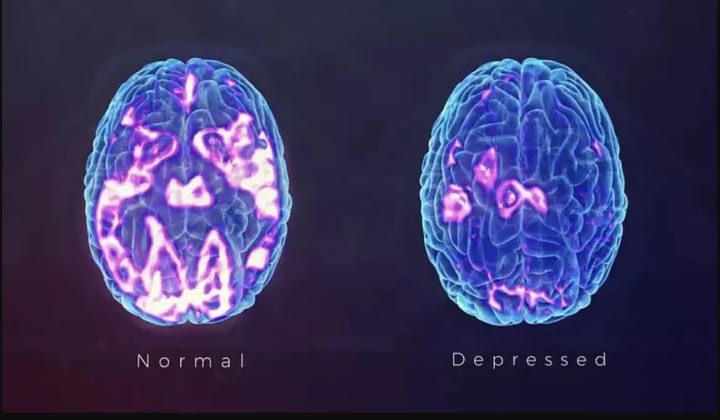
The production of neurotransmitters slows down, which leads to imbalance in the body. They are responsible for mood, motivation and energy, which is very important for every person. Hence comes apathy, burnout, fatigue, and depression.
The brain ceases to create and strengthen neural connections, from which it becomes more difficult to adapt to what is happening around you, to cope with stress. By the way, cortisol, the stress hormone, also enters the “active phase”.
For fear and anxiety we have in response is the almond-shaped body, which during depression becomes much more active than usual. It does not allow a person to think normally, the efforts of negative feelings.
The department for working with memory also suffers, so people with depressive disorder have problems with memory and constant lethargy, and emotions and feelings are not thought about much.
Remember, depression is treatable. With the right support and effort, it's possible to reclaim your life and happiness.
About the Creator
torch macktraher
want to dive deeper into psychiatry, astronomy, religion, and cinema? you're in the right place! Here, you'll find a variety of articles to broaden your horizons and make your time worthwhile. Enjoy reading and discovering something new!
Reader insights
Outstanding
Excellent work. Looking forward to reading more!
Top insights
Easy to read and follow
Well-structured & engaging content
Eye opening
Niche topic & fresh perspectives
Heartfelt and relatable
The story invoked strong personal emotions
On-point and relevant
Writing reflected the title & theme
Keep reading
More stories from torch macktraher and writers in Psyche and other communities.
Is high self-esteem narcissism? Myths about narcissistic personality disorder.
How often do you run into all the possible negative videos and articles about narcissists? “Narcissistic Abuse, Narcissistic Partner, etc.” But is it as bad as social media screams about it? So much negativity has been sprinkled towards people with this disorder! It's time to refute such rants.
By torch macktraher12 months ago in Psyche
If Love Were Worth Begging For, It Would Have Been Given to Me Generously Without Asking
If you’ve ever stared at your phone waiting for a message that never came… If you’ve ever rewritten a text ten times because you were afraid of sounding “too much”… If you’ve ever begged someone—silently or directly—to treat you the way you deserved…
By Ahmed aldeabella5 days ago in Psyche


Comments
There are no comments for this story
Be the first to respond and start the conversation.