
Mirrors are mysterious portals
If you read this article, you'll never look at a mirror the same way again


Have you ever wondered what would happen if you stared at your reflection in the mirror for a long time? It may seem like a trivial question, but there’s an experiment that could make you reflect (in every sense) in a completely new way. This psychological experiment had surprising reactions, and it makes us question the nature of reality and human perception.
The mirror experiment: the reflection that distorts reality
In several psychological experiments, participants were asked to look into their own eyes in a mirror, without blinking, for an extended period of time. Despite its simplicity, the experiment had an unsettling effect on participants. Most of them began to see their faces distorting. Some saw their faces twisting into strange forms, as if they were looking at another person. Others felt that their reflection moved independently from their physical movements. Most participants experienced significant psychological discomfort and, in some cases, tried to leave the room, frightened by what they were seeing.
The experiment, while conducted to analyze psychological responses to visual distortion, raised broader questions about the perception of reality and what happens when we confront something that challenges our understanding of the world.
Mirrors as portals in ancient times
Since ancient times, mirrors have been used not only to reflect physical images but also as tools for divination and esoteric practices. In many cultures, mirrors were seen as true portals to other worlds or dimensions. Ancient Egyptians, for example, used polished bronze mirrors during religious rituals, believing they could reflect not only the physical body but also the subtle energies that permeate the soul. In ceremonial magic, mirrors were seen as a means to contact invisible entities or to explore the subconscious mind.
Thus, the mirror was not just an object of beauty or practicality but also a mystical tool capable of linking the material world with the spiritual. In various esoteric traditions, the reflection was not just a static image but a gateway to discovering hidden truths, communicating with spirits, or exploring unseen dimensions.
"Madness" and the perception of reality
Now, if you found yourself staring into a mirror and saw your face distorting, what would your reaction be? Most people, if not aware of the psychological experiment context, might think there’s something wrong with their mind. The visual distortions caused by such an exercise could easily be interpreted as a manifestation of madness. Society tends to consider "crazy" what doesn’t fit the shared view of reality.
But in this experiment, each participant experienced the same visual distortion. The deformation wasn’t an isolated case, but a common reaction to an unknown phenomenon, challenging the laws of normal perception. What this suggests is that perhaps "madness" is simply a different perception of reality, a view that challenges societal conventions. Maybe when someone perceives reality differently, they are not crazy; they could simply be someone who is able to see what others cannot.
Psychology: an incomplete science?
This brings us to an interesting reflection: how much do we really know about the human psyche? Psychology, while considered a science, still has huge gaps when it comes to fully understanding the nature of the mind. Psychological theories often overlap without solving the fundamental issues of the soul and consciousness. In fact, one could argue that psychology, more than a "precise science," is a collection of theories constantly evolving, with answers often replaced by new hypotheses.
When it comes to madness, psychology has always tried to define and measure what is "normal" versus what isn’t, but the reality is the human mind is too complex to be confined by rigid theories. Extrasensory perceptions, out-of-body experiences, and other mystical phenomena are often deemed "irrational" because they are not easily explained by traditional psychology. However, this doesn’t mean these are invalid experiences, but simply that psychology doesn’t yet have the tools to fully understand them.
Nothing is as it seems: the importance of staying open
Perhaps the most important lesson we can draw from experiments like the mirror experiment is that reality is not as solid and fixed as it seems. Mirrors, as portals, teach us that we can perceive dimensions different from the ones we see every day. What we consider "madness" could simply be a higher perception, urging us to look beyond physical appearances and explore our inner reality.
Our world is complex and mysterious, and often rigid and conventional explanations aren’t enough to explain everything. It’s essential to keep an open mind, not just to accept new possibilities, but to seek our personal truth. Reality is a constantly evolving canvas, and it’s up to each of us to decide how we choose to see it. The true "madness" could be the refusal to acknowledge the invisible dimensions surrounding us and remaining anchored to a version of reality that is incomplete.
Did I manage to intrigue you? Now you know that the mirror in your bathroom is not just a simple piece of glass with reflective paint, but can be a portal to different dimensions. If this has made you think about how mirrors influence the energy around you, I invite you to read my practical article on how to purify your home mirrors and allow only positive energies to enter. You can read the full article here!
#Mirrors #PositiveEnergy #Wellness #Magic #FengShui #PersonalGrowth #Purification #Spirituality #Design #Home #Energy #PositiveVibrations #Meditation
About the Creator
Halina Piekarska (UltraBeauty Blog)
Blogger, writer, and illustrator, I share stories, reflections, and practical tips on psychology, well-being, and natural beauty. I believe that learning never stops, and I strive to enrich readers’ lives with knowledge and inspiration.
Keep reading
More stories from Halina Piekarska (UltraBeauty Blog) and writers in Psyche and other communities.
The Darkness
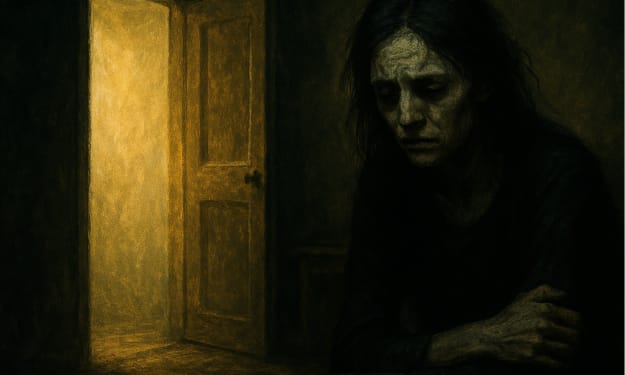
The darkness had taken her place. There had been a moment, a fragile instant, when the light, which once slipped through her hair like a caress, had retreated. She had given all her light to him. Everything. Every breath, every heartbeat, every fragment of herself. And yet, he had never understood the magnitude of her gift. She believed that loving him meant emptying herself, that love was a promise of dissolution, of merging. But he had never merged with her. He remained a shadow, an idea that never took form, like a dream that fades the moment you try to grasp it.
By Halina Piekarska (UltraBeauty Blog)11 months ago in Psyche
Who is your "Person"?
It's important to recognize that you cannot go through life as easily on your own. My name is Elizabeth and I'm a survivor of child abuse and horrific trauma. Healing from trauma is not a quick fix and recognizing that it will take time, is part of the struggle.
By Elizabeth Woods4 days ago in Psyche
The Surprising Psychology Behind People Who Love Staying at Home
In a world that constantly celebrates travel, parties, social gatherings, and busy lifestyles, people who prefer staying at home are often misunderstood. Many assume they are lazy, antisocial, or missing out on life. However, psychology tells a very different story. Loving to stay at home can reveal deep aspects of personality, mental wellbeing, and emotional intelligence. Interestingly, psychologists have found that people who enjoy their own company often possess unique psychological strengths. Their preference for quiet environments is not necessarily about avoiding the world — sometimes it is about understanding themselves better. Let’s explore the surprising psychology behind people who genuinely love staying at home.
By Shahid Zamana day ago in Psyche


Comments
There are no comments for this story
Be the first to respond and start the conversation.