
Maybe the Moon is Beautiful Only Because It's Far
What We Can’t Reach, We Revere
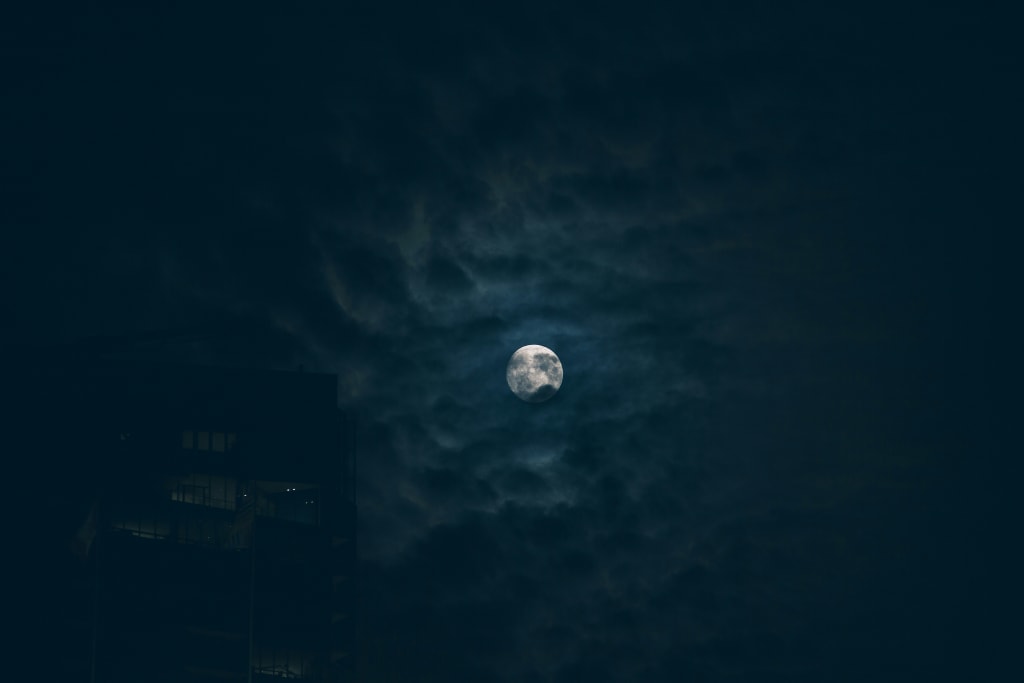
Some things glow more brightly because we’re not close enough to see the cracks. Perhaps moon is beautiful only because it is far. Its light, cold and unattainable, is of a regard that would not endure the gaze of intimacy. This notion — that distance is essential for beauty, and in some ways creates it — has long influenced aesthetic theory. Edmund Burke, in A Philosophical Enquiry into the Origin of Our Ideas of the Sublime and Beautiful (1757), understood that the vague and immense are capable of overpowering our senses and elicit a sense of the sublime. Beauty (in this sense) is not in the beautiful itself, but in the reaction of awe at something too far to be properly perceived. As Burke insisted, clarity and closeness would leech things of their emotional force; mystery in contrast rises from obscurity, scale and distance. The moon, as seen from this planet, is beautiful not because of what it is, but because of its distancing technology.
Immanuel Kant added a further twist to this principle by introducing the idea of “disinterested pleasure” when he wrote in the Critique of the Power of Judgment (1790). For Kant, aesthetic judgement must be independent of desire, personal interest, or other utility. Too proximity induces near-sightedness, and when we’re too close—emotionally or physically or ideologically — we lose the perspective that enables judgement of beauty for its own sake. Distance itself is less avoidance and more a necessity for genuine appreciation. In this nature, the moon is beautiful in that it is useless to common observation, it is separate from every day contention. Its neither a threat nor a service to us—all it wants is to be contemplated. As soon as we memorize it, it risks being flattened into ‘just another thing in the pocket,’ devoid of wonder.
The philosopher Edward Bullough, in his 1912 essay “Psychical Distance as a Factor in Art and an Aesthetic Principle,” codified distance as crucial to aesthetic experience. Art, or any aesthetic object, to be beautiful requires a certain distance between the observer and the thing observed. It’s a psychological separation as much as a physical one — a lack of concern, emotional investment or personal matriculation. Too close to home and it stops being art, starts being life, and life, for the most part, is a raw deal. Bullough’s theory proposes that the beautiful dwells in the restraint, in the holding-back of imagination, or the reduction of complexity. The moon, once again, isn’t loved for its geology or dust, but for the emotional space it holds in our minds — far enough to launch dreams at, near enough to see but never touch.
Gerald C. Cupchik, demonstrating the genealogy of Bullough’s concept, reveals how psychical distance is a subtle yet enduring current in the history of aesthetics. In his 1989 text, “The Evolution of Psychical Distance as an Aesthetic Concept”, Cupcik writes that distance is important because it “entails ambiguity and openness” that are crucial to being an aesthetic stimulus. Obsession with immersion (removing the distance between viewer and object), he explains, is built into the demands of modernity and usually collapses the actual conditions of possibility of beauty. The nearer we draw, the more we strip the aesthetic down to the functional, the symbolic down to the literal. The moon, once a poet’s muse, is transformed into a resource field for industrial minerals and geo-spatial cartography. What was formerly an invitation to silence and contemplation is refashioned in diagrams and data.
Max Ryynänen brings this critique up to the present in his 2023 text “Under the Skin: Notes on the Aesthetics of Distance and Visual Culture.” According to Ryynänen, visual culture has now flattened the experience with technical immediacy. Perpetual bombardment of hyper-detailed images, immediate access and immersive media... Time for reflection reduces. ”Beauty, for him, does not lie in sharpness but in suggestion, not in closeness but in a studied back off. And as the moon is subject to live broadcast, digital simulations and corporate plans, its mystery is dismembered and reused. When the foe vanishes, so does the place for wonder, Ryynänen warns.
Such thinkers remind us of the distance that should be kept, not a failure of access, but a mode of attention. We tend to think of proximity as something that leads to understanding, or closeness, or beauty, but then I had this idea that beauty exists in what is absent from our hands. The moon is striking to look at from earth, is what I am saying. It is the very fact of its removal that keeps it glowing.
References:
Burke, Edmund. A Philosophical Enquiry into the Origin of Our Ideas of the Sublime and Beautiful. London: R. and J. Dodsley, 1757.
Bullough, Edward. “Psychical Distance as a Factor in Art and an Aesthetic Principle.” British Journal of Psychology 5 (1912): 87–118.
Cupchik, Gerald C. “The Evolution of Psychical Distance as an Aesthetic Concept.” Empirical Studies of the Arts 7, no. 1 (1989): 27–50.
Kant, Immanuel. Critique of the Power of Judgment. Translated by Werner S. Pluhar. Indianapolis: Hackett Publishing, 1790.
Ryynänen, Max. “Under the Skin: Notes on the Aesthetics of Distance and Visual Culture.” Journal of Aesthetics Studies 12, no. 2 (2023): 101–120.
About the Creator
Top tipple tricks
Been thinking a lot about drinking, lately. Not least because of a recent episode of over-indulgence and the inevitable after effects. Some readers may recall the earlier articles I wrote about beating the booze. Here I set out an experiment in techniques for cutting down on my alcohol intake. The experiment was successful, the techniques worked, and I have armed myself with an arsenal of weapons in the war against the demon drink. I have yet to fire the first round however. It's all a question of timing (perhaps procrastination).
By Raymond G. Taylor3 days ago in Psyche




Comments
There are no comments for this story
Be the first to respond and start the conversation.