

CW: talk of divorce, depression, and suicide. Also bad words.
When I was thirteen, my absolute favorite song was “Face Down” by the Red Jumpsuit Apparatus. One might ask, and reasonably, what business a child from a decidedly nonviolent background had identifying with a song about a woman’s abusive relationship. There are a few answers to this.
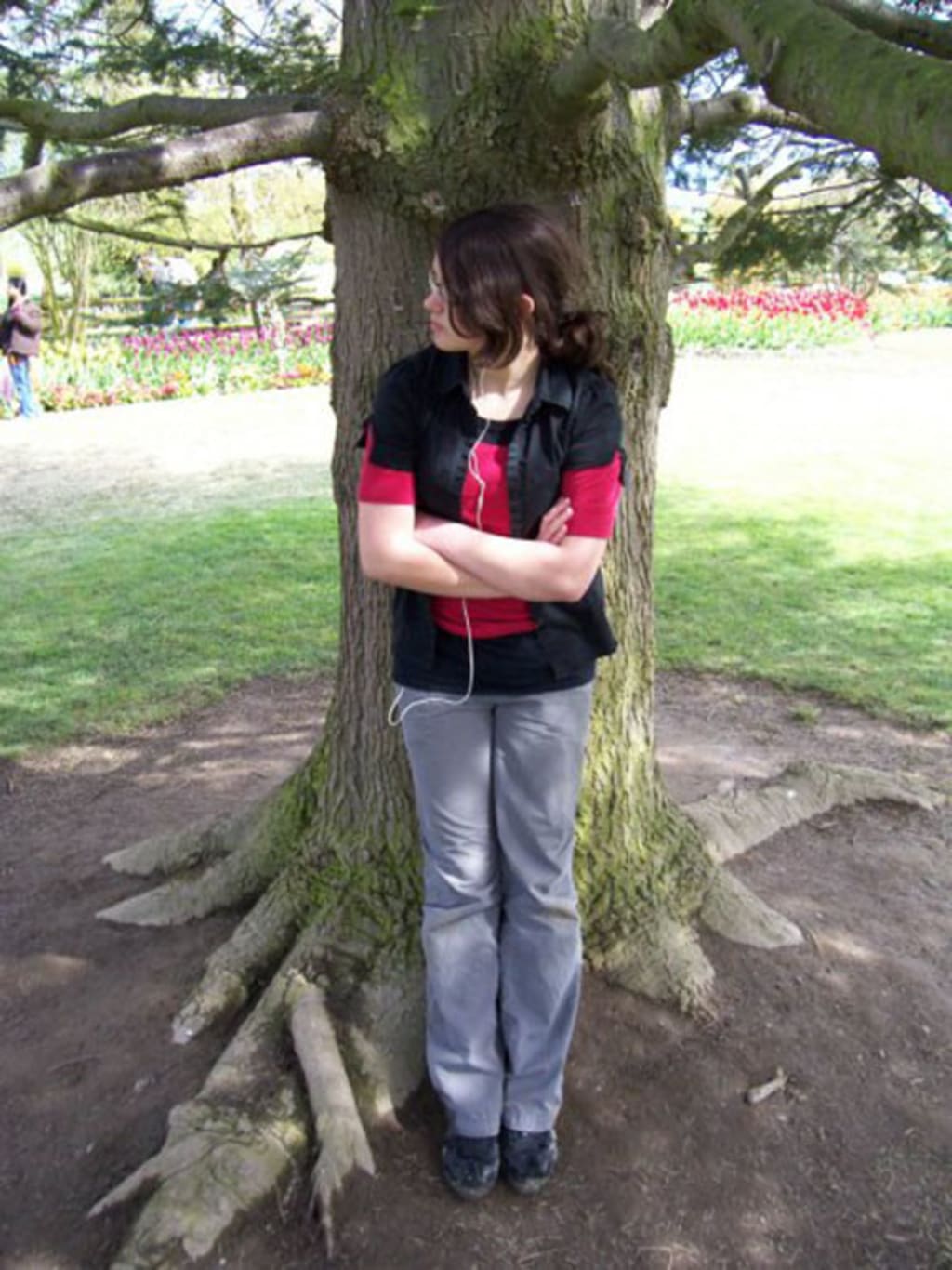
The first is that I honestly didn’t think it all the way through. I had no goddamn idea what the song was about, I just liked the sounds it made. I got into this habit, sitting on the bus at the ass-crack of dawn (seriously, why don’t we let teenagers sleep??) with my scuffed white standard-issue Apple earbuds plugged into my mom’s hand-me-down iPod Shuffle: I’d tap my fingers on my thigh in time with whatever song happened to be prematurely deafening me. The longer I did it, the more complex it grew, incorporating both hands and, later, both feet, each appendage doing its own independent thing. (Man, I should’ve been a drummer.) I can only imagine what I looked like, sitting on those brown vinyl-trying-desperately-to-be-leather seats, bowing and jerking and wiggling in that protracted full-body spasm of pure adolescent rage.
Those bus rides stick out to me now as some of the most peaceful moments of my childhood; choosing the song with which I’d kick off my day became almost a sacred rite, like whatever song I chose would somehow influence the hours ahead. I’ve shed most of the superstition around my choice of ambiance, but the quasi-drummer habit remains, albeit in (I hope) a subtler, more refined form. Nowadays, with new music, I seek out particularly complex rhythms and time signatures—5/4, 7/8; one of my favorites is 3-over-2, so I have to split focus between my left hand doing two taps in the same time my right hand does three. I got diagnosed with ADHD about a year ago, at 25; makes a hell of a lot of sense in retrospect.
To my nascent drumming habit, “Face Down” presented a particular challenge, in that beneath the verses lay this frenetic, sprinting guitar line that tested the utmost limits of my wrist’s speed, precision, and endurance. Any day I managed to get through the whole song without my wrist locking up or my pace falling behind was automatically a Very Good Day.
It was an outlet. Nothing new there, for ADHD kids or for teenagers at large—music has a way of tapping into your deepest, most turbulent emotions and letting them spew right out, like pulling the tab on a Coke your sister shook behind her back before she gave it to you. (Full disclosure, I probably was that sister.) For angsty, hormonal teens, this sense of release has an obvious appeal. For my undiagnosed-ADHD brain, the prospect only got sweeter.
It was sweet to me for one more reason. Maybe two, or three, I don’t know—depends on how you count, I guess. It was the same reason(s?) why I, a child whose parents were demonstrably loving and never raised a hand to her, could identify so viscerally with a song about domestic violence. See, thirteen was right around the time my life started falling apart.
There’s a real chicken-or-egg conundrum to this era of my life that frankly gives me a headache to think about. Cause-and-effect relationships got real tangled up. But basically, several big things happened all at the same time: I entered into arguably one of the hardest, cruelest trials a child must endure, junior high; my parents’ marriage of fifteen-odd years started to spoil; and my mother spiraled into a deep depression.
The child-of-divorce story isn’t new, either. Probably the factor with the most profound effect on my psychological state, though, was my mom’s depression. Whether it was triggered by the divorce is debatable, though my dad can’t really be blamed, given the considerable evidence suggesting that my mom’s condition was/is genetic. In any case, the divorce certainly didn’t help.
It didn’t happen all at once, of course. I’ve never heard of a family falling apart overnight, clean and simple. For us, the process happened over years—four or five, maybe, between the point my parents really started fighting to the point when the divorce was finalized. These also happened to be, joy of joys, the years in which I underwent the brunt of puberty. Like I didn’t have enough to deal with, amirite?
My dad moved out when I was around thirteen or fourteen, and I and my two sisters stayed with mom. I hate to say it—I love my mom, and I know she was doing her best, and these days I have crazy amounts of respect for her and the way she’s managed to stabilize and rebuild—but it was a questionable choice, leaving us with her. As the person who took up the lion’s share of excess emotional labor on her behalf, I can safely attest that she was not in a place to be caring for three daughters by herself.
What follows, I can relay with authority for two main reasons: one, I probably bore closest witness to my mom’s struggle during those years, second only to herself; and two, in a flourish of delightful karmic irony, many of my mom’s greatest fears, crutches, vulnerabilities, and neurochemical deficiencies, I also seem to have inherited.
She was scared to be alone. That was a lot of why the divorce process dragged on as long as it did—my dad knew pretty early on that he needed out (though he could’ve expressed it in better ways than extramarital affairs, a sin that I never conceived him capable of, and one that struck me as the ultimate betrayal, even worse than leaving, which I kind of understood). They got married when they were eighteen. My dad had only graduated from high school two weeks before (my mom dropped out, and later got her GED, and then her BA, and then her Master’s; hell of a woman, really, despite the light in which this story paints her). By all accounts, neither of them came from a very stable background, though I’ve only ever gotten scraps of information: dad’s dad, whom I’ve never met, was an abusive alcoholic, and my dad moved around a lot growing up, like an army brat without the army; my mom’s dad, whom I’ve also never met, killed himself when she was sixteen, and her mom wasn’t exactly a paragon of parenting. My parents came together and built what they hoped would be a stable home in bald-faced defiance of their own histories, and despite a lack of fiscal resources, that home really was stable, more or less, for a long time. I still remember a time when I could lie back and cocoon myself in the gentle warmth and humiliation of watching my parents kiss. Ew, cooties.
Neither my dad nor my mom had ever truly had to stand on their own two feet, alone. My dad was ready; my mom was not. I remember judging her viciously for this, like I knew shit about anything, but from the outside it seemed glaringly obvious that this marriage was toast and she’d end up on her own eventually, so she may as well face the music. But she wouldn’t turn, and so I had to.
I turned to music to express all the rage, resentment, grief, exhaustion, and pitiful, childish longing I felt incapable of expressing anywhere else. There was no room for my feelings in that house—it was already full to bursting with the noxious fumes of my mother’s misery and terror. I could only throw open the windows, let out all the poison I could, and keep a tight lid on the poison that wanted so desperately to spew out of me. I couldn’t add mine to hers; if I did, what air would we have to breathe?
I felt stifled. Caught underfoot, and forbidden to struggle for fear of the consequences. From that angle, in a hand-wavey metaphorical sense, it kind of tracks that I’d find myself in a song about a woman whose face gets ground into the dirt time and time again, a woman who must, in bald-faced defiance of her circumstances, find a way to stand up over and over and over.
A lot of my music was like this—fast, loud, angry, defiant. Feelings rendered brazenly at full volume, demanding to take up space, to be heard, felt, known. Songs about betrayal and grief, righteousness and resistance. Like that, I built a little pocket world for myself in which right and wrong were clearly defined and fiercely defended, a world where I could say and do and feel whatever the fuck I wanted, where I could slough the weight from my shoulders, vent the poison from my lungs. A place where love wasn’t a noun, but a verb—where I would be seen and cared for like any other kid.
This pocket world, where I escaped each weekday morning and afternoon, flailing against scored brown vinyl on the way from one purgatory to another—this was also the only place where I allowed myself to hope.
Hope grew like a little green sprout off the many-ringed stump of grief. There’s always something lurking underneath anger, isn’t there? For me, it was grief. I grieved for my mother, for the life she so desperately wanted and was so viciously denied; I grieved for my sisters, for having to shoulder their own weight in a home that could not share their burden; I even grieved for my father, for the man I wanted him to be, the man I knew him to be, the easy-going goodness that he was pushed to betray after years of frustration and guilt. And, selfishly, I grieved for myself, for the child whose home had no place for her, and whose unconscionable burden she was forced to bear alone.
At times, my back was bowed too far and too long for me to look up. People always said the sky was the limit, but was the sky even there anymore? I had to take the existence of starlight on pure belief—but I did it, if for no other reason than that I needed to believe. I needed to believe there was a life beyond this. I needed to believe there would be space for me and my CAUTION: PRESSURIZED emotions somewhere, someday.
One other song sticks out to me from back then. It wasn’t a special favorite of mine, but it made an impression anyway—“Never Too Late” by Three Days Grace.
This song makes me think of my mom. I remember even back when I was thirteen thinking of it like a letter to her from me, a letter I wanted to send her again and again each time she lay in the gloom of her bedroom-cave helplessly clutching my hand, and especially each time she tried to die. It’s almost mathematical, the way I learned to think of it: the possible events that can occur in your life, and the possible states you can inhabit, are infinite; even if the pattern seems to skew in a direction you don’t like—even if nothing good has ever, ever happened to you before—the probability is nonzero that tomorrow will be a Very Good Day. That probability drops to zero the moment you give up, and not before.
To the woman who longed for a life she was denied, I wanted to say: it’s not too late.
To the child who pressed herself into bedrock and buried her feelings beneath, I want to say: it’s never too late.
About the Creator
Keep reading
More stories from Savannah Stoehr and writers in Psyche and other communities.
Top tipple tricks
Been thinking a lot about drinking, lately. Not least because of a recent episode of over-indulgence and the inevitable after effects. Some readers may recall the earlier articles I wrote about beating the booze. Here I set out an experiment in techniques for cutting down on my alcohol intake. The experiment was successful, the techniques worked, and I have armed myself with an arsenal of weapons in the war against the demon drink. I have yet to fire the first round however. It's all a question of timing (perhaps procrastination).
By Raymond G. Taylor4 days ago in Psyche
Why I Stopped Reading Self-Help Books — And What I Read Instead
For years, I believed self-help books were the shortcut to a better life. Whenever I felt stuck, unmotivated, or confused about the future, I would buy another self-help book. The titles were always promising: Change Your Life in 30 Days, The Secret to Unlimited Success, The Mindset of Winners. Each one seemed to hold the key to a more productive, happier version of myself.
By Shahid Zamanabout 6 hours ago in Psyche


Comments
There are no comments for this story
Be the first to respond and start the conversation.